

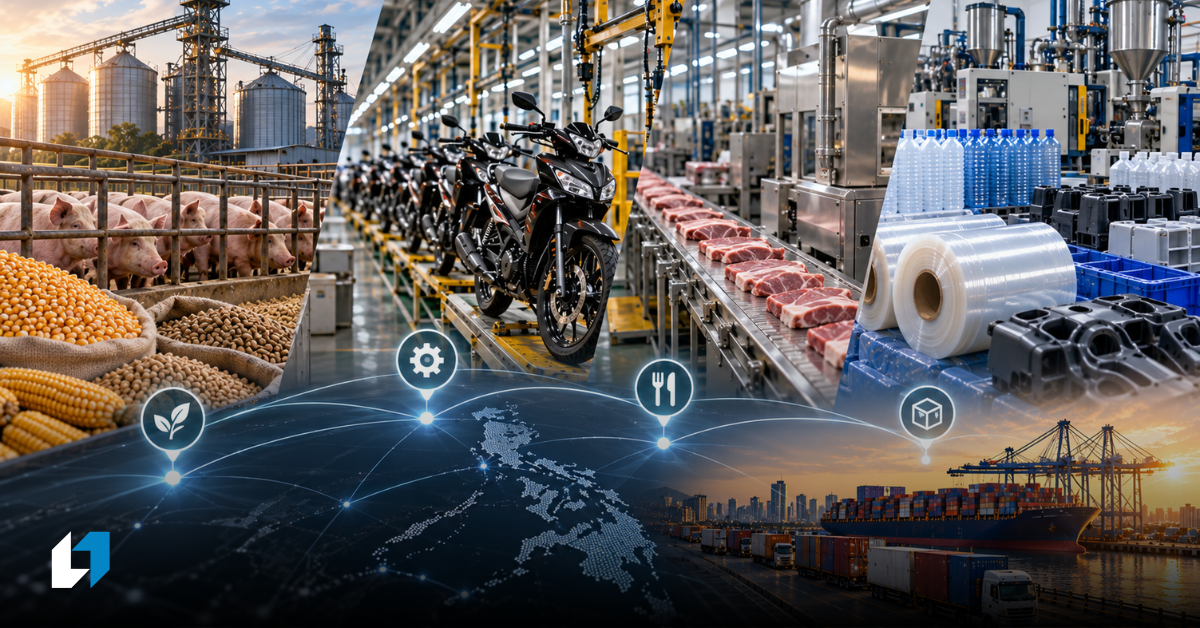
Hog farming may seem an unlikely place to look for lessons about Philippine industrial development.
Yet among 240 industries in the Philippine Statistics Authority’s detailed 2018 input-output table, hog farming had the strongest backward linkage in the economy.
It was not alone. Motorcycle manufacturing ranked second. Meat processing ranked third. Vegetable and animal oils ranked fourth, followed by plastic products.
What makes these rankings particularly interesting is that these industries have very powerful economic multipliers, but relatively low value added as a share of their output.
This combination may point to an important opportunity for Philippine economic development.
The country already has industries capable of generating substantial activity across domestic supply chains. The challenge is how to develop those industries further so that the Philippines captures more value from the production networks that already exist.
How one peso of demand can generate nearly three pesos in output
Backward linkage measures how strongly an industry draws inputs from other industries. The stronger the linkage, the greater the potential for an increase in demand for one industry’s output to stimulate production among its suppliers and their suppliers.
This was one of the measures used by Henry Ong, Emma Cecelie Ligot and Wilfredo Racaza Jr. in “A Structural Analysis of the 1985 Philippine Economy: Its Implication on a Multi-Sectoral Economic Development Strategy,” published in the DLSU Business & Economics Review in 1993.
The DLSU researchers argued that industries are interconnected and that expansion in one sector can stimulate others through these relationships.
Applying the same concept to the much more detailed 2018 input-output accounts produces some remarkable numbers.
Hog farming had an output multiplier of about 2.99. Motorcycle manufacturing was close behind at 2.98. Meat processing had a multiplier of about 2.95.
In other words, P1 of additional final demand in these industries is associated with nearly P3 of direct and indirect gross output throughout the production network under the input-output model.
Here are the top 10 industries by backward linkage:
| Industry |
BL Index |
Output Multiplier |
Value Added / Output |
| Hog farming |
1.395 |
2.99 |
28.4% |
| Manufacture of motorcycles | 1.393 | 2.98 |
14.4% |
| Processing and preserving of meat |
1.379 |
2.95 |
25.2% |
| Vegetable and animal oils and fats |
1.365 |
2.92 |
26.9% |
| Plastic products |
1.356 |
2.90 |
25.1% |
| Other transport equipment |
1.354 |
2.90 |
25.3% |
| Chicken egg production |
1.352 |
2.90 |
23.2% |
| Synthetic rubber |
1.351 |
2.89 |
22.9% |
| Pesticides and agrochemicals |
1.350 |
2.89 |
25.4% |
| Electric lighting equipment |
1.342 |
2.88 |
23.5% |
But look at the final column.
The value added generated directly within these industries generally represents only around 14 to 28 percent of their gross output.
Across the Philippine economy as a whole, value added represented roughly 50 percent of gross output in 2018. This difference deserves attention.
Strong multiplier, low value added
At first glance, the numbers appear contradictory.
How can an industry generate such a large multiplier but retain a relatively small amount of value added?
The answer lies partly in the way production works.
Gross output consists of intermediate inputs purchased from other industries plus the value added created within the industry itself.
An industry that purchases large quantities of feeds, materials, chemicals, components, electricity, transportation and other inputs will naturally have a large intermediate-input component.
Those purchases are precisely what can give the industry a strong backward linkage.
So a high multiplier and a relatively low value-added share are not necessarily signs of poor performance. To some extent, they are two sides of the same production structure.
But from a development perspective, they raise another question.
Can the Philippines preserve these powerful domestic linkages while increasing the amount of value created within and around these production chains? This is where the opportunity lies.
Consider the hog
Hog farming provides a good example.
Its value added represents about 28 percent of gross output, yet it has the strongest backward linkage among the 240 industries.
The original DLSU study already showed why agriculture could generate extensive economic relationships. Ong, Ligot and Racaza found that livestock and poultry were important purchasers of agricultural products such as palay, corn, coconut and other crops. They also identified strong relationships between agriculture and food manufacturing.
But the economic potential of livestock does not have to end at raising hogs.
The production chain can extend into animal nutrition, feed technology, veterinary pharmaceuticals, breeding and genetics, agricultural equipment, cold storage, meat processing, food manufacturing, logistics, packaging, branding and eventually higher-value consumer products.
The development opportunity is therefore not simply to produce more hogs. It is to move more of the production chain into activities where Philippine companies can create additional value.
A country that raises livestock and sells relatively unprocessed output captures one part of the value chain.
A country that also develops advanced feeds, animal health products, processing technology, cold-chain infrastructure, branded food products and the equipment and services required by the industry captures much more.
The same logic applies well beyond agriculture.
Manufacturing presents an even bigger opportunity
Consider motorcycle manufacturing.
It had the second-highest backward linkage among the 240 industries, with an output multiplier of approximately 2.98.
Yet value added represented only about 14 percent of gross output, the lowest among the top 10 industries in the ranking.
This tells us something important.Motorcycle manufacturing already has the characteristics of an industry capable of transmitting demand across a large production network. But the bigger development question is how much additional value the Philippines could capture by expanding the activities surrounding that network.
Instead of merely assembling motorcycles from components produced elsewhere, greater domestic capabilities in parts manufacturing, electronics, batteries, precision engineering, industrial design, software, tooling and other specialized activities could potentially allow more value to remain within the Philippine economy.
Plastic products tell a similar story. Their output multiplier was about 2.90, while value added represented roughly 25 percent of gross output.
The same principle can be applied to transport equipment, synthetic rubber, agrochemicals and electrical equipment.
These industries already possess something valuable: strong connections with other parts of the production system.
The next step is to upgrade what happens inside those networks.
This was already a problem in 1985
This issue is particularly striking because the original DLSU researchers identified a related structural weakness more than three decades ago.
They found that several Philippine manufacturing industries had potentially strong multiplier effects, but much of the benefit could leak outside the domestic economy because of imported inputs.
Electrical machinery was a notable example.
The industry, which included semiconductor production, was already an important Philippine exporter in 1985. Yet the DLSU researchers found weak domestic interlinkages because much of its input requirements came from abroad.
Their recommendation was to develop ancillary industries capable of supplying more of these inputs locally.
They specifically argued that import substitutes could increase the domestic content of production and exports and allow the economy to capture more of the benefits generated by industrial expansion.
This argument remains relevant today, but it can be taken one step further. Developing domestic suppliers is important. Developing higher-value domestic suppliers is even more important.
From multiplier to value creation
This changes the way we should think about industrial policy.
The objective should not simply be to identify industries with the largest multipliers and expand them, nor should it simply be to attract industries that appear technologically sophisticated.
The better strategy may be to identify industries that already have strong domestic production networks and then determine where Philippine companies can move into higher-value portions of those networks.
For agriculture, that could mean more processing, technology, logistics and branded products.
For transport equipment, it could mean components, electronics, engineering and design.
For chemicals, it could mean more specialized formulations and industrial applications.
For electronics, it could mean moving beyond assembly toward more components, engineering, testing, design and other higher-value activities.
Economic development is not simply about producing more. It is about what an economy produces, what it buys domestically, and how much value it creates from those activities.
The 2018 input-output table suggests that the Philippines already possesses industries capable of generating powerful multiplier effects.
The surprising part is that many of the industries with the strongest linkages also have relatively low value added as a share of their output. This should not be interpreted as a reason to abandon them.
It should be interpreted as an opportunity to develop them.
The Philippines already has the production networks. The next challenge is to capture more value from them.

