

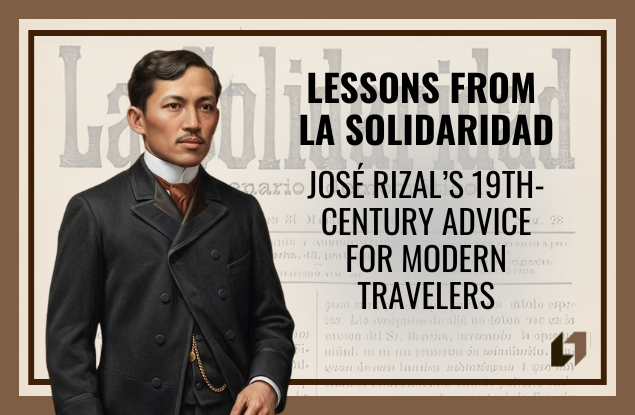
Few Filipinos of the nineteenth century explored the world as widely as José Rizal.
At a time when long-distance travel required weeks of sea voyages and considerable resources, Rizal journeyed across Europe and Asia in pursuit of knowledge. He studied medicine in Madrid, trained in ophthalmology in Paris and Heidelberg, conducted research in London, and observed the cultures and institutions of several nations. These experiences shaped not only his intellectual development but also his understanding of how societies grow and progress.
For Rizal, travel was never simply about moving from one place to another. It was, in his view, one of the most powerful forms of education.
In an essay titled “Travels,” published on May 15, 1889 in the reformist newspaper La Solidaridad, Rizal reflected on why exposure to the world plays such an important role in intellectual growth. More than a century later, his observations read almost like advice for modern professionals seeking broader perspectives.
Curiosity is the beginning of discovery
Rizal believed the desire to travel appears naturally throughout life. In one of the most memorable lines of the essay, he describes how the meaning of travel evolves as people grow older:
“Travel is a whim in childhood, a passion in youth, a need in men, and an elegy in the aged.”
For children, travel is fueled by imagination and curiosity. For the young, it becomes an irresistible urge to explore the unknown. By adulthood, it turns into something deeper—a practical way of understanding the world.
In this sense, Rizal saw travel not as a luxury, but as a natural extension of human curiosity.
Experience teaches what books cannot
Although Rizal valued scholarship and reading, he believed that written descriptions could never fully substitute for firsthand experience.
A person studying geography through maps or reading about foreign lands might form an idea of those places. But the deeper reality—the movement of people, the atmosphere of a city, the rhythm of daily life—can only be understood by seeing it directly.
As Rizal explains:
“He who knows the surface of the earth, the topography of a country only from maps and charts which he studies behind his desk might have an idea… but an idea like that he would have of an opera by Meyerbeer or by Rossini through the pages of a newspaper or review.”
The traveler, by contrast, encounters something far richer.
“But what cannot be taken from nature is that vivid impression that only he knows and can communicate: that movement, that life in the music of the birds and trees; the distinguishing aroma and perfume of a place.”
For Rizal, understanding a place meant engaging the senses and emotions—not merely absorbing information.
Travel carries knowledge across civilizations
Rizal also argued that many of history’s intellectual breakthroughs occurred because people traveled in search of knowledge.
He pointed to ancient Greece as an example, describing how Greek scholars journeyed to Egypt to study science, philosophy, and religion. When they returned home, they carried new ideas that later shaped Greek civilization.
As he wrote:
“The Greeks went to Egypt to ask her priests for learning; they read their papyrus and were plunged into the contemplation of those gigantic tombs… and they returned from Egypt philosophers like Pythagoras, historians like Herodotus, lawmakers like Lycurgus and Solon.”
Civilizations advanced not in isolation, but through the movement of people and ideas.
Travel expands perspective
Beyond knowledge, travel changes how people think.
Encountering different languages, customs, and institutions forces individuals to reconsider beliefs they once assumed were universal. Exposure to other societies reveals new possibilities and challenges narrow assumptions.
Rizal observed that travelers often return home with clearer judgment and broader understanding:
“He finds new things that give him new perspectives. He corrects his judgment and ideas. He puts away many prejudices and examines closely what he has judged before without seeing.”
Through these experiences, the traveler not only learns about the world but also learns to see his own society differently.
Movement connects humanity
Rizal also believed travel could bring people closer together.
By encountering foreign cultures directly, individuals develop a deeper appreciation for the diversity of human life. Instead of viewing differences with suspicion, travelers learn to recognize the common threads that connect societies.
Rizal writes that the instinct to explore exists
“so that tortured by it, we may study and admire its works; that we may communicate and fraternize and be united, that we form one single family which is the desire of all wise men.”
For him, exploration was not just educational—it was also a path toward greater understanding between nations.
Why Rizal’s insight still matters
Rizal wrote these reflections in 1889, long before airplanes, international tourism, and digital communication connected the world.
Yet the principle he described remains remarkably relevant. Exposure to different environments challenges assumptions, expands perspective, and encourages curiosity. It introduces individuals to new systems, technologies, and cultural perspectives that may inspire new ideas.
More than a century ago, Rizal captured this truth in a single powerful observation:
“Every advance of modern society is due almost completely to travel.”
Seeing the world does more than broaden horizons.
Sometimes, it changes the way we think—and that change can shape the future.

