

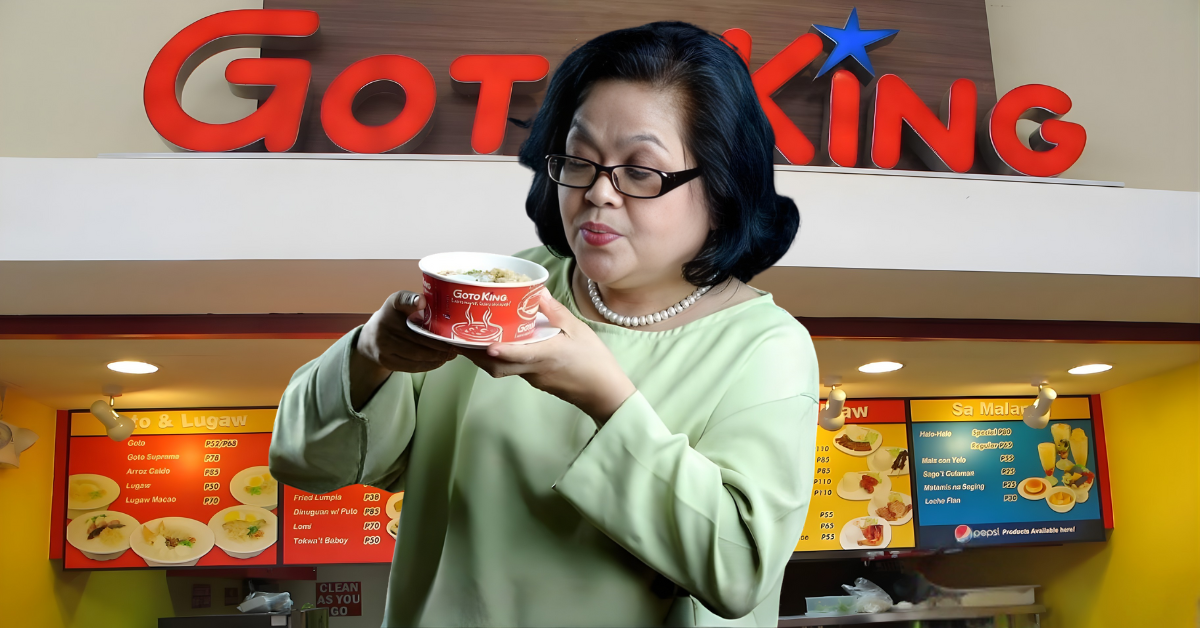
Before Goto King became a recognizable name, Maria Teresa “Tix” Laurel was already part of a working business. She wasn’t unemployed or searching for direction. She was embedded in her husband’s company, doing work that was stable, necessary, and predictable.
“I was involved in the family business,” Laurel says.
Her role was operational and precise.
“I was working with my husband’s company, and I was in charge of inventory for spare parts.”
The business itself had nothing to do with food. It was rooted in logistics and transport.
“They were into trucking copra and fishing.”
Laurel’s responsibility was to make sure the trucks kept running.
“I was detailed in tracking the inventory of the spare parts for the trucks that were ferrying the copra from Quezon to Manila.”
It was a system-driven job—monitoring movement, anticipating needs, and waiting for issues to arise.
“My job was to keep track of the movement of the spare parts inventory.”
But that structure also meant long stretches of inactivity.
“If no trucks were breaking down or anything, I was just there waiting for the movement of the spare part.”
Over time, the routine wore on her.
“Parang it became a natural thing for me, so I was kind of bored.”
The boredom wasn’t just about the job itself. It was about the realization that she was capable of more, but wasn’t being challenged.
A conflict at home
Despite her growing restlessness, not everyone supported the idea of her starting something on her own—especially her mother.
“What’s funny is that my mother never wanted me to go into business.”
Her mother’s perspective was shaped by a traditional role.
“She was a housewife, and although she was a good cook, wala naman siyang business experience.”
From that viewpoint, entrepreneurship looked unnecessary—and risky.
“So, she didn’t want me to pursue it, saying things like, ‘You have your children; tama na yan.’”
The disagreement became a recurring tension.
“We were always in conflict about this.”
For Laurel, the issue wasn’t ambition for ambition’s sake. It was about long-term security and independence.
“My point was, ‘Mama, pag malaki na yung mga bata, baka wala na yung Negosyo.’”
Her concern reflected a forward-looking mindset. Staying comfortable in the present didn’t guarantee stability in the future.
Choosing discomfort over complacency
Eventually, the unease outweighed the comfort of staying put.
“Pretty soon, I decided to venture out on my own.”
At that point, she didn’t yet know what form that venture would take. What mattered was the decision to move.
The family business had given her structure, discipline, and exposure to operations. But it had also clarified what she didn’t want: a role defined by waiting.
Her story highlights a quiet but powerful moment many entrepreneurs face—not when opportunity appears, but when restlessness becomes impossible to ignore.
Laurel did not leave because the family business failed. She left because it worked too well, offering safety without growth.
The conflict with her mother underscored a generational divide: one side valuing security and roles, the other sensing that security could disappear without self-made footing.
That internal tension—between responsibility and self-direction—became the real starting point of her entrepreneurial journey.
Before Goto King, before catering, before SM, there was a woman sitting in an office, tracking spare parts, waiting for trucks to break down—and realizing she didn’t want her future to depend on waiting.
Walking away from a comfortable position wasn’t an act of rebellion. It was an act of foresight.
And long before she sold her first bowl of goto, Maria Teresa “Tix” Laurel had already made her most important decision: not to stay still just because staying still felt safe.
This article includes quotes from an interview originally published by Esquire Philippines, authored by Henry Ong.

