

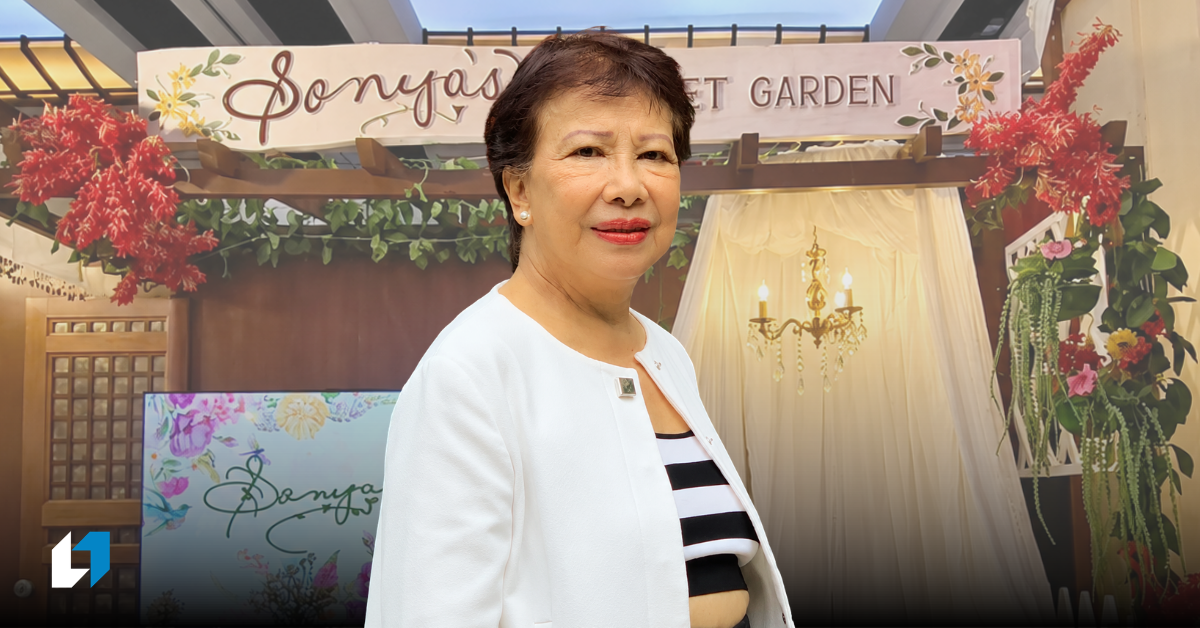
What eventually became Sonya’s Garden did not begin as a carefully planned restaurant business. For Sonya Garcia, the property initially started as a personal retreat inspired by gardening, nature, and memories of her grandmother’s home in Capiz.
When Garcia first bought the property in Tagaytay, there was very little on the land.
“There was nothing here then,” she recalls. “I planted three flowers until they grew and spread all over. It was really a godforsaken place.”
What began as a small gardening project slowly evolved as Garcia spent more time cultivating the property and growing her own vegetables.
“Then I began to grow vegetables, and people would come,” she says.
Rather than immediately treating the place as a commercial enterprise, Garcia approached it more like a personal space she wanted to share with others.
“I would tell them, ‘You can harvest your own food.’”
That idea reflected her broader philosophy about health and nature.
“I was really into nature and believed in using only what was good for the body.”
Long before organic dining and farm-to-table restaurants became mainstream trends, Garcia was already building an experience centered on fresh ingredients and direct interaction with food.
Starting With a Table for Two
When visitors began arriving more frequently, Garcia slowly started serving meals.
“When I started in 1998, it was just a table for two,” she recalls.
There was no large dining room, elaborate kitchen, or aggressive marketing strategy. Instead, the concept grew gradually through curiosity and word of mouth.
“People heard about it, and I would say it was The Secret Garden,” Garcia says.
That phrase eventually became part of the property’s appeal. In hospitality and retail, exclusivity and discovery often create strong emotional pull. The idea of a “secret garden” made the place feel personal and hidden—something guests felt they had discovered themselves rather than encountered through advertising.
“I think that’s what worked, the curiosity, because it was a secret garden,” Garcia explains.
At first, Garcia was not even charging guests for the experience.
“So they started coming, and at first I would not charge them,” she says.
Instead, she focused on introducing visitors to the experience she personally loved.
“I would just tell them to experience harvesting and eating food. That is the sweetest, when it’s freshly picked.”
This approach highlights an important entrepreneurial insight: many successful hospitality concepts begin by creating memorable experiences before focusing heavily on monetization. Garcia was not initially selling food alone; she was offering an atmosphere, a lifestyle, and a connection to nature that felt rare even at the time.
Growing Through Word of Mouth
As more visitors arrived, guests themselves encouraged Garcia to formalize the business.
“Then they told me, ‘You better start charging because we want to bring our friends,’” she recalls.
What started with a single table slowly expanded as demand increased.
“So okay, I started with a table for two, then it expanded — naging eight people, then 15, it just kept growing.”
The growth happened organically rather than through rapid expansion or large-scale investment. This gradual scaling allowed Garcia to preserve the atmosphere that originally attracted visitors in the first place.
At the center of the concept was the freshness of the food itself.
“And I was happy that people enjoyed eating food that was not tainted,” she says.
The menu in the early years remained simple and health-oriented.
“In the beginning, I had a salad, I made my own dressing. I also had pasta and a few salmon dishes, mga ganon, you know, food that’s good for your health.”
This emphasis on natural ingredients and wellness would later become one of the defining identities of Sonya’s Garden.
The restaurant also developed a reputation for being unconventional.
“And then they would come here and say I didn’t have a menu,” Garcia recalls.
Rather than offering a traditional restaurant setup, the dining experience felt more personal and spontaneous, reinforcing the idea that guests were visiting someone’s home and garden rather than a commercial establishment.
Building an Experience, Not Just a Restaurant
Garcia’s concept eventually attracted attention from other restaurateurs, including Tony Boy Escalante.
“Tony Boy used to come here,” she recalls. “He would come in the morning and then again in the evening. He was also enamored with the idea.”
According to Garcia, she even helped him during the early stages of developing his own restaurant concept.
“Sabi niya, pwede rin siyang ganon. So I also helped him put up his restaurant.”
The story behind Sonya’s Garden illustrates a powerful lesson in hospitality entrepreneurship: people are often drawn not only to food, but to environments that make them feel emotionally connected and emotionally restored.
Garcia did not begin with a conventional restaurant strategy. She began with a garden, a lifestyle she personally loved, and a desire to share that experience with others. Ironically, that authenticity became the foundation of the brand’s long-term appeal.
What started as “The Secret Garden” eventually evolved into one of the country’s most recognizable countryside dining destinations—largely through word of mouth, emotional connection, and the simple appeal of freshly harvested food shared in a peaceful environment.

