

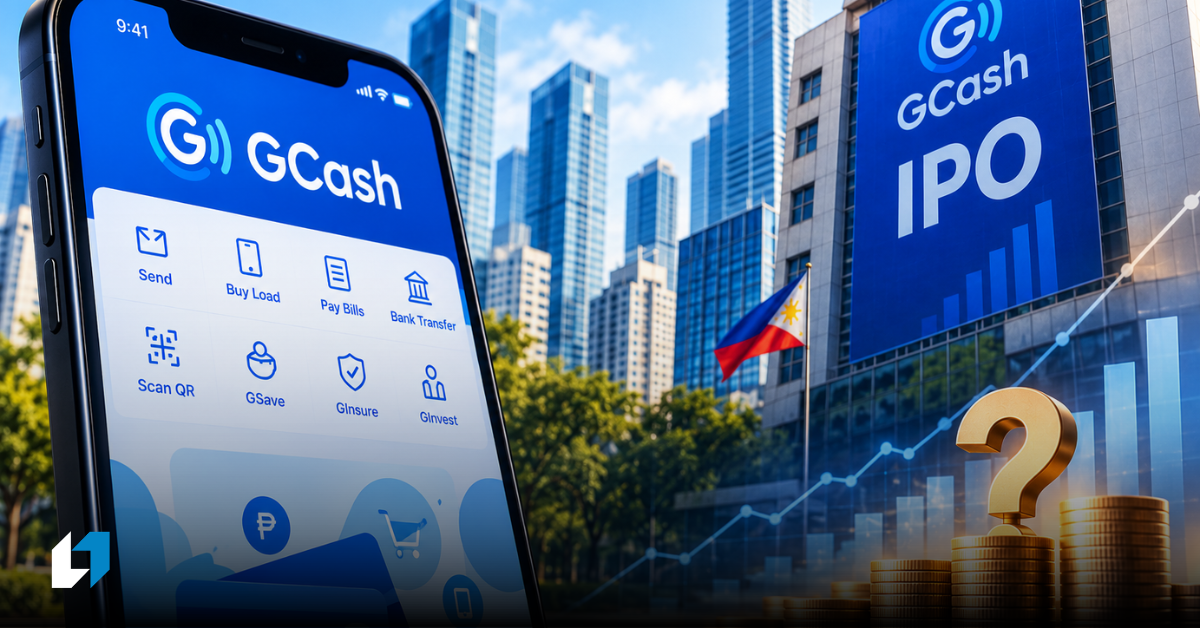
There is little doubt that GCash has built one of the strongest financial technology businesses in the Philippines.
Its parent company, Mynt Inc., earned P17.25 billion in 2025, up from P11.13 billion in 2024 and P6.38 billion in 2023. By June 2026, GCash had 41.5 million monthly active users, while its trailing return on equity stood at 26.8 percent.
These are impressive numbers. They also help explain why investors may be willing to pay a substantial premium for GCash at its initial public offering price of P6.60 per share.
But a good company is not necessarily a good investment at every price.
In the Esquire Philippines article “5 Things Every Investor Needs to Know About GCash’s IPO,” written by financial analyst Henry Ong, the offering was examined from several perspectives, including where the IPO proceeds will go, what is driving GCash’s growth, how much future growth is already reflected in the share price and whether the company’s returns on capital support its valuation.
The analysis raised an important point. GCash’s fundamentals are not the problem. In fact, they are exceptionally strong. The more difficult issue is how much investors should pay for them.
GCash has strong fundamentals
GCash’s profitability has improved dramatically over the past several years. Net income increased from P6.38 billion in 2023 to P11.13 billion in 2024 and P17.25 billion in 2025. Its trailing return on equity as of June 2026 was 26.8 percent.
A return on equity of 26.8 percent means GCash generates about P26.80 of earnings for every P100 of equity invested in the company.
Our own reformulation of GCash’s financial statements also produces a return on net operating assets, or RNOA, of more than 30 percent.
Another measure examined in Ong’s Esquire Philippines article was return on invested capital, or ROIC. The analysis estimated GCash’s ROIC at approximately 25 percent against an estimated weighted average cost of capital, or WACC, of about 14 percent. This spread is significant.
A company creates economic value when the return it earns on capital exceeds the return required by the providers of that capital. At an estimated 25 percent ROIC against a 14 percent cost of capital, GCash appears to have created substantial economic value.
So the case against paying P6.60 cannot simply be that GCash is not profitable enough. The valuation has to be examined differently.
How much can today’s fundamentals support?
One useful way to analyze a stock is to separate the value supported by its existing accounting fundamentals from the value that depends on future growth.
Based on the IPO structure, GCash’s estimated post-offer book value is about P1.25 per share. The actual figure may be slightly different after offering expenses.
Against this book value, GCash currently earns a trailing ROE of 26.8 percent. We estimate its required return on equity at about 14.4 percent.
This means GCash earns an excess return of:
26.8% − 14.4% = 12.4%
This excess return creates what is known as residual earnings.
Applied to GCash’s estimated book value:
P1.25 × 12.4% = P0.155 per share
If GCash can continue earning this amount of residual income indefinitely but generates no additional growth, its value can be estimated as:
P1.25 + (P0.155 ÷ 14.4%) = P2.33 per share
The P2.33 figure should not be interpreted as a target price for GCash.
Rather, it serves as an accounting-based valuation anchor. It estimates what the company’s existing book value and current level of excess returns can support before assigning additional value to future growth, and this is where P6.60 becomes interesting.
About 65 percent of the IPO price depends on future growth
GCash’s IPO price is P4.27 higher than the P2.33 accounting-based anchor.
This means about 35 percent of the IPO price is represented by our accounting-based value anchor, while the remaining 65 percent depends on future growth assumptions.
|
Valuation component |
Per share |
Share of P6.60 |
| Accounting-based value anchor |
P2.33 |
35% |
| Value dependent on future growth |
P4.27 |
65% |
| IPO price |
P6.60 |
100% |
The P4.27 should not be interpreted as having no value.
Investors routinely pay for future growth. In fact, companies with strong competitive advantages and high returns on capital should command premiums because they have greater opportunities to create value in the future, but future growth is fundamentally different from earnings that already exist.
The larger the portion of a stock’s price that depends on future performance, the more investors need the company to deliver on those expectations.
In GCash’s case, roughly two-thirds of the P6.60 price depends on what happens next.
What if GCash continues to grow?
Assuming zero growth may be too conservative for a company such as GCash.
We can therefore give the company progressively higher growth assumptions and see what happens to its estimated value.
If GCash maintains its 26.8 percent ROE and residual earnings grow at 6 percent annually, the estimated value rises from P2.33 to approximately P3.10 per share.
Raise the long-term growth assumption to 8 percent and the estimated value increases further to about P3.67.
These are substantial increases from the no-growth valuation, but they remain considerably below P6.60.
To arrive at the IPO price using the same residual income framework, GCash would need long-term residual earnings growth of approximately 11.5 percent.
This was one of the important findings of Ong’s Esquire Philippines analysis.
At first glance, 11.5 percent may not appear particularly demanding for a fintech company whose earnings have grown rapidly. The problem is the duration of that growth.
Growing 11.5 percent for a few years is different from growing indefinitely
GCash has already demonstrated that it can grow much faster than 11.5 percent. Its net income increased 74 percent in 2024 and another 55 percent in 2025.
But valuation does not depend only on how fast a company can grow next year. It also depends on how long that growth can continue.
The 11.5 percent implied growth rate that supports P6.60 under the residual income model is effectively a perpetual growth assumption under the constant-growth framework. This is much more demanding than assuming GCash can grow by 11.5 percent for the next three or five years.
If GCash’s competitive advantage lasts for only a finite period before its excess returns gradually disappear, the growth required to justify P6.60 becomes substantially higher.
This is why investors should be careful when comparing historical growth with the growth implied by a stock price. A company can easily exceed an implied growth rate for several years but still fail to create enough value to justify the price if that exceptional performance does not persist long enough.
Growth also becomes harder as GCash gets larger
There is another problem with projecting historical growth far into the future. The larger a company becomes, the more absolute earnings it must generate to maintain the same percentage growth.
A business earning P1 billion needs another P100 million to grow by 10 percent. A business earning P20 billion needs another P2 billion. GCash is already approaching the latter scale.
For the first half of 2026, net income increased to P10.82 billion from P10.09 billion a year earlier, an increase of about 7.3 percent. Revenue increased to P43.27 billion from P39.19 billion.
This does not mean GCash’s growth has permanently slowed. Six months is too short a period to establish a long-term trend, but it illustrates why historical growth rates cannot simply be extended indefinitely. Future growth must come from a much larger earnings base.
Another valuation approach points to the same issue
Ong’s Esquire Philippines article also examined GCash using a different valuation framework.
Instead of focusing on book value and residual earnings, the analysis compared GCash’s ROIC with its WACC.
As discussed earlier, GCash’s estimated ROIC was approximately 25 percent against an estimated WACC of 14 percent.
Assuming long-term growth of 8 percent, the relationship between ROIC, growth and WACC supports an enterprise value-to-invested-capital ratio of approximately:
(25% − 8%) ÷ (14% − 8%) = 2.8 times
But at P6.60 per share, GCash has an estimated enterprise value of about P415 billion against estimated invested capital of P57.1 billion.
This produces an EV-to-invested-capital ratio of approximately 7.3 times.
Reverse the calculation and a valuation of 7.3 times invested capital implies long-term growth of roughly 12 percent, assuming GCash can maintain an ROIC close to 25 percent.
This is notable because two different valuation approaches produce broadly similar conclusions.
The residual earnings model implies growth of approximately 11.5 percent. The ROIC-based model implies growth of approximately 12 percent.
The exact numbers are less important than what they tell investors about P6.60. The IPO price already assumes substantial future growth.
High returns do not make price irrelevant
Investors often pay premium valuations for companies with high ROE, strong brands and dominant market positions. There is nothing inherently wrong with doing so.
GCash deserves to trade at a premium because its returns are substantially higher than its estimated required return, but the size of the premium still matters.
A company with an ROE of 26.8 percent can create considerable value if its required return is only 14.4 percent. But if investors pay a price that already assumes those excess returns will grow rapidly for many years, much of that future value has already been brought into today’s share price.
This is why an exceptional company can still become an expensive stock.
The company does not have to fail for investors to earn disappointing returns. It only has to grow more slowly than the price assumes, earn lower returns on future investments or see its competitive advantage fade sooner than expected.
The real issue is P6.60
GCash has already demonstrated that it can generate strong earnings and high returns on capital.
Its net income has grown rapidly. Its ROE is 26.8 percent. Our estimates of RNOA and ROIC indicate that GCash earns returns considerably above its cost of capital.
Those fundamentals justify a premium valuation. The harder issue is whether they justify P6.60 today.
Our residual income analysis produces an accounting-based value anchor of approximately P2.33 without growth. Even after assuming 6 percent long-term growth, the estimated value rises only to about P3.10. At 8 percent growth, it reaches approximately P3.67.
To reach P6.60, the model requires approximately 11.5 percent long-term residual earnings growth.
The separate ROIC analysis from Henry Ong’s Esquire Philippines article reaches a similar conclusion. GCash’s market valuation implies roughly 12 percent long-term growth if the company can continue earning a 25 percent return on invested capital.
None of this changes the quality of the company. It changes the amount of future performance investors are being asked to pay for today.
GCash may already have proven that it is an exceptional business. At P6.60, investors are also being asked to pay an exceptional price for that business.
The better the company, the easier it is to justify paying a premium. But the higher the premium becomes, the more exceptional the future must be to justify it.

