

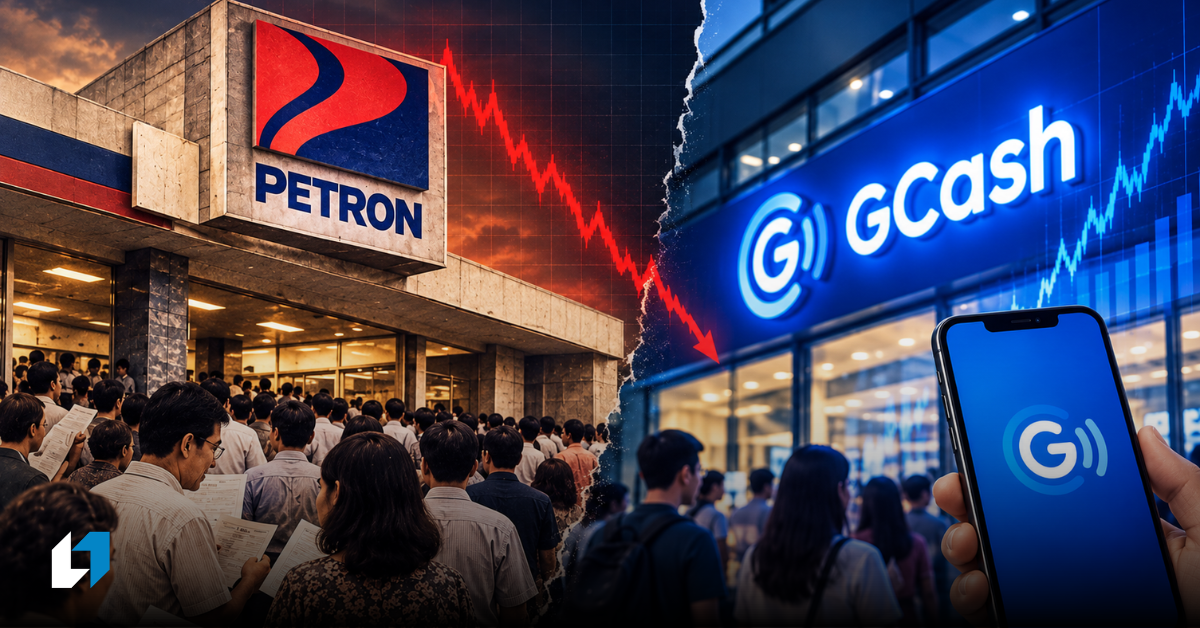
In September 1994, the Philippine stock market witnessed an event so extraordinary that it became known as the “mother of all IPOs.”
Petron Corporation, one of the country’s largest and most recognizable companies, was being privatized. For the first time, ordinary Filipinos had an opportunity to become part-owners of the oil company whose gasoline stations were familiar sights across the country.
The response was overwhelming. Approximately 500,000 Filipinos became shareholders of Petron, making the offering one of the most widely participated stock market events in Philippine history.
The timing could hardly have been better. The Philippine stock market was experiencing a bull market, and investors were enthusiastic about newly listed companies.
Petron’s IPO was priced at ₱9 per share. When trading began on September 7, 1994, its share price surged to more than twice the offering price.
For investors who received IPO allocations, the immediate gains seemed to validate the excitement surrounding the country’s biggest public offerings.
But over the following six years, Petron’s share price suffered a prolonged decline. By late 2000, the stock was trading at approximately ₱1 to ₱2 per share, based on historical price charts.
An investor who purchased Petron at ₱9 and saw its share price fall to ₱1.50 would have experienced an 83 percent decline in the quoted share price, before accounting for dividends and corporate actions.
The company remained one of the country’s leading petroleum businesses. Yet its popularity and market position did not prevent investors from experiencing substantial losses in the stock market.
More than three decades later, another familiar Philippine company has attracted widespread public attention through its initial public offering.
On October 20, 2026, Mynt Inc., the parent company of GCash, made its stock market debut at ₱6.60 per share. Like Petron in 1994, GCash has become part of everyday Filipino life. Millions of consumers use its services, and its IPO gave ordinary Filipinos an opportunity to own shares in a company they already knew.
More than 140,000 GCash subscribers participated in the offering through the GCash app, including individuals who had never previously invested in the stock market, but there is one important difference.
Petron entered a bull market. GCash entered a bear market.
One important difference between the two IPOs is the condition of the Philippine stock market when they were launched.
Petron went public during the stock market boom of the early 1990s, when investor enthusiasm was high and new listings frequently attracted substantial demand.
In 1994 alone, 21 companies listed on the Philippine stock exchange and raised approximately ₱37.4 billion. These included Petron, SM Prime Holdings, Universal Robina Corporation, Megaworld, and Aboitiz Equity Ventures.
A retrospective published by The Philippine Star described the period as an IPO fever, when newly listed companies frequently experienced dramatic price increases.
Petron benefited from that environment. Its ₱9 IPO price quickly rose above ₱20 as investors competed to acquire shares.
However, the Philippine market’s enthusiasm eventually faded. The Asian financial crisis of 1997 caused a severe downturn across regional equity markets, and Petron’s share price declined along with the broader market.
GCash entered a considerably different environment.
The Philippine stock market has struggled with weak investor participation, foreign fund outflows, and disappointing returns. By October 2026, the PSE index had fallen to an 11-month low amid concerns over rising oil prices, interest rates, and economic conditions.
Reuters reported that the PSE index was down approximately 4.1 percent for the year when GCash listed.
Unlike Petron, which benefited from strong market enthusiasm, GCash had to attract investors during a period of weak sentiment.
GCash opened at ₱6.60, briefly reached ₱6.76, and closed at its IPO price. There was no spectacular first-day rally comparable to Petron’s experience.
During bull markets, investors may accept higher valuations because they expect prices to continue rising. During bear markets, investors generally become more selective and demand greater compensation for risk.
GCash therefore faces a different challenge from Petron. Instead of sustaining the enthusiasm of a bull market, it must convince investors that its growth prospects justify a premium valuation despite weak market conditions.
Why Petron’s share price kept falling
Petron’s subsequent performance provides an important lesson about the difference between a successful company and a successful investment.
At the time of its IPO, Petron was already a major player in the Philippine petroleum industry. It operated an established refining and distribution business and had Saudi Aramco as a strategic shareholder.
Yet its market leadership did not prevent a prolonged decline in its share price.
Historical price charts show that Petron generally traded between ₱7 and ₱10 during much of 1995, with temporary recoveries in subsequent years.
By 1997, the stock had fallen sharply as the Asian financial crisis affected Philippine equities. The decline continued into the following years, with Petron trading near ₱1 to ₱2 by late 2000.
Several factors may explain this performance. First, the stock’s initial surge had pushed its valuation substantially above the IPO price. Investors who purchased shares above ₱20 were paying more than twice the original offering price for the same underlying business.
Second, Petron operated in a capital-intensive industry exposed to fluctuations in crude oil prices, refining margins, competition, and economic conditions.
Third, the Asian financial crisis affected the broader Philippine stock market, reducing investor appetite for equities.
Early investors may also have sold shares to realize profits after the initial rally, although historical price charts alone cannot establish how much selling came from IPO subscribers or other investors.
The long-term results were disappointing. A study commissioned by the Department of Energy examined Petron’s investment performance from its 1994 IPO through December 2007.
It found that an investor who purchased shares at ₱9 and held them until the end of 2007, when Petron closed at ₱5.70, would have earned an annualized return of approximately 4 percent after accounting for dividends and stock distributions.
That return was below prevailing government securities yields during the period.
Petron remained an important company, but investors who bought its shares during the original excitement did not necessarily receive attractive long-term returns.
GCash has stronger profitability, but its valuation is demanding
GCash differs significantly from Petron because it operates in financial technology rather than petroleum refining and distribution.
Mynt’s net income increased from ₱6.38 billion in 2023 to ₱11.13 billion in 2024 and ₱17.25 billion in 2025. By June 2026, GCash had 41.5 million monthly active users, while its trailing return on equity reached approximately 26.8 percent.
These figures suggest that GCash has developed a highly profitable business with substantial competitive advantages.
However, strong fundamentals do not automatically mean that its shares are attractively priced.
In an earlier Financial Adviser analysis, “GCash Has Strong Fundamentals. But How Much Should Investors Pay for Them?”, we examined the company’s valuation using a residual income framework.
The analysis estimated that GCash’s existing book value and current excess returns supported an accounting-based valuation of approximately ₱2.33 per share before additional growth assumptions.
At its ₱6.60 IPO price, approximately 65 percent of the valuation depended on future growth.
Assuming GCash could maintain its return on equity of 26.8 percent, the model produced an estimated value of ₱3.10 per share at 6 percent long-term residual earnings growth and ₱3.67 at 8 percent growth.
To justify the full ₱6.60 IPO price, the model required approximately 11.5 percent long-term residual earnings growth.
A separate valuation approach based on return on invested capital produced a similar implied growth requirement of approximately 12 percent.
These calculations do not mean that GCash is worth only ₱2.33 or that its share price must decline. Rather, they illustrate how much future performance investors are already paying for.
GCash can remain highly profitable and continue to expand its business. But if its growth falls below the assumptions reflected in its valuation, investors could still experience disappointing returns.
How likely is GCash to follow Petron’s decline?
There is no reliable statistical basis for assigning a precise probability that GCash will repeat Petron’s historical decline.
The two companies operate in different industries, have different financial structures, and entered the market under different economic conditions.
However, our valuation model allows us to examine how sensitive GCash’s share price could be to changes in long-term growth expectations.
At the ₱6.60 IPO price, the market valuation is consistent with approximately 11.5 percent perpetual residual earnings growth under our model.
If the assumed growth rate falls to 8 percent, the estimated value declines to ₱3.67. This represents a potential decline of approximately 44 percent from the IPO price.
At 6 percent growth, the estimated value falls to ₱3.10, equivalent to a decline of approximately 53 percent.
Under the no-growth assumption, the accounting-based valuation of ₱2.33 represents a decline of approximately 65 percent.
These are valuation scenarios rather than price forecasts. They assume the company’s current profitability and other model inputs remain unchanged.
Nevertheless, they demonstrate that a substantial correction is possible without requiring GCash’s business to collapse.
For GCash to experience a decline comparable to Petron’s 83 percent capital loss in our historical illustration, its share price would have to fall from ₱6.60 to approximately ₱1.12.
Such an outcome would likely require a much more severe deterioration in profitability, competitive position, investor expectations, or some combination of these factors.
Our existing valuation analysis does not establish that such an extreme outcome is probable.
The more relevant risk is that GCash could remain a successful company while its share price adjusts to more moderate growth expectations.
What could prevent GCash from following Petron?
There are also reasons why GCash could perform considerably better than Petron did after its IPO.
Unlike Petron, which entered the market during a period of strong investor enthusiasm, GCash listed when Philippine equity valuations were already depressed and market sentiment was weak.
A recovery in the broader stock market could improve demand for GCash shares.
The company also has opportunities to expand beyond its established payments business into lending, savings, insurance, investments, and other financial services.
Its large customer base provides an opportunity to generate additional revenue from existing users.
Analysts remain divided on how much this growth potential is worth. Other analysts have expressed concern about the company’s valuation, regulatory risks, and slower growth prospects.
The disagreement reflects the uncertainty surrounding how much future earnings GCash can generate and what investors should pay for those earnings today.
Another important difference is that GCash’s IPO did not produce the immediate speculative surge that characterized Petron’s listing.
Investors who purchased GCash at ₱6.60 did not have to pay twice the offering price to acquire shares during its first trading session.
This reduces one source of valuation risk compared with investors who purchased Petron above ₱20 shortly after its IPO.
However, it does not eliminate the possibility that GCash’s original offering price already reflected aggressive expectations.
The danger of buying a company simply because everyone knows it
In 1994, ordinary Filipinos knew Petron because they purchased fuel from its stations and recognized its importance to the Philippine economy.
Its IPO gave them an opportunity to become part-owners of a company they already trusted.
GCash has a similar advantage today. Millions of Filipinos use its platform for payments, money transfers, and other financial transactions.
The ability to subscribe to its IPO directly through the GCash app made stock ownership accessible to consumers who might not otherwise participate in the stock market.
But familiarity with a company’s products does not necessarily translate into an understanding of its valuation.
A business may have millions of customers, strong earnings, and substantial growth opportunities, yet still deliver disappointing investment returns if its shares are purchased at an excessive price.
Petron’s experience shows that it did not have to disappear or lose its position as a major petroleum distributor for investors to suffer substantial losses. Its stock price simply failed to sustain the expectations reflected in its early market valuation.
GCash faces a similar test. At ₱6.60 per share, investors are paying not only for the earnings the company generates today but also for the growth they expect it to deliver over many years.
If that growth materializes and its competitive advantages remain intact, the premium valuation may prove justified.
If growth slows, the valuation could contract even while the company continues to report profits.
The lesson from Petron’s 1994 IPO is therefore not that GCash is destined to follow the same path.
It is that the popularity of a company and the success of its public offering provide little assurance about the returns investors will earn afterward.
Petron’s history is a reminder that even the country’s most familiar and successful businesses can become disappointing investments when expectations exceed what their future earnings can support.

