

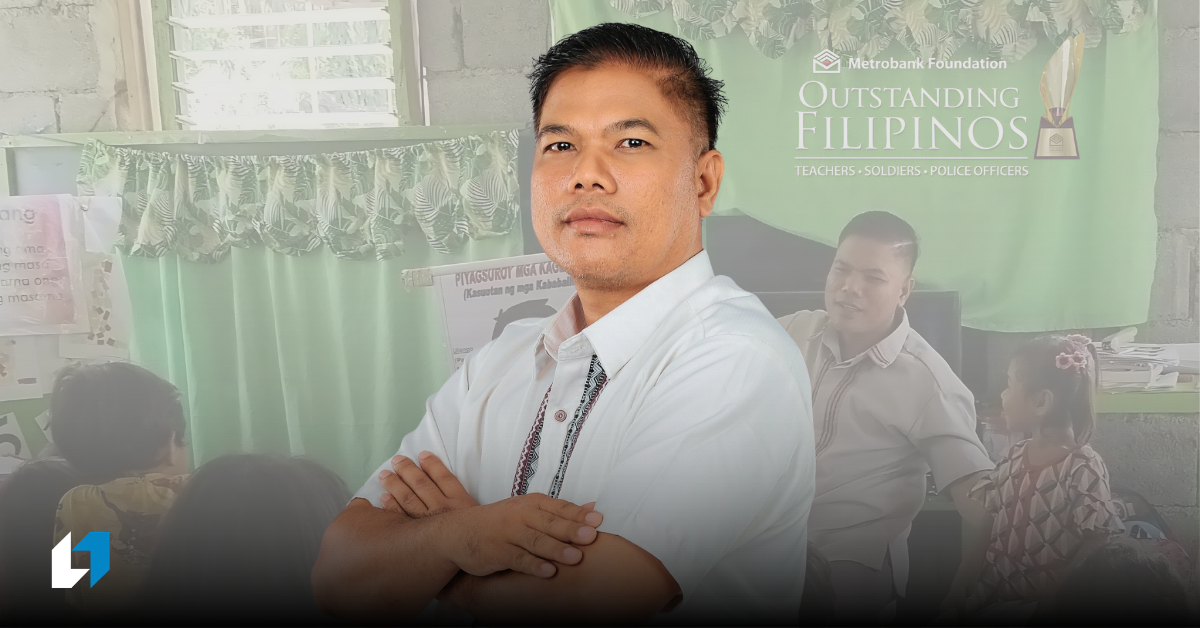
When Emmanuel D. Guarde began teaching children in his community in Oriental Mindoro, he came to understand that education could create opportunities for Indigenous learners. But he also saw that something important could be lost along the way.
Guarde is a Mangyan Alangan from Paitan, Naujan, Oriental Mindoro. Today, he serves as Master Teacher III at Cornelio Lintawagin Memorial Elementary School, but his journey began with a simple desire to serve children in his own community.
His years of work in classrooms and Indigenous communities eventually earned him recognition as one of the 2026 Metrobank Foundation Outstanding Filipinos, an honor Guarde sees not simply as a personal achievement but as recognition of the community and the cause he has spent much of his career serving.
His journey as an educator began with a simple desire to serve children in his own community. As he spent more time in the classroom, Guarde noticed that the education Indigenous children received did not always reflect who they were, where they came from, or what their communities valued.
It led him to an idea that would eventually shape much of his career.
“I wanted to become a teacher who would not ask children to leave their culture at the school gate,” Guarde says.
For him, education should not require Mangyan children to choose between academic progress and cultural identity.
“I wanted my learners to understand that being Mangyan is not something they should be ashamed of,” he says. “Their language, stories, traditions, skills, and knowledge are valuable sources of learning.”
That conviction eventually led Guarde deeper into Indigenous Peoples Education and to graduate studies. He completed his PhD with research that focused on the cultural practices, values and traditions of the Alangan Mangyan and how they could be meaningfully integrated into the curriculum.
His career has since evolved beyond conventional classroom teaching. Guarde describes himself as a teacher, learner, researcher, cultural advocate and community servant.
At the center of all those roles is a question: How can education help Indigenous children move forward without leaving behind the culture that helped shape them?
When children see themselves in the lesson
Guarde saw the effect of culturally responsive education in his own students.
Some Indigenous learners were initially hesitant to participate in class. But their behavior changed when lessons began to include their own stories, traditions, language and community experiences.
Students started sharing what they knew. For perhaps the first time in a formal classroom, knowledge they had learned at home was being treated as something valuable rather than something separate from education.
“That experience reminded me that sometimes a child does not lack ability; the child simply needs an environment where his or her identity is respected,” Guarde says.
It changed the meaning of education for him. Academic competence remained important, but he came to believe that schools also have a responsibility to develop confidence, dignity and a sense of identity.
“For me, one of the greatest rewards of teaching is seeing a learner say, in effect, ‘I belong here. My story matters. My culture matters. And I can learn.’”
This is why Guarde believes education should do more than develop intelligent children.
“It should develop children who know their worth.”
Creating lessons from what the community already knows
The approach was also practical. Like teachers in many communities with limited resources, Guarde did not always have enough instructional materials or facilities. Indigenous learners themselves often had limited educational opportunities.
Instead of allowing those constraints to stop the work, he changed the question.
“Instead of asking, ‘What do we not have?’ I learned to ask, ‘What can we create from what we have?’”
The answer was all around him. Guarde began developing localized and Indigenous learning materials based on community stories, traditional knowledge, local resources and the experiences of learners themselves.
He also worked closely with parents, elders and other community members.
This eventually led to one of the initiatives he considers most important: documenting the cultural practices, values, traditions, stories and community knowledge of the Alangan Mangyan and finding ways to integrate them into education.
The work contributed to the development of Mangyan Alangan Community-Based Competencies and Indigenous learning materials, including stories and resources for young learners.
But Guarde sees something more important than the materials themselves.
The process allows elders to become recognized as knowledge holders while children become learners of their own heritage.
In that sense, the classroom becomes a bridge between generations.
Knowledge held by elders can enter educational materials. Children can learn that knowledge in school. And traditions that might otherwise become weaker over time have another opportunity to pass to the next generation.
Education beyond the classroom
Guarde’s work eventually expanded beyond lessons and instructional materials.
He became involved in initiatives related to literacy, livelihood, weaving, cultural preservation and community outreach.
The common principle was that education should have value beyond examinations and grades.
“For me, the best education is education that remains useful even after the child leaves the classroom,” he says.
That means understanding the learner not simply as a student but as part of a family, culture and community.
It was a lesson Guarde says he learned as he grew in the profession.
Teaching, he realized, was not simply about delivering lessons. It required understanding learners, their families, their culture and the community that shapes them.
That approach also explains why elders and parents became important participants in his work.
Education, in Guarde’s view, becomes stronger when the school does not operate separately from the community it serves.
The cost of preserving something valuable
The work has required personal sacrifices. Guarde says there were times when he used his own resources to produce learning materials, support activities, travel to communities, conduct research and pursue projects for Indigenous learners.
Completing graduate studies while working and serving the community also demanded time, discipline and perseverance. Professional responsibilities sometimes meant less time with his family or postponing personal needs.
But Guarde does not necessarily regard everything he gave up as a loss.
“Some sacrifices became investments—in my learners, in my community, and in a vision of education that I believe is worth pursuing.”
Over time, however, he also learned that commitment requires limits.
Teachers may naturally want to help when they see students in need, but Guarde says they cannot solve every problem with their personal money.
He learned to distinguish between what he could provide himself and what should be addressed through school programs, partnerships, community organizations, government agencies and other stakeholders.
He also prioritizes essential expenses and his family’s needs.
“Service does not always have to be measured in money,” he says. “Sometimes, the most valuable things we can give are our time, knowledge, connections, creativity, and commitment.”
For Guarde, sustainability matters because helping others should be something a teacher can continue to do for years rather than something that eventually comes at the expense of his own family and well-being.
When identity is not a disadvantage
For Guarde, receiving national recognition carries particular significance because of where he comes from.
He spent years working quietly in classrooms and communities. Much of that work happened without an audience: preparing materials, conducting research, visiting communities and listening to parents and elders.
But as a Mangyan Alangan himself, Guarde hopes the recognition communicates something more important to Indigenous children.
“Indigenous identity is not a barrier to excellence,” he says.
He wants children in his community to see that education, leadership, research and service do not require them to become less proud of where they came from.
His own journey offers an example. Guarde pursued advanced education and completed a PhD, but instead of distancing himself from his Indigenous roots, he made those roots central to his research and professional work.
The culture became not an obstacle to education, but a source of knowledge worthy of study and preservation.
When an elder’s knowledge survives
Guarde still hopes to help create an education system where Indigenous culture is not treated merely as a decoration or an occasional classroom topic.
He wants Indigenous knowledge to be recognized as a meaningful source of knowledge in its own right.
That means continuing to develop culturally responsive learning resources, supporting Indigenous communities, mentoring teachers and strengthening the relationship between education and community development.
His advice to younger teachers reflects the same philosophy that guided his own career.
“Find a problem that matters to you and dedicate your work to solving it.”
A teacher may have a small classroom and limited resources. The work may also go unnoticed.
“But never underestimate the impact of one teacher who chooses to care deeply,” Guarde says.
For him, that impact cannot always be measured through salary, position or awards.
It can be seen when a child who once doubted himself begins to believe he can succeed. It can be seen when an Indigenous learner becomes proud of his identity. It can be seen when education creates new opportunities for a community.
And sometimes, it can be seen simply when something that might have disappeared survives.
“Success is when an elder’s knowledge is preserved instead of forgotten,” Guarde says.
That may ultimately be one of the most important outcomes of the education Guarde has spent his career trying to build.
“An award may eventually be forgotten. A title may eventually change. Material things may eventually disappear.”
If what elders know is passed to children, if those children grow up proud of who they are, and if they eventually pass that knowledge to another generation, education becomes more than a path toward individual advancement.
It also becomes a way for a community to carry its identity into the future.

