

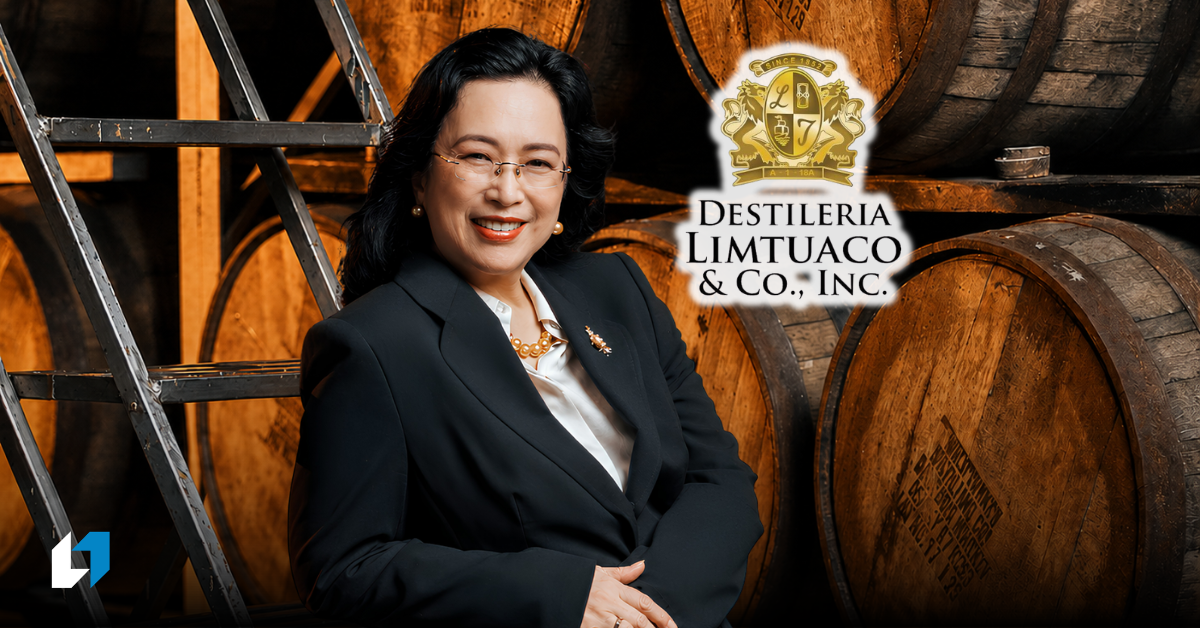
Long before modern liquor brands dominated store shelves, one of the earliest alcohol products to gain widespread popularity in the Philippines began as a Chinese herbal tonic. According to Olivia Limpe-Aw, the origins of Destileria Limtuaco can be traced back to a secret family recipe brought to the country in the 1800s.
“The man who started it all was Don Bonifacio Limtuaco,” Limpe-Aw says.
At the center of the business was a medicinal wine known as Sioktong.
“He brought with him to the Philippines a family recipe, a secret family recipe for a Chinese herbal tonic called Sioktong,” she explains.
During that period, Chinese medicinal wines were widely consumed within Chinese communities and were often associated with health and wellness. But over time, Sioktong expanded beyond a niche tonic and became commercially successful on a much larger scale.
“It became very popular,” Limpe-Aw recalls.
The product’s popularity eventually created a new problem: imitation.
“And of course, when it became super popular, we had a lot of competition,” she says. “They copied it.”
The situation reflects one of the earliest examples of a branding phenomenon still seen today: when a product becomes so dominant that consumers begin using the brand name to describe the entire category.
“Eventually, parang Colgate, which became the generic for toothpaste, Sioktong became the generic term for Chinese medicinal wine.”
In branding and marketing, this is often viewed as both a sign of success and a strategic risk. On one hand, becoming synonymous with a category reflects overwhelming market recognition. On the other hand, once a brand becomes generic, competitors can benefit from the popularity of the category without building the original brand themselves.
For many businesses, maintaining distinction after achieving category dominance becomes difficult. Consumers may continue using the name widely even as competing products flood the market.
Expanding Beyond Herbal Wine
As the business evolved, the family gradually expanded beyond herbal medicinal wine into broader liquor production.
“During the Spanish time, it was said that he knew how to speak Spanish,” Limpe-Aw says, referring to her ancestors involved in the business.
That ability helped the family establish relationships with Spanish traders and businessmen during the colonial period.
“He was a businessman dealing also with the Spaniards,” she explains.
Those relationships exposed the family to European liquor-making traditions and eventually helped broaden the company’s capabilities.
“And from there, we learned how to make Ginebras, the gins, the rums during that time.”
The shift illustrates an important entrepreneurial principle: long-lasting businesses rarely survive by remaining dependent on only one product category. Instead, they evolve as markets and consumer preferences change.
In the case of Destileria Limtuaco, the company gradually transformed from a herbal tonic producer into a broader distillery business serving changing consumer tastes in the Philippines.
This ability to adapt across generations may explain why the company survived while many other 19th-century businesses disappeared over time.
Bringing New Products Into the Market
One of the company’s biggest transformations happened under the leadership of the third generation, James Limpe.
“He was one of the few Chinese back then who was able to study in the United States,” Limpe-Aw says.
According to her, exposure to Western culture and business practices influenced how he approached the company after returning to the Philippines.
“Because of his exposure to Western culture and Western business practices, when he came back to the Philippines, he brought more modern ways of doing business.”
At the same time, his international connections opened the door to new product opportunities.
“From his connections in the US, he was also able to work with an American company,” Limpe-Aw recalls.
That partnership eventually helped introduce whiskey to Filipino consumers.
“So it was the brand Three Feathers Whiskey,” she says. “He was the one who popularized whiskey in the Philippines.”
The story highlights another recurring pattern in entrepreneurial history: many industries evolve when founders or successors introduce products that consumers are not yet fully familiar with. In many cases, entrepreneurs are not merely selling products—they are helping shape consumer behavior itself.
Introducing whiskey to the Philippine market required more than distribution. It involved educating consumers, building demand, and positioning an unfamiliar product for local tastes.
Building Brands That Last Across Generations
Looking back, the story of Sioktong and Destileria Limtuaco illustrates how strong brands often begin with distinct products that solve a need or create a new category.
But the company’s long survival also came from its willingness to evolve. From Chinese herbal tonic to gin, rum, and whiskey, each generation adapted the business to changing markets and changing consumer preferences.
At the same time, the history of Sioktong also serves as a reminder of the power—and danger—of becoming too dominant within a category. When consumers begin using a brand name as the generic term for a product itself, it signals extraordinary market influence. Yet it also creates new competitive pressures as imitators emerge and the original brand becomes harder to distinguish.
For Destileria Limtuaco, however, the ability to continuously reinvent the business across generations helped the company remain part of Philippine commercial history for more than 170 years.

