

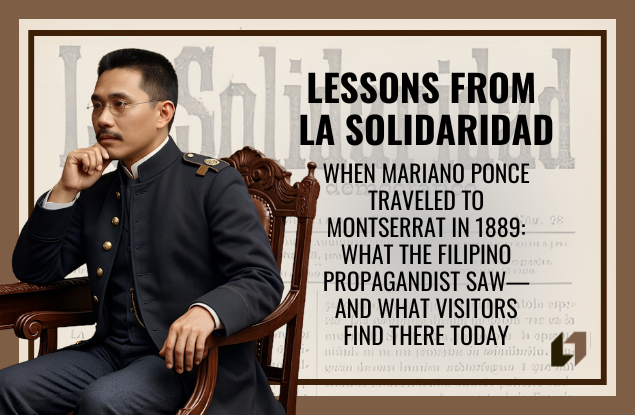
In November 1889, a Filipino reformist writing under the pen name “Naning” published a travel narrative in La Solidaridad.
The author was actually Mariano Ponce, one of the intellectual leaders of the Philippine Propaganda Movement.
While studying in Spain together with figures such as José Rizal and Marcelo H. del Pilar, Ponce occasionally wrote travel essays describing the places he visited across Spain.
One of these pieces, titled “An Excursion”, recounts a journey to the famous mountain sanctuary of Santa Maria de Montserrat Abbey.
More than a century later, many of the places he described still exist—and the journey has become far easier.
The Journey to Montserrat in 1889
Ponce described traveling through the Catalan countryside toward the famous monastery built high in the mountains.
The sanctuary had already been famous for centuries as a pilgrimage site.
He noted that visitors and pilgrims could find lodging in the area, mentioning one of the inns where travelers stayed:
“In Montserrat the traveller and the pilgrim find gratuitous lodgings in homes that are relatively decent and comfortable.”
He also mentioned the Alphonse Inn, describing it as a modest but practical lodging for visitors.
“The Alphonse Inn where we stayed has four floors of five rooms each… six persons can be easily accommodated.”
Today, that specific inn is no longer known under the same name, but lodging around Montserrat still exists—including guesthouses run by the monastery itself and hotels in nearby towns like Monistrol de Montserrat.
Monistrol and the Road to Manresa
Ponce and his companions eventually left Montserrat and continued toward nearby towns.
He described the town of Monistrol as a small settlement associated with the monastery:
“Monistrol is a small village known in olden times as Monasteriol.”
The town still exists today and remains the gateway to Montserrat.
It lies beneath the mountain and is connected to Barcelona by train.
Ponce then traveled to another historic Catalan city:
“We took the train in this town for Manresa and after a short half-hour trip we arrived at the celebrated city.”
The city of Manresa was historically important for Christian pilgrimage. Ponce described visiting the cave associated with St. Ignatius of Loyola, the founder of the Jesuits.
What He Saw in Manresa
In his article, Ponce described the famous cave where Ignatius of Loyola is believed to have prayed and meditated.
“The cave of St. Ignatius Church is a beautiful modern building.”
He explained that the site commemorated the period when the saint abandoned his military life and devoted himself to religion.
“During the period of his penitence, after abandoning his military career.”
Today, the Cave of St. Ignatius in Manresa still exists and is part of a pilgrimage route followed by visitors from around the world.
Returning to Barcelona
After the excursion, Ponce and his companions returned to Barcelona.
Travel in 1889 was far from comfortable.
He described leaving early in the morning and traveling in a crowded coach.
“We were once more huddled in the coach… at four o’clock in the morning.”
Because they lacked blankets, they improvised.
“In the absence of a rug we had our feet covered by the mail sack.”
The description reminds readers how difficult travel could be during the late 19th century.
How Easy the Journey Is Today
Today the same trip described by Ponce has become one of the most popular day trips from Barcelona.
Travelers can reach Montserrat quickly using modern transportation.
From Barcelona:
- A direct train reaches Monistrol de Montserrat in about 1 hour.
- From there, a rack railway climbs the mountain to the monastery in about 15 minutes.
Overall, the journey from Barcelona to the monastery typically takes around 1 to 1.5 hours by public transport.
Visitors today can also take a cable car, drive, or hike the historic pilgrimage trails.
In contrast, travelers like Ponce had to rely on coaches and slow trains, often traveling for hours across rugged terrain.
The Same Mountains, A Different World
Despite the changes in transportation, the mountain that impressed Ponce remains largely the same.
Montserrat is still one of the most iconic landscapes in Spain, rising dramatically above the Catalan plains.
The monastery continues to attract millions of visitors every year—both pilgrims and tourists.
Standing there today, one can easily imagine the Filipino propagandists who visited the site more than a century ago while dreaming about reform and freedom for their homeland.
For men like Mariano Ponce, these journeys across Europe were not just sightseeing trips.
They were part of a larger intellectual awakening—an effort to learn from the world while imagining a better future for the Philippines.

