

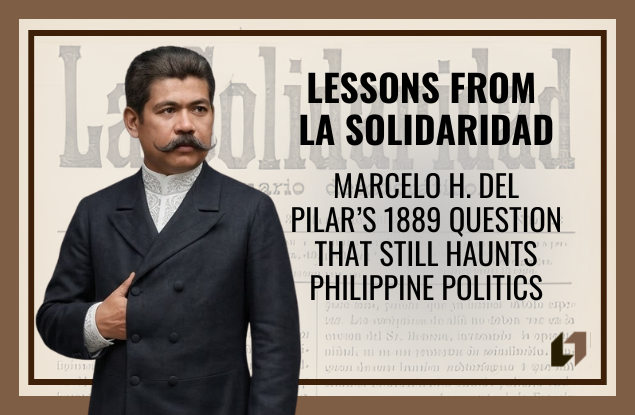
On September 30, 1889, Filipino reformist Marcelo H. del Pilar raised a question that would challenge the logic of colonial rule.
Writing in the reformist newspaper La Solidaridad, Del Pilar addressed the issue of assimilation—the idea that the Philippines should be treated as an integral part of Spain.
For many Filipino reformists, assimilation meant something very concrete:
if the Philippines belonged to Spain, then Filipinos should enjoy the same rights as Spanish citizens.
But colonial authorities did not see it that way.
Del Pilar pointed out a striking contradiction.
A Filipino who moved to Spain could enjoy political rights guaranteed by the Spanish Constitution. But that same Filipino would lose those rights simply by living in the Philippines.
As he explained:
“The Filipino who transfers his residence to the Peninsula, Cuba, or Puerto Rico enjoys such rights, in spite of his alleged primitive state.”
Yet the opposite was also true.
“The Spaniard, Cuban, or Puerto Rican who is born with these rights loses them inevitably… solely by living in the Philippines.”
In other words, the issue was not citizenship—it was geography.
In the Philippines, Del Pilar argued,
“the place and not the citizenship determines the exercise or the restriction of rights.”
The Question of Representation
Del Pilar then raised another question that would become central to the reform movement.
If Filipinos were part of the Spanish nation, why were they denied representation in the Spanish parliament?
He wrote:
“What reason is there for not having the Philippines represented in the Spanish parliament?”
For Del Pilar, the answer revealed a deeper problem: colonial authorities treated Filipinos as subjects to be governed, rather than citizens to be represented.
Yet he insisted that Filipinos were not passive or ignorant.
“The loyal people who know that they are not a flock of sheep, that they are not slaves… if they should have duties, they also should have rights.”
This statement captured the core demand of the Propaganda Movement.
Filipinos were willing to fulfill their obligations as citizens—but they also expected the rights that came with those obligations.
A Growing Political Awareness
Del Pilar also noted that many Filipinos were already using legal and constitutional means to demand reform.
“In the Philippines there is a growing desire for a better life… with attention to their needs expressed through legal means.”
Reformists had formally presented their demands to the Spanish government.
These included representation, equality before the law, and the protection of civil rights.
Yet despite these petitions, colonial authorities often dismissed Filipino demands as unrealistic or radical.
Del Pilar rejected that view.
He argued that these reforms were not revolutionary at all.
They were simply rights already recognized by Spain’s own constitution.
Why Del Pilar’s Argument Still Matters
More than a century later, Del Pilar’s essay remains a powerful reflection on the meaning of political equality.
At its core, his argument was about consistency.
If a nation claims that all its citizens are equal, then those rights must apply everywhere—not only in certain places.
His critique also highlights a broader principle that remains relevant today:
rights should not depend on geography, privilege, or political convenience.
They must be grounded in the rule of law.
In 1889, Del Pilar believed that the future of the Philippines depended on whether these principles would be recognized.
More than a hundred years later, his words still echo in modern discussions about governance, representation, and accountability.

