

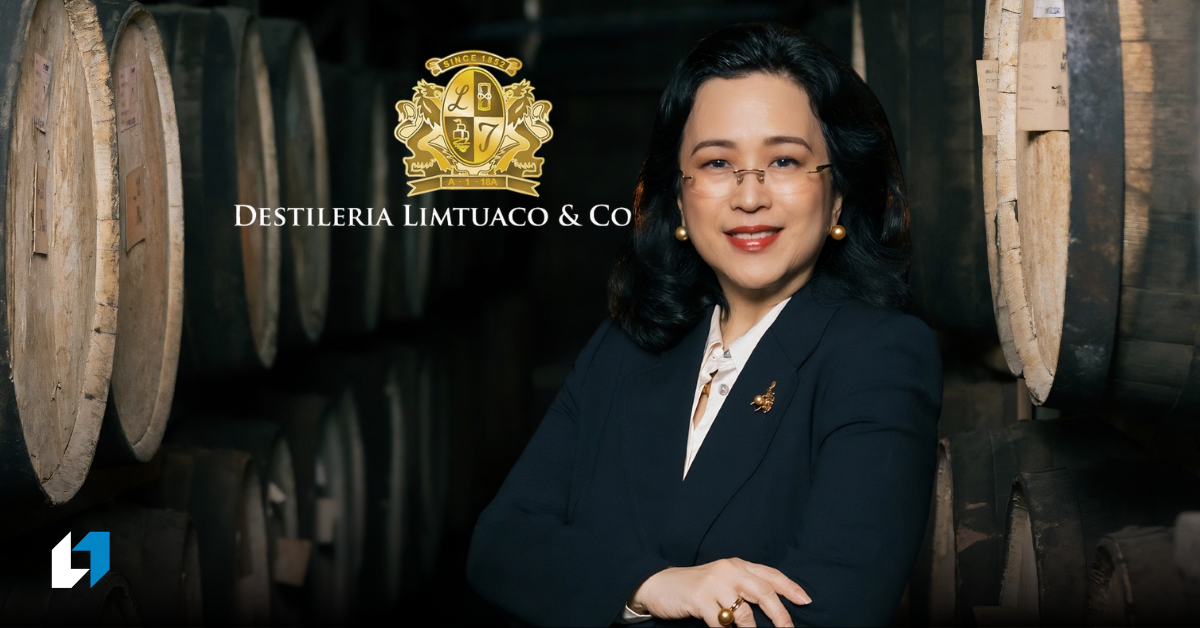
Very few Filipino businesses can trace their roots back to the Spanish colonial period. Fewer still have survived wars, political transitions, changing consumer tastes, and multiple generations of leadership. According to Olivia Limpe-Aw, the story of Destileria Limtuaco is not just a family business story—it is also part of Philippine commercial history.
“We are the oldest distillery in the Philippines,” Limpe-Aw says. “We were established in 1852.”
The company’s origins began with a Chinese herbal tonic known as Sioktong, introduced to the Philippines by Don Bonifacio Limtuaco, whom Limpe-Aw describes as their “great-great-grand-uncle.”
“He brought with him to the Philippines a family recipe, a secret family recipe for a Chinese herbal tonic called Sioktong,” she explains.
At the time, Chinese medicinal wines were highly valued within the Chinese community for their perceived health benefits. Over time, however, the product became so popular that the brand itself eventually evolved into a generic term.
“This later became the generic term for Chinese medicinal wine, but originally it was our brand name,” Limpe-Aw says.
She compares it to globally recognized brands that became synonymous with entire product categories.
“Parang Colgate, which became the generic for toothpaste, Sioktong became the generic term for Chinese medicinal wine.”
The episode reflects one of the strongest signs of brand dominance: when consumers begin using a brand name to describe an entire category. While this often reflects strong market leadership, it can also create long-term trademark challenges as competitors begin copying the product and benefiting from the category association.
Passing the Business Across Generations
According to Limpe-Aw, the company’s continuity across generations was not always straightforward.
“So the business was given to the son, but I think the son died young,” she recalls.
Leadership eventually passed to her great-grandfather, Lim Chay Seng, who became the second generation to run the business.
“Pamangkin siya,” Limpe-Aw says. “I’m not really sure exactly, but I think he bought the company from the uncle.”
This transition highlights an important reality in many old family businesses: succession often evolves based not only on bloodline, but also on capability, circumstance, and survival. In many entrepreneurial families, nephews, cousins, or extended relatives sometimes become the next stewards of the enterprise when direct succession paths become unavailable.
As the company evolved, it also adapted to the changing business environment during the Spanish colonial era.
“During the Spanish time, it was said that he knew how to speak Spanish,” Limpe-Aw says.
That ability allowed the family to build commercial relationships with Spanish traders and officials.
“He was a businessman dealing also with the Spaniards.”
Those relationships eventually expanded the company’s expertise beyond herbal tonics into distilled spirits such as gins and rum.
“And from there, we learned how to make Ginebras, the gins, the rums during that time,” she explains.
The story illustrates another key principle behind long-lasting businesses: survival often depends on the ability to evolve beyond the original product category. Rather than remaining limited to medicinal wine, the company gradually expanded into broader liquor production as consumer markets changed.
Modernizing the Business
The next major transformation came under the leadership of Limpe-Aw’s grandfather, James Limpe, who represented the third generation.
“He was one of the few Chinese back then who was able to study in the United States,” she says.
James Limpe graduated from the University of Washington, exposing him to Western business systems and consumer trends at a time when overseas education was still rare among Chinese-Filipino businessmen.
“Because of his exposure to Western culture and Western business practices, when he came back to the Philippines, he brought more modern ways of doing business,” Limpe-Aw explains.
This exposure would later influence one of the company’s biggest product shifts: introducing whiskey to the Philippine market.
“From his connections in the US, he was also able to work with an American company, and they introduced whiskey to the Philippines.”
At the time, whiskey was still relatively unfamiliar to many Filipino consumers.
“So it was the brand Three Feathers Whiskey,” she says. “He was the one who popularized whiskey in the Philippines.”
The episode highlights how exposure to global markets often shapes local entrepreneurship. Many family businesses evolve significantly when younger generations return from overseas education with new ideas, products, and management systems.
Surviving War and Reinventing the Business
The company’s history also intersected directly with major events in Philippine history.
During World War II, Limpe-Aw says her grandfather became involved in efforts to prevent Japanese forces from taking over local distilleries.
“There was an order from General Douglas MacArthur not to allow the Japanese to do that,” she recalls.
According to family history, her grandfather disposed of the company’s inventory instead of surrendering it.
“So he was the only one who actually disposed of all his inventory,” she says.
The decision eventually led to his imprisonment.
“For that, he earned the ire of the Japanese, who incarcerated him in Fort Santiago.”
His name, according to Limpe-Aw, still appears in the prisoner records at Fort Santiago.
The story illustrates how many old Filipino family businesses survived not only economic crises, but also periods of war and political upheaval.
Growing Into a Modern Liquor Company
The next major expansion came under the leadership of Limpe-Aw’s father, Julius Limpe, who represented the fourth generation.
“He was really the one who made it big,” she says.
Although Julius initially wanted to become a research doctor and was deeply interested in art, he eventually returned to manage the family business after studying at Indiana University.
“He poured his passion for research into action in the field of liquor making,” Limpe-Aw recalls.
According to her, he held patents related to the acceleration of aging spirits and helped industrialize the company’s operations.
“He was truly an industrialist,” she says. “He was also credited for introducing whiskey to the masses through our flagship brand, White Castle Whiskey.”
Beyond operations and product development, Julius Limpe also focused heavily on marketing and branding.
“He was truly a marketing man,” Limpe-Aw says.
She credits him with helping scale the company through a combination of operational discipline, product innovation, and strong branding instincts.
“He scaled up the business, he was really good in that.”
Looking back, the history of Destileria Limtuaco reflects more than just the story of a liquor company. It demonstrates how family businesses survive across generations by continuously adapting to changing markets, technologies, and historical circumstances.
From Chinese medicinal wine during the Spanish era to modern whiskey brands sold nationwide, the company’s evolution mirrors the changing tastes and economic history of the Philippines itself.

