

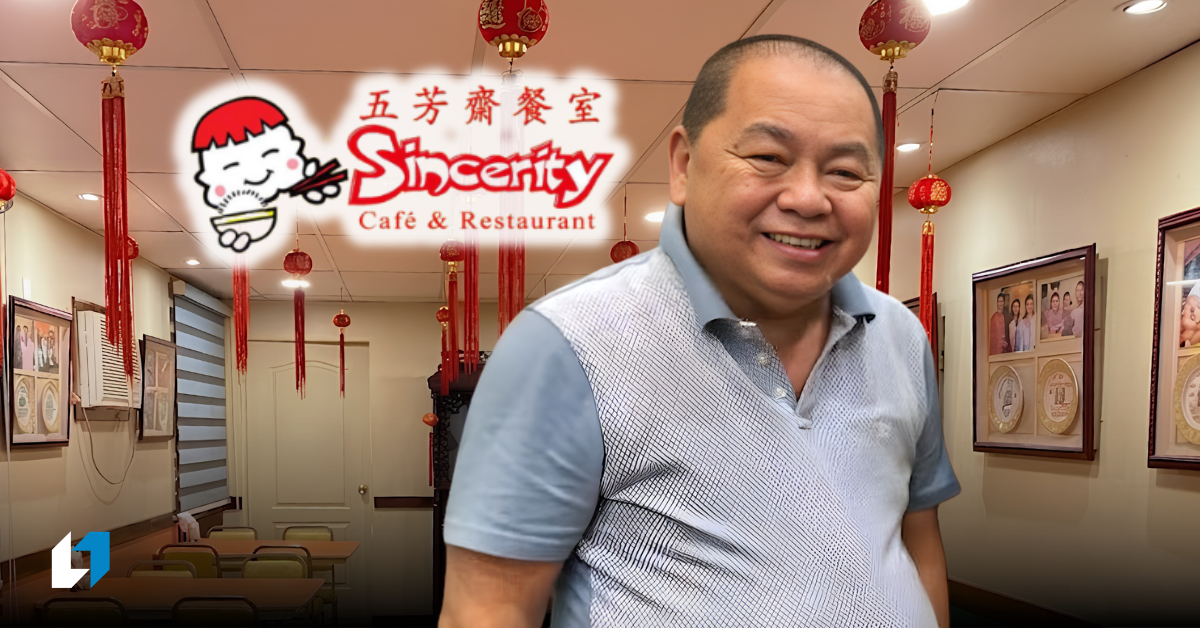
Long before Sincerity Café became a Binondo institution, survival—not ambition—was the family’s driving force. Peter Uy did not grow up expecting to inherit a restaurant business. In fact, the idea of entrepreneurship entered their lives only after everything else had fallen apart.
“Kasi yung father ko before, siya ang unang distributor ng Kodak film,” Uy recalls. The business eventually failed. “Tapos nalugi, nagsara, so naghirap kami.” When the company collapsed, his father stepped back. “Yung father ko, parang nag-lay low siya,” Uy says. The responsibility of keeping the family afloat shifted almost entirely to his mother.
At the time, the household had little room for experimentation. There were nine children to feed, and income was uncertain. When an uncle suggested starting a business, Uy remembers his mother’s hesitation clearly. “Sabi ng mama ko, ‘Anong negosyo? Wala akong alam.’” She had tried small ventures before, including selling herbal products from home and supplying Divisoria, but none of them worked. Capital was the biggest barrier. “Kulang pera niya pang negosyo,” Uy says. “Ang dami naming magkakapatid.”
What changed everything was outside intervention. His uncle decided to step in financially and removed the need for planning altogether. “Sabi niya, ‘Sige, ako nang bahala,’” Uy recalls. The instructions were simple and blunt. “‘Oh, eto puhunan. Bili ka bigas, magluto ka, benta.’”
In 1956, Sincerity Café began not as a restaurant with a concept, but as an eatery built out of necessity. The first location was on Carvajal Street in Binondo. The startup capital was ₱600. “Yung lamesa namin, mga second-hand,” Uy says. “Yung upuan namin iba-iba kulay.” There was no attempt to curate an image. The goal was to cook, sell, and survive.
The menu was equally straightforward. It started as a small mami house with only a few dishes. Over time, they added pato misua, ngo-yong (kikiam), and wah chyan (oyster cake). Uy is clear about where the food came from. “Yung mother ko ang chef,” he says. “Lahat ng recipe, sa kanya galing—authentic yan from China.” His father took on market duties, sourcing ingredients daily, while his mother cooked everything herself.
From a young age, Uy was already part of the operation. “Ako tumutulong sa papa ko dati,” he says. His work revolved around the palengke—buying, carrying, and delivering. Before school, he had another small job that helped the family get by. “Bago mag-tanghali, rasyon muna ako ng ulam,” he explains, referring to delivering cooked meals. “Yun ang extra income ko.”
Formal education became difficult to sustain alongside work. Uy enrolled in management at the University of the East but eventually stopped attending classes. The logistics alone made it impractical. “Before ako pumasok sa eskwela, nagde-deliver ako hardware sa kuya ko sa Marikina,” he says. Traffic delays meant he was constantly late. “Pag mag-test ka, makuha mo zero,” Uy recalls. Dropping subjects became easier than accumulating failing marks. “So nag-concentrate ako sa trabaho ko.”
As the eatery gained traction, expansion became a possibility—but capital remained tight. Once again, survival depended on relationships. Uy’s uncle provided additional help, and neighbors extended informal credit. “Yung neighbor namin, siya naman nagpa-utang ng ingredients,” Uy says. “Pagkuha namin, luto agad, tapos benta, pag gabi bayad.”
There were no safety nets, no buffers, and no long-term plans. Ingredients were cooked the same day they were acquired. Sales paid for what had been borrowed. The business functioned on daily trust—between suppliers, neighbors, and customers.
Looking back, Uy does not romanticize those early years. The beginnings of Sincerity Café were not fueled by passion for food or dreams of growth. They were shaped by urgency. “Wala kaming choice,” he says plainly.
Yet it was precisely that lack of choice that forged the foundation of the business. Every peso was accounted for. Every dish had to sell. Every day mattered. Before Sincerity Café became known for consistency and authenticity, it was simply a family’s way of staying afloat—one cooked meal at a time.
This article includes quotes from an interview originally published by Esquire Philippines, authored by Henry Ong.

