

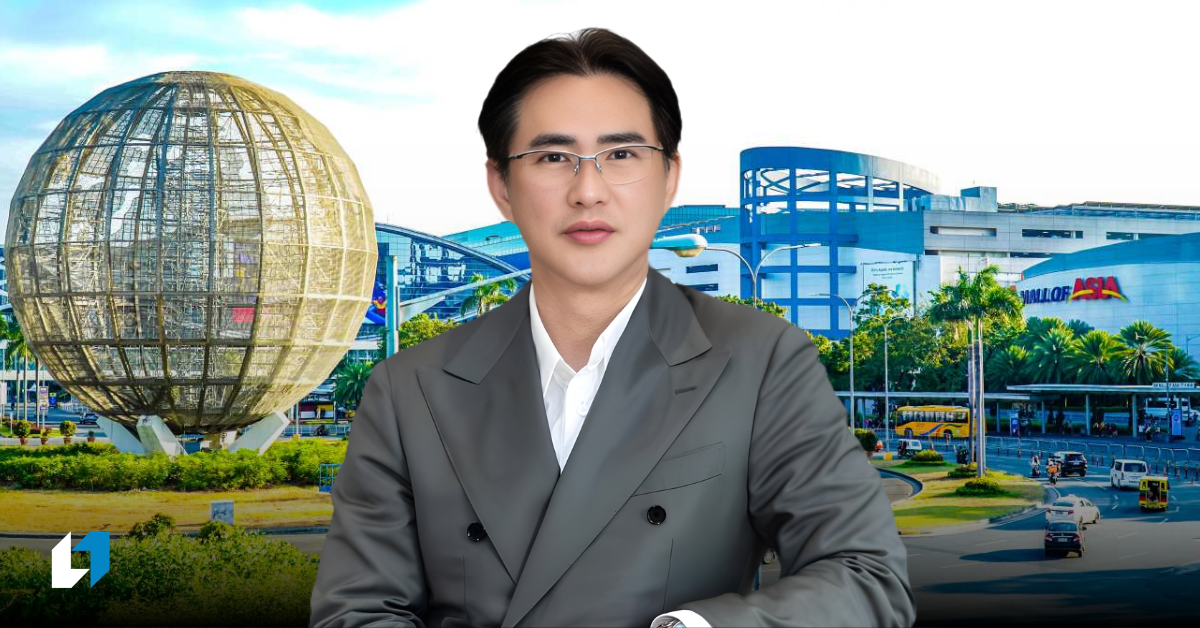
When SM Supermalls decided to build Mall of Asia, the project did not come with obvious signals of success. There was no established market, no surrounding commercial district, and no guarantee that customers would follow. What it did have was conviction from the people backing it.
Steven Tan remembers what the site looked like before construction reshaped the area.
“There was nothing around us, it was all cogon grass.”
At the time, the emptiness was hard to ignore.
“There was only the church, and that was the only structure aside from a flat, one-story warehouse-looking office in front.”
Despite the scale of the project, the location appeared disconnected from the rest of the city. For many observers, this raised a simple question: why build here?
Tan’s answer did not come from market studies alone. It came from trust in the people making the decision.
“My guiding lights have always been the Sy family, especially Tatang.”
For him, the scale of commitment mattered more than short-term doubt.
“They’ve invested billions of pesos.”
That level of investment carried its own logic.
“Would a wise businessman, the most successful businessman, invest in something that would lose?”
For Tan, that question became a source of clarity.
“That alone, for me, was already guidance.”
Betting ahead of demand
Mall of Asia was not designed to follow existing foot traffic. It was designed to create it. That meant building ahead of visible demand and trusting that the scale itself would shape behavior.
When the mall opened on May 16, 2006, the outcome was immediate.
“But we opened it, and on day one, it was swamped with people.”
The scene exceeded expectations.
“You cannot imagine that day—May 16, 2006.”
What had once been empty land quickly became crowded.
“The whole mall was full of people.”
The response spilled beyond what the mall was prepared for.
“All the restaurants were packed. There were no spaces to eat.”
Customers improvised.
“People were buying from the restaurants and eating in the common areas—that’s how successful it was.”
The opening day validated a long-held belief within SM: scale, when executed with conviction, could create its own market.
From risk to reference point
In the years that followed, Mall of Asia became more than just a retail destination. It became a reference point for what large-scale, integrated developments could achieve.
Tan reflects on its longevity with a sense of perspective.
“It’s been operating for the past, what, nearly 20 years?”
What began as a risky bet has endured.
“And it’s one of the most successful malls in the country, if not the most successful mall in the country right now, right?”
The outcome reframed earlier fears that the project would fail.
“There was a lot of negativity around Mall of Asia back then.”
For Tan, the experience reinforced a leadership lesson shaped by observation rather than theory.
“But for me, I just focused, stayed focused.”
That focus was rooted in alignment—between leadership, vision, and execution.
Vision backed by capital and patience
Mall of Asia’s story underscores a reality often missed in discussions about large developments: vision alone is not enough. It must be backed by capital, patience, and the willingness to absorb uncertainty.
The Sy family’s approach reflected that mindset. Rather than reacting to early criticism, they stayed committed to the long-term view.
For Tan, watching that process unfold up close shaped how he understood leadership.
Trusting a vision does not mean ignoring fear. It means deciding which signals matter more. In the case of Mall of Asia, the strongest signal was not public opinion—it was the scale of belief behind the project.
What once stood on cogon grass is now a landmark known well beyond the Philippines. And for those involved in its creation, Mall of Asia stands as proof that the biggest risks often require the deepest conviction—and the patience to wait for the market to catch up.
This article includes quotes from an interview originally published by Esquire Philippines, authored by Henry Ong.

