

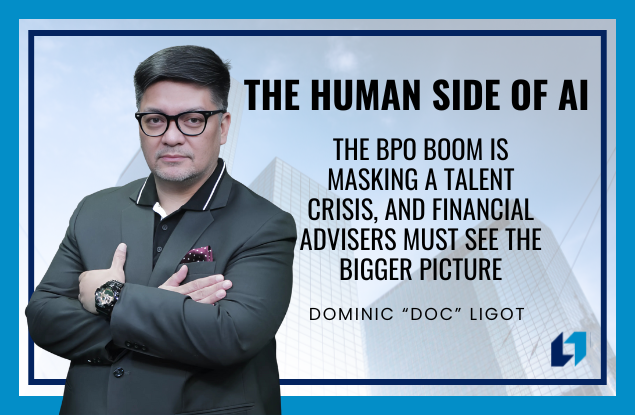
We love telling the story of the Philippines as a services powerhouse: the world’s call center capital, the second-largest exporter of BPO talent, and a global supplier of nurses, accountants, and OFWs. But beneath this narrative lies a structural imbalance that every Filipino financial adviser must reckon with, because it affects labor markets, client career paths, and the long-term resilience of the economy.
Our strength in services has become our weakness.
As I pointed out recently at a BPO conference, the Philippines imports almost everything, from rice to machinery, while exporting people. BPOs have been a lifeline for foreign currency and employment, but they’ve also created distortions that policymakers and advisers can no longer ignore.
Take healthcare. We celebrate the rise of medical BPOs, yet hospitals are desperately short of nurses. Why? Because entry-level BPO jobs pay nearly double what local hospitals offer. Telemedicine wins; local healthcare loses.
The same story plays out in finance and accounting. Financial BPOs are recruiting aggressively, absorbing young accountants before they ever touch real Philippine corporate work. For the first time, accounting is “cool” again, but traditional firms and local industries are left scrambling.
The talent isn’t disappearing, it’s being redirected.
And while BPOs have undeniably elevated skills (banking work in global BPOs is often more complex than tasks in local banks), the knowledge rarely flows back into Philippine institutions. We are training world-class professionals, but foreign firms are the primary beneficiaries.
That brings us to the looming threat: AI-enabled global competition.
Countries like Vietnam are rapidly developing their technical talent. They may not speak English, but AI translation soon will. If language ceases to be our competitive edge, what remains? And with leaders like Elon Musk and Donald Trump favoring AI investments over outsourcing, the winds may shift quickly.
The middle ground, is AI-enabled BPOs, leveraging AI to enhance, not erode, Philippine service exports. But this transition will require more than technology. It demands policy intervention, industry coordination, and advisory expertise.
For financial advisers, this shifting landscape matters deeply.
Your clients’ careers, earning trajectories, and long-term financial plans hinge on how well the Philippines adapts. You must help them anticipate industry risks, skill shifts, and economic transitions, not react to them belatedly.
Our BPO dominance has been a blessing. It can become a springboard, or a trap.
The trade-off, as always, is opportunity. The advisers who guide clients through this transition will not only protect wealth, they will help build a more resilient Filipino workforce.
Dominic “Doc” Ligot is one of the leading voices in AI in the Philippines. Doc has been extensively cited in local and global media outlets including The Economist, South China Morning Post, Washington Post, and Agence France Presse. His award-winning work has been recognized and published by prestigious organizations such as NASA, Data.org, Digital Public Goods Alliance, the Group on Earth Observations (GEO), the United Nations Development Programme (UNDP), the World Health Organization (WHO), and UNICEF.
If you need guidance or training in maximizing AI for your career or business, reach out to Doc via https://docligot.com.

