

Many people assume that success eliminates the need for a backup plan.
After all, when a career is thriving and opportunities continue to arrive, it is easy to believe that the good times will last indefinitely. Yet some of the most successful professionals understand that careers, industries, and markets can change unexpectedly. Rather than waiting for problems to appear, they prepare long before they need to.
That was the mindset that eventually led actor Joel Torre to build a business outside of show business.
By the time Torre began thinking seriously about entrepreneurship, he had already achieved what many actors spend an entire lifetime pursuing.
Widely regarded as one of the finest actors of his generation, Torre had built a distinguished career in Philippine cinema and television. He had worked with some of the country’s most respected directors, appeared in critically acclaimed films, and earned numerous acting awards along the way. For decades, he was one of the most recognizable and respected figures in the entertainment industry.
From the outside, it would have appeared that he had little reason to worry about the future.
Yet it was precisely his years in show business that convinced him he needed another source of income.
More than twenty years ago, Torre found himself having a conversation with his wife that would eventually change the course of his professional life.
“I told my wife, ‘I’m getting tired of long hours and I’m not getting any younger. My market value might decline soon, so I need a fallback position.'”
After spending decades in the entertainment industry, Torre understood something that many people outside the profession rarely see. Success in show business can be unpredictable. One year may be filled with projects while another may be considerably quieter. An actor can be in demand today and struggle to find opportunities tomorrow.
Unlike salaried employees who receive a regular paycheck, actors often depend on projects that come and go.
According to Torre, this reality forced him to think differently about money and long-term financial security.
“At that time kasi, if you’re an actor, hindi ka makapag-save.”
The challenge was not merely about earning money. It was about the irregular nature of the income itself.
Torre explained that there were periods when work was abundant and periods when there were no projects at all.
“I worked so hard and there will come a time, wala kang trabaho, so ang savings mo are used up.”
Over time, he noticed a pattern that many actors fall into. During productive years, income is strong. During slower periods, savings become the primary source of support. Eventually, those savings begin to shrink.
“Minsan sasabihin mo, ‘Tutal artista ka naman, meron namang movie dyan na darating,’ pero ang savings mo, they get depleted.”
The assumption that another project would eventually come along was not enough for him.
He wanted something more reliable.
Looking Beyond Acting
Torre eventually came to a simple conclusion.
“No, no, no. You should have a passive income na kahit wala ako doon, it will generate income para double kita ko.”
He was not planning to leave acting. Nor was he dissatisfied with his career. What he wanted was another source of income that could continue generating cash flow regardless of whether he was working on a film or television project.
The idea appealed to him for another reason.
Actors often have periods between projects when their schedules become less demanding. Rather than viewing that time as idle, Torre began seeing it as an opportunity to build something that could create long-term value.
“During creative time when I had work, I was earning money, but there were times na walang project, my savings get depleted, so non-productive ka.”
He wanted to change that equation.
“As an actor I had a lot of time in between, so I could do it para yung idle time ko productive.”
For Torre, the goal was not simply to earn more money. It was to create an asset that could continue producing income even when he was not actively working.
The idea would eventually lead him to entrepreneurship.
Why Food Made Sense
Once Torre decided he wanted a business, the next challenge was deciding what kind of business to build.
For him, the answer came naturally. Food had been part of his life long before he became an actor.
Growing up in Bacolod, he developed an appreciation for food at an early age. Like many Ilonggos, he was raised in a culture where meals were celebrated and good cooking was deeply valued.
“I grew up with food as the youngest in my family.”
He often accompanied his mother to the market and observed her in the kitchen.
“My mom would bring me to the market. Ako yung mascot niya sa Bacolod.”
His mother was also an excellent cook, which helped shape his appreciation for food.
“I’m glad to say my mom was an excellent cook, so we were taught how to appreciate good food.”
Although acting eventually became his profession, the idea of entering the food business never completely disappeared.
“When I was working in showbiz, it was always at the back of my mind that one day I would go into the food business.”
Years later, when he finally decided to build a fallback position, food remained the obvious choice.
“I needed a fallback and that was food.”
Building Around a Signature Product
After deciding to enter the restaurant business, Torre knew he needed something that would distinguish the concept from other establishments.
“Kailangan may signature tayo.”
Being from Bacolod, the answer seemed obvious.
“Taga Bacolod ako eh, eh di Inasal.”
The team became so excited about the concept that they immediately began working on the details.
“We were so excited that we couldn’t sleep anymore.”
They traveled to Bacolod to refine and perfect the recipe.
“We got a cook and went to Bacolod to perfect the recipe.”
Although Torre had never operated a restaurant before, he quickly discovered that many aspects of the business felt familiar.
When it came to food production, he realized he had been learning long before he opened his first restaurant.
“I had to learn the ropes, but when it came to food production, I realized it was second nature because I grew up with my mom sa kitchen,” he recalled. “Ako yung ano niya sa kusina. Ganito ka mag-keep, ganito. Wala akong practice. I would see my mom cooking.”
Years of observing his mother in the kitchen had given him a foundation that he did not fully appreciate until he entered the food business himself.
From a Fallback Plan to a Restaurant Brand
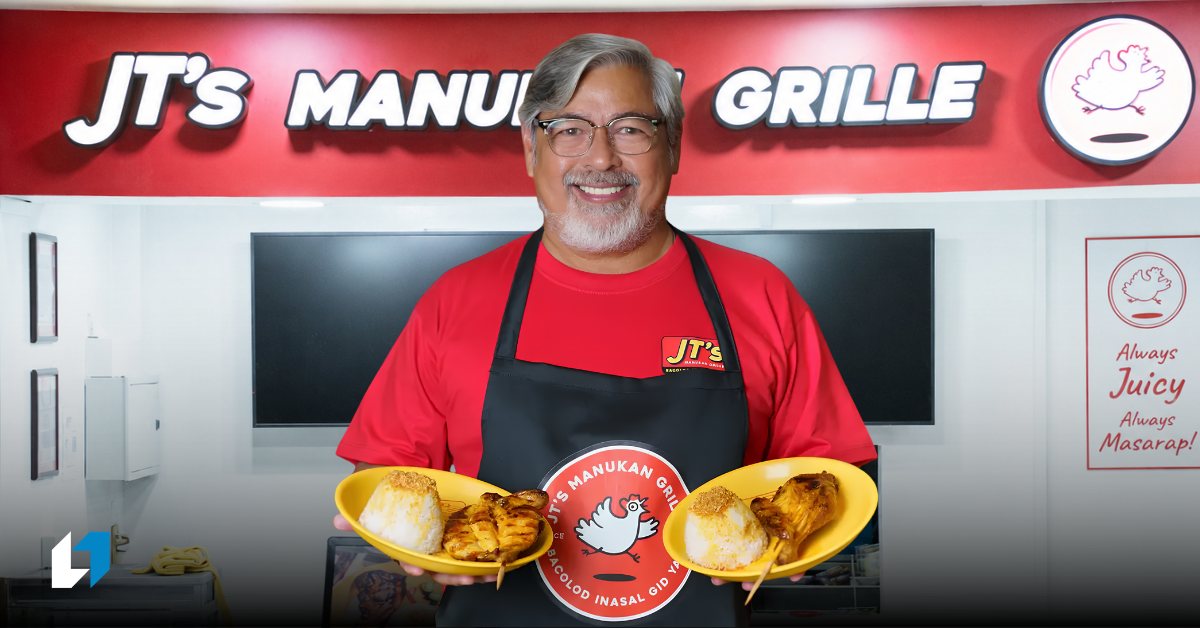
In 2003, Torre and his wife opened the first JT’s Manukan Grille. What began as a small restaurant eventually grew into something much larger. Customers responded to JT’s Manukan’s authentic Bacolod-style chicken inasal, and word-of-mouth helped the business expand beyond its modest beginnings. Over the years, JT’s Manukan developed into one of the Philippines’ best-known chicken inasal brands, growing to dozens of locations and even expanding overseas.

