

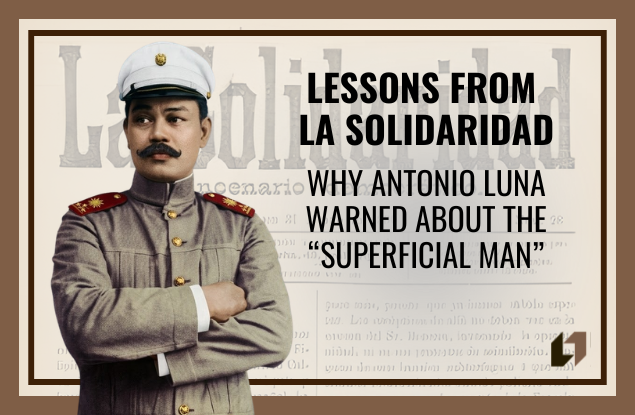
In 1891, Filipino intellectual Antonio Luna published a short but striking essay titled “Superficiality” in the reformist newspaper La Solidaridad. Writing under the pen name Taga-Ilog, Luna did not describe a political event or a historical figure. Instead, he presented something more unsettling—a psychological portrait of a personality type that quietly thrives in society.
The subject of his essay is what Luna calls the “superficial man.”
At first glance, this individual appears impressive. He moves confidently through social circles, tells entertaining stories, and attracts attention wherever he goes. Luna describes him as “outwardly elegant, robust, manly… eager and anxious to parade himself, his affections, his elegance.”
To casual observers, such a person seems charming and sophisticated. But Luna quickly suggests that this polished appearance hides something deeper and far less admirable.
A Life Driven by Vanity
According to Luna, the superficial man is motivated primarily by one thing: admiration.
Everything he does—his gestures, jokes, friendships, and conversations—is carefully designed to attract approval from others. Luna explains that “the satisfaction of his vanity, to win the admiration of other persons — these determine the way he struts and gives life to all his aspirations.”
In other words, his life becomes a performance. The goal is not sincerity or meaningful accomplishment, but applause.
Charm and confidence therefore become tools rather than genuine expressions of character. The superficial man learns how to present himself in ways that will earn admiration, even if the personality behind the presentation remains hollow.
Friendship as Performance
Luna also observes how this personality approaches friendship. At first, the superficial man appears generous and warm. He may offer enthusiastic help when someone confesses a problem or financial difficulty. His reaction is dramatic and emotional, giving the impression of loyalty and compassion.
Yet Luna warns that these gestures often lack depth.
True friendship, he explains, cannot be built on exaggerated displays of sympathy. It develops slowly through shared experience, trust, and respect. As Luna writes, “faith, long association, mutual respect are the necessary elements which… unite to form a beautiful realization of faithful amity.”
Real friendship requires time. The superficial man, however, prefers theatrical gestures that create the appearance of loyalty without the substance.
The Mask of Charm
Perhaps the most memorable observation in the essay is Luna’s description of how this personality hides behind charm and wit. The superficial man entertains people constantly, telling stories, gossiping, and joking about everything around him.
But Luna suggests that this humor is not harmless. It serves as a distraction—a mask that prevents others from seeing the person’s deeper motives.
He writes that such a man lives as if “life is a continuous carnival and so he always wears a mask.”
Behind that mask may lie vanity, egoism, and manipulation. The constant performance allows him to avoid scrutiny while maintaining admiration.
Flattery as a Tool of Influence
Another tactic the superficial man uses, according to Luna, is flattery. He studies people carefully and learns what they want to hear. Compliments come easily, often exaggerated but delivered with confidence.
The strategy works because it appeals to a common human weakness. As Luna observes, the superficial man understands that people enjoy praise, and “he knows this human weakness and he gets everything he can out of the knowledge.”
Flattery becomes a tool for influence. By telling others what they want to hear, the superficial man builds networks of approval that help him advance socially.
When Society Rewards the Wrong People
The deeper message of Luna’s essay lies not only in the personality he describes but in the society that admires such individuals.
Charming talkers, fashionable social climbers, and entertaining storytellers often receive attention and praise. Meanwhile, quieter individuals who possess integrity and depth may remain unnoticed.
Luna’s essay suggests that society sometimes confuses appearance with character.
People who seem confident, sociable, and amusing can quickly become admired figures even when their values are shallow. The danger is not simply the existence of superficial individuals but the willingness of society to reward them.
Why Luna’s Warning Still Matters Today
More than 130 years after Luna wrote “Superficiality,” the personality he described still appears everywhere.
Modern society offers even more opportunities for individuals to build carefully crafted images. Social media platforms allow people to project confidence, success, and charm to large audiences, often with little scrutiny of what lies behind the presentation.
The “mask” Luna described in 1891 has not disappeared. It has simply taken new forms.
Public figures, influencers, corporate climbers, and political personalities sometimes rely on the same techniques Luna identified: charm, flattery, humor, and carefully managed appearances.
The Lesson Behind Luna’s Essay
Luna’s warning remains remarkably relevant. Confidence and popularity do not necessarily reflect depth of character. Charm can conceal manipulation, and admiration can sometimes reward the most skillful performers rather than the most sincere individuals.
By examining the personality of the superficial man, Antonio Luna reminded readers that true character reveals itself not through performance but through consistency, integrity, and genuine relationships.
More than a century later, his observation still serves as a useful reminder: the people who attract the most attention are not always the ones who deserve the most respect.

