

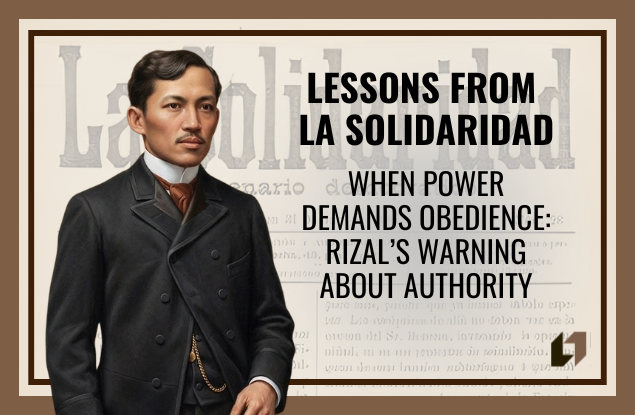
On July 31, 1889, Filipino reformist José Rizal published an article titled “New Truths” in the reformist newspaper La Solidaridad.
At the time, Rizal and other Filipino reformists were engaged in a public intellectual debate with Spanish writers and officials who defended the colonial system in the Philippines. One of those critics was Vicente Barrantes, who had attacked Filipino reformists and portrayed Spanish rule as benevolent and necessary.
Rizal wrote “New Truths” as a response to these arguments.
The central claim he confronted was the idea that Spanish rule in the Philippines was “peaceful and paternal” and that introducing reforms would threaten stability.
Rizal immediately exposed the contradiction in that argument.
Quoting the position he was criticizing, he wrote:
“The introduction of reforms can be injurious to our peaceful and paternal rule.”
This phrase captured a common justification used by colonial authorities: that maintaining order required limiting reform.
But Rizal argued that such reasoning revealed something deeper — a political system that feared scrutiny and change.
If a government truly served the people, reforms should strengthen it, not threaten it.
The Argument of “Paternal Rule”
Spanish officials and their defenders often described colonial rule as paternal — meaning Spain governed the Philippines like a parent guiding a child.
Rizal challenged this idea directly.
He pointed out that this supposed paternal system did not empower Filipinos but instead kept them dependent.
He wrote that under such a system, the Filipino people were expected to remain passive while colonial authorities claimed to know what was best for them.
Rizal warned that this mindset discouraged accountability.
He observed that defenders of the system insisted reforms would weaken government authority and lead to disorder. But he argued that such fears were exaggerated and often served the interests of those already benefiting from the existing structure.
If reforms were resisted simply to preserve authority, then the system was protecting itself rather than the people.
Challenging the Narrative of “Civilizing” the Philippines
Another claim Rizal dismantled was the idea that Spain had “civilized” the Philippines during centuries of colonial rule.
Spanish writers often argued that the friars and colonial authorities had uplifted the Filipino people through religion and education.
Rizal responded with biting sarcasm.
He wrote:
“Neither do we wish to say anything for the present about what the friars in the Philippines had done for the savages when they arrived.”
Rizal then pointed out that even after centuries of colonial rule, education remained limited.
He observed:
“It is sufficient to say now that according to the friars, when the Spaniards arrived all the natives knew how to read and write in their own alphabet and that they had traditions and legends.”
He then added an observation that undermined the colonial claim of progress:
“Now there are only 70 out of every 100 persons who can read and write.”
If Spain had truly brought civilization and education to the islands, Rizal implied, literacy and intellectual development should have dramatically improved rather than stagnated.
This was a powerful critique of the colonial narrative that portrayed Spain as a benevolent civilizing force.
When Authority Demands Silence
Rizal also criticized the expectation that Filipinos should simply accept the colonial system without questioning it.
He wrote that defenders of the regime preferred a population that remained quiet and obedient rather than engaged and critical.
In one passage, Rizal described the kind of citizen colonial authorities seemed to prefer:
“He would wish the government to sleep, to be idle, to be criticized more and more, to continue being called a simpleton so that in this manner the Filipino people… should rise one day when it gets tired of tyranny and idiocy.”
Here Rizal warned of a political danger.
Suppressing reform and discouraging criticism does not eliminate public dissatisfaction — it only postpones it.
Eventually, the pressure builds.
History, Rizal suggested, shows that societies that refuse reform often face deeper crises later.
A Lesson That Still Resonates
More than a century later, Rizal’s observations remain strikingly relevant.
Across many societies today, governments sometimes defend controversial decisions by arguing that stability must come before reform. Leaders often justify policies by claiming they are necessary to maintain order or protect national interests.
But Rizal’s critique reminds us that stability should never become an excuse to avoid accountability.
The idea of “paternal rule” can easily evolve into a system where authority expects obedience rather than transparency.
Rizal’s essay encourages citizens to question such reasoning.
If power claims to act in the people’s interest, it must be willing to withstand scrutiny and reform.
Otherwise, the claim of benevolence becomes little more than a justification for preserving control.
Rizal’s Enduring Warning
In “New Truths,” Rizal was not simply defending Filipino dignity against colonial criticism.
He was also offering a timeless lesson about governance.
Political systems that rely on unquestioned authority may appear stable on the surface, but they often carry deeper weaknesses.
By contrast, societies that encourage reform, transparency, and public debate are far more resilient.
More than a century later, Rizal’s message still speaks clearly:
when power insists that it alone knows what is best for the people, citizens must ask the same question he asked in 1889.
Is that authority truly serving the public — or merely protecting itself?

