

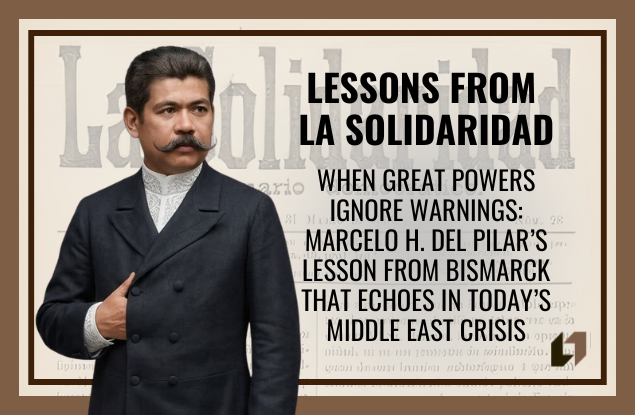
On April 15, 1890, the reformist newspaper La Solidaridad published an article titled “The Downfall of Bismarck.” The piece was written by Marcelo H. del Pilar, the leading editor of the paper and one of the intellectual architects of the Filipino reform movement in Spain.
Del Pilar often used international events to educate Filipino readers about politics, empire, and the forces shaping the modern world. By discussing developments in Europe, he was also indirectly explaining how imperial power operated—an important lesson for Filipinos living under Spanish colonial rule.
In “The Downfall of Bismarck,” del Pilar examined the resignation of Otto von Bismarck, the powerful statesman who had dominated European politics for decades. But del Pilar’s essay was not simply a report on European affairs. It was a reflection on the dangers of imperial ambition and the risks of geopolitical escalation.
More than a century later, the warnings in his essay feel strikingly relevant.
Del Pilar Explains Why Bismarck Fell
Del Pilar begins by observing how Bismarck’s resignation had attracted widespread attention across Europe.
“The resignation of the Iron Chancellor has awakened curiosity, because many and varied are the accounts which the international press give on the causes which led to such an important occurrence.”
For del Pilar, the key issue behind Bismarck’s downfall was the colonial question.
“The cause of the downfall of the famous Chancellor should be sought in the colonial question.”
Bismarck, he explains, had long resisted colonial expansion.
“Since the beginning of his chancellorship, Bismarck was reluctant and refused to take part in colonial ventures.”
But economic pressures pushed Germany toward empire. Protectionist policies in Europe limited German access to foreign markets.
Del Pilar writes:
“Protectionism which reigned in all countries forced him to take measures in the event that foreign markets were closed to German products.”
Colonies therefore became a way for European powers to secure markets and expand their economic influence.
Bismarck’s Fear of Imperial Conflict
Despite Germany’s growing colonial ambitions, del Pilar explains that Bismarck remained cautious.
The German chancellor believed aggressive expansion could provoke dangerous conflicts.
“Bismarck vigorously opposed these projects because he considered them dangerous adventures that would bring with them the danger of provoking wars.”
Bismarck feared that competition among imperial powers could escalate into wider international conflict.
As del Pilar explains:
“This idea of Bismarck was part of the policy to avoid enemies for Germany in the event of an unfortunate war with France.”
In other words, Bismarck understood that geopolitical rivalry could easily spiral into war.
When Leaders Ignore Warnings
The conflict that ended Bismarck’s career came from his disagreement with the young German emperor Wilhelm II.
The emperor favored aggressive colonial expansion, particularly in Africa.
Del Pilar notes that the emperor ignored Bismarck’s warnings:
“The Emperor, far from listening to the warnings of his chancellor… reiterated the order that Emin-Pacha should go to the African interior.”
Unable to prevent this new policy, Bismarck eventually stepped down.
“In view of this actuation of the young emperor, Bismarck resigned as chancellor.”
Del Pilar concludes that Bismarck feared the consequences of reckless geopolitical competition.
“The able diplomat was afraid of the dangers of external conflicts which might disturb international peace.”
Why Del Pilar Wrote About This
Marcelo H. del Pilar did not write this article merely to discuss European politics.
As editor of La Solidaridad, he used global events to help Filipino readers understand the mechanics of empire.
Through Bismarck’s story, del Pilar illustrated how powerful nations pursue influence through economic pressure, colonial expansion, and geopolitical rivalry.
These were the same forces shaping the colonial world in which the Philippines existed.
What happened after Bismarck’s departure
Emperor Wilhelm II’s shift from “cautious diplomacy” to Weltpolitik (World Policy) acted as the primary catalyst for the geopolitical destabilization del Pilar feared.
By aggressively pursuing a “place in the sun” through rapid naval expansion and erratic colonial interventions in Africa and Morocco, the Emperor dismantled the delicate web of alliances Bismarck had spent decades weaving.
This aggressive posture effectively forced formerly rival powers—Britain, France, and Russia—into a defensive “Triple Entente,” leaving Germany strategically encircled.
Ultimately, the “dangerous adventures” del Pilar identified spiraled out of control; without Bismarck’s pragmatic restraint to act as a “safety catch,” a localized Balkan conflict in 1914 ignited the global conflagration of World War I, leading to the total collapse of the German Empire and the very international peace del Pilar had warned was at stake.
A Lesson That Still Echoes in Today’s Geopolitics
More than a century later, the concerns raised by del Pilar feel remarkably familiar.
Today the world again watches a dangerous geopolitical confrontation unfold in the Middle East. Rising tensions between the United States and Iran have produced missile strikes, proxy conflicts, and threats to global energy supply routes.
The situation illustrates the same pattern that del Pilar described in his essay.
Great powers justify intervention through economic interests, strategic influence, or security concerns. Yet these actions often increase the risk of broader conflict.
Bismarck understood this danger when he warned against reckless expansion.
As del Pilar wrote:
“He considered them dangerous adventures that would bring with them the danger of provoking wars.”
The warning applies just as much today as it did in the nineteenth century.
Del Pilar’s Enduring Warning
Marcelo H. del Pilar used the story of Bismarck not simply to describe a political event but to highlight a timeless lesson about power.
When nations pursue expansion, prestige, or dominance without restraint, they often create tensions that can spiral into global conflict.
The downfall of Bismarck illustrated what happens when cautious diplomacy gives way to aggressive ambition.
More than a century later, as rival powers test each other’s limits in the Middle East and beyond, del Pilar’s insight still resonates.
History has shown repeatedly that when leaders ignore warnings about geopolitical rivalry, the consequences rarely remain local—they echo across the entire world.

