

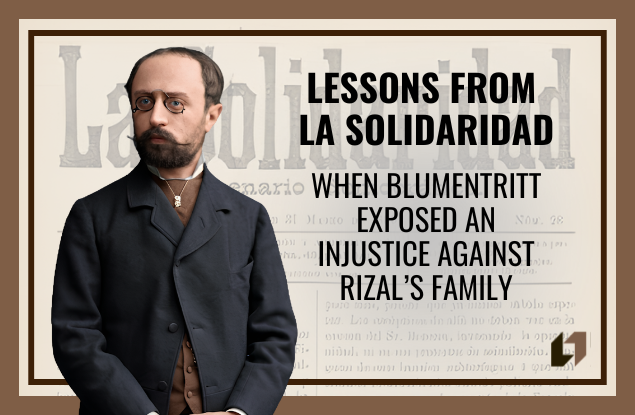
On July 31, 1889, the reformist newspaper La Solidaridad published a letter written in Leitmeritz, Austria on July 19, 1889 by Ferdinand Blumentritt.
Blumentritt, a respected European historian and ethnographer, had become one of the closest intellectual allies of José Rizal. Though he had never lived in the Philippines, he followed events in the country closely and often spoke out against injustices suffered by Filipinos under Spanish colonial rule.
The letter he sent to the editor of La Solidaridad concerned a deeply controversial incident in the Philippines: the refusal of church burial to Mariano Herbosa, Rizal’s brother-in-law.
Herbosa was married to Lucia Rizal, one of Rizal’s sisters. When he died in Calamba in 1889, his family requested that he be buried in consecrated ground according to Catholic tradition. But the local parish authorities refused.
The decision shocked many who knew Herbosa.
Blumentritt described him as a man of kindness and charity. Far from being someone unworthy of religious rites, he had lived a life marked by generosity and compassion.
As Blumentritt wrote:
“Justice was also harmed, because the memory of a man who was a good son, a good husband, a good father, a good Catholic and Christian has been grossly slandered.”
He then described Herbosa’s acts of charity and service to others:
“He had opened his home to the sick and poor, the destitute… he gave food and shelter to poor mothers… sick of loathsome but not shameful diseases.”
According to Blumentritt, Herbosa had helped the poor and the sick without hesitation, providing shelter and care for those in need. Yet despite these acts of kindness, the Church authorities denied him burial in consecrated ground.
For Blumentritt, the decision revealed something disturbing.
The issue was not morality.
The issue was revenge.
Because Herbosa was related to Rizal—whose writings had exposed abuses by Spanish friars—he was punished even in death.
Blumentritt pointed out the hypocrisy of the decision by comparing it with cases where individuals guilty of far worse actions were still granted proper burials.
He wrote with biting irony:
“An adulterer kills his mistress and then commits suicide… yet because he is the son of kings, he is given a solemn burial and a chapel is erected on the place where the adulterer was buried.”
In other words, social status and political connections could override moral considerations.
But a good man connected to a critic of authority could be denied even the dignity of burial.
Blumentritt believed this revealed a deeper problem.
When institutions apply rules selectively—strict for critics, flexible for the powerful—they undermine the very principles they claim to defend.
The injustice of the situation moved Blumentritt to protest publicly. Writing to the editor of La Solidaridad, he appealed not only to Filipinos but also to Spain itself.
He wrote:
“To the Spanish nation, to all honorable Catholics, to all noble Spaniards… we denounce these injustices.”
Blumentritt believed that the Spanish government and the broader Catholic community needed to know what was happening in the Philippines.
The incident, he argued, was not merely a personal insult against Rizal’s family.
It was an insult to justice itself.
He captured this in a simple but powerful line:
“Justice was also harmed.”
The episode revealed how easily authority could distort moral rules when personal hostility or political motives were allowed to influence decisions.
More than a century later, the lesson remains strikingly relevant.
Institutions—whether religious, political, or legal—derive their authority from the belief that they will apply their rules fairly. When those rules are enforced selectively, public trust begins to erode.
People quickly recognize when standards become flexible for the powerful but rigid for critics.
Blumentritt understood that justice cannot survive under such conditions.
Principles that are applied inconsistently cease to be moral standards. Instead, they become instruments of power.
What makes this episode especially remarkable is that the criticism came not from a Filipino reformist but from a European scholar observing events from afar.
From thousands of miles away, Blumentritt could see clearly what many defenders of the colonial system refused to acknowledge: that denying burial to a charitable man simply because he was related to Rizal was not an act of religious discipline.
It was an act of revenge.
By publishing Blumentritt’s protest, La Solidaridad exposed an uncomfortable truth about power and justice.
When institutions allow personal grievances to dictate their decisions, justice becomes personal.
And once justice becomes personal, it ceases to be justice at all.

