

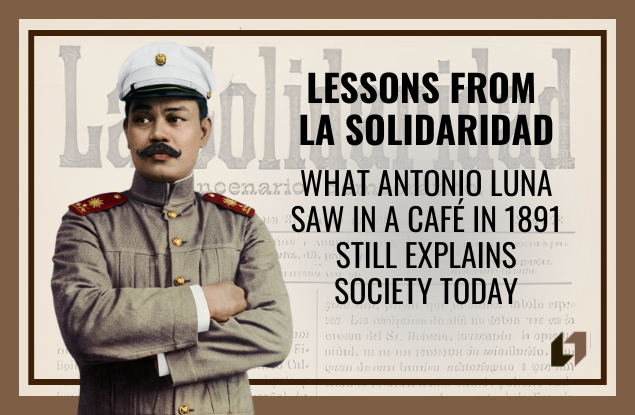
In January 1891, a short essay appeared in the reformist newspaper La Solidaridad. It was written under the pen name Taga-Ilog, a pseudonym widely attributed to Antonio Luna.
The piece was titled “At the Café.”
At first glance, it reads like a simple observational sketch. The narrator sits quietly inside a crowded café and watches the people around him—fashionable women with extravagant hats, businessmen engaged in lively conversation, families seated at small tables, and young couples exchanging glances across the room.
But the café Luna describes is not merely a place for coffee and conversation. As the narrator continues to observe the crowd, the setting slowly reveals itself as something larger: a miniature portrait of society itself.
More than a century later, the scene still feels remarkably familiar.
A Room Full of Appearances
Luna begins by describing the fashionable visitors entering the café. Their clothes and accessories immediately attract attention. The women arrive wearing elaborate hats and jewelry, while men speak loudly about their affairs and acquaintances.
Everything seems elegant and refined.
Yet beneath the polished surface, the narrator senses something artificial. The gestures, the compliments, and even the conversations feel exaggerated, as though everyone is performing for an audience.
The café becomes, in Luna’s words, a place where people gather not only to drink coffee but to “parade their elegance” and social importance. The atmosphere gradually resembles a stage where each guest tries to play the role of someone impressive.
In this setting, appearances become more valuable than authenticity.
Love Versus Social Convenience
One of the most revealing moments in the story centers on a young woman whose parents quietly encourage her to marry a wealthy older man.
To the family, the match seems ideal. The gentleman’s wealth promises security and social prestige. But Luna reveals that the girl’s heart belongs to someone else—a poor law student named Enriquito.
The student stands nearby, watching silently.
The contrast between the two men is deliberate. One represents wealth and convenience; the other represents sincerity and genuine affection. In the polite atmosphere of the café, however, practical considerations outweigh personal feelings.
Luna uses this quiet scene to show how society often measures relationships in terms of status rather than emotion.
Society as Theater
As the narrator continues observing the café, the room grows louder and more animated. Conversations become exaggerated, gossip spreads quickly, and people attempt to outshine one another through stories and displays of refinement.
What should be a casual gathering begins to resemble a carefully choreographed performance.
At one point, Luna’s narrator delivers a sarcastic remark about the young woman’s father, suggesting that “if he were a chicken he would have less time for feasting.”
The humor is sharp, but the message is clear: respectable figures in society are not always guided by wisdom. Sometimes they are driven by indulgence, vanity, and social ambition.
Through moments like this, Luna quietly exposes the gap between outward respectability and inner character.
A Café That Reflects the World
By the end of the essay, the café itself becomes symbolic. Within its walls appear many of the forces that shape society at large—ambition, vanity, calculation, and the constant desire for admiration.
The narrator watches calmly but critically, suggesting that elegant manners and fashionable clothing often disguise deeper motives.
The scene ultimately reflects a simple truth about human behavior. As Luna hints throughout the piece, “humanity is always the same.”
The costumes may change, but the impulses remain.
Why Luna’s Observation Still Matters
Although Antonio Luna wrote “At the Café” in 1891, the behavior he described has not disappeared.
The café has simply moved.
Today’s social theater often unfolds not in smoke-filled coffeehouses but on digital platforms where carefully curated images replace elaborate hats and jewelry. Luxury travel photos, designer brands, and exclusive experiences serve as modern signals of status.
People still compete to appear successful. Social approval often depends on visible symbols of achievement, and relationships can still be influenced by financial considerations.
In many ways, Luna’s crowded café resembles today’s social media feed.
The Quiet Lesson Behind the Story
The lasting brilliance of Luna’s essay lies in its simplicity. By quietly observing ordinary people inside a café, he revealed patterns of human behavior that remain visible more than a century later.
The tension between authenticity and image continues to shape social life. The desire to impress others often competes with the desire to live sincerely. And society still rewards those who appear successful—even when the appearance hides something far less substantial.
More than 130 years ago, a Filipino writer sitting in a European café noticed how easily people confuse display with meaning.
The setting has changed, but the insight remains.
Sometimes the clearest portrait of society is found not in political speeches or economic reports, but in the ordinary places where people gather—and quietly reveal who they really are.

