

The Real AI Opportunity Isn’t Technology. It’s Talent.
When people talk about artificial intelligence, they often focus on technology. New models. New tools. New breakthroughs.
But the real opportunity may be much simpler. Talent. For the past few years, I have argued that AI is first and foremost a workforce issue.
Recently, I revisited a talk I gave in 2024. What stood out was how relevant the message still feels today.
AI is already taking over routine tasks. In fields such as analytics, software development, and research, many repetitive activities can now be completed much faster with AI assistance. That does not mean jobs disappear overnight. It means work changes. The professionals who thrive will be the ones who learn to work alongside AI. The professionals who struggle will be those who ignore it.
This is why AI adoption should not be limited to technical workers. We need what I call an “all of labor” approach. Builders matter. These are the engineers and developers creating AI systems.
But users matter too. Managers, executives, planners, and decision-makers need to understand how AI fits into business strategy.
Most importantly, educators matter. Without teachers who understand AI, we cannot prepare future workers.
This workforce perspective is especially important for the Philippines. The country’s economic success has long depended on talent. The BPO sector is a strong example. As AI changes global demand, new job categories will emerge. Some already have.
Data annotation is one example. These workers label images, classify information, and help create training data used by AI systems. Many similar opportunities are likely to follow.
The lesson is clear. The question is not whether AI will create jobs. The question is whether we are preparing people to fill them.
Government also has an important role to play. Most policy discussions focus on regulation. Regulation matters. However, talent development deserves equal attention.
Several countries are investing aggressively in AI education and workforce development. These investments are designed to attract industries, create jobs, and strengthen competitiveness. The Philippines has already demonstrated that large-scale training programs can work. Project SPARTA trained thousands of data professionals and created valuable momentum.
Yet the scale of the challenge remains significant. We need more ambitious goals. Training thousands is a good start. Training millions should be the objective.
Infrastructure is another key issue. AI requires computing power, data centers, and digital resources.
Countries that invest in these foundations will be better positioned to attract investment and support innovation. Those that do not may struggle to keep up.
For investors, business leaders, and policymakers, the message is straightforward. AI should not be viewed only as a technology trend. It should be viewed as a national capability.
Talent. Infrastructure. Education. Leadership. These are the building blocks of long-term competitiveness.
The Philippines has one major advantage. People are interested. There is strong curiosity about AI across industries and professions. That interest creates an opportunity.
But interest alone is not enough. Execution is what matters now. The conversation has largely been won. The challenge today is implementation.
The countries that move fastest from awareness to action will be the ones that benefit most from the AI era.
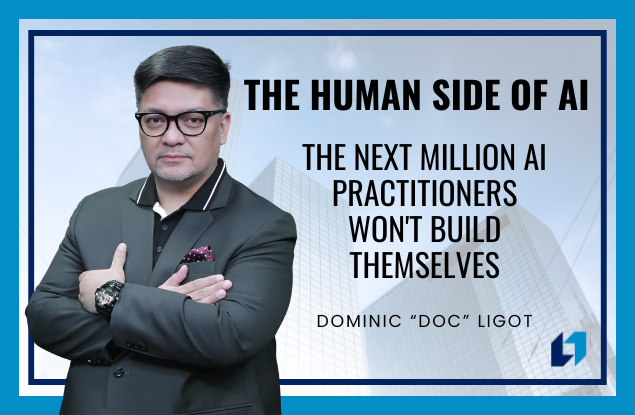
Dominic “Doc” Ligot is one of the leading voices in AI in the Philippines. Doc has been extensively cited in local and global media outlets including The Economist, Channel News Asia, South China Morning Post, Washington Post, and Agence France Presse. His award-winning work has been recognized and published by prestigious organizations such as NASA, Data.org, Digital Public Goods Alliance, the Group on Earth Observations (GEO), the United Nations Development Programme (UNDP), the World Health Organization (WHO), and UNICEF.
If you need guidance or training in maximizing AI for your career or business, reach out to Doc via https://docligot.com.

