

When the internet first disrupted our lives in the late 1990s, Philippine lawmakers scrambled to respond. But instead of strengthening existing frameworks, Congress often preferred to create new, shiny laws that signaled they were “keeping up with the times.” We saw this with the Cybercrime Prevention Act of 2012, a law that tried to legislate every possible online offense in one go, only to create overlaps, ambiguities, and, notoriously, provisions on online libel that have been weaponized against journalists and critics.
Now, with the rise of artificial intelligence (AI), I see the same reflex taking shape. Lawmakers are filing bills for a “Philippine AI Act,” an “AI Bill of Rights,” or similar omnibus proposals. On the surface, this looks bold and visionary. But if history is any guide, we risk making the same mistake: legislating for headlines instead of for coherence.
The truth is that AI does not exist in a legal vacuum. Its impacts are already being felt in privacy, cybercrime, intellectual property, and labor, all areas with long-standing Philippine statutes. What we need is not a brand-new AI code but a sober, systematic updating of the laws we already have.
AI and the Data Privacy Act
Take the Data Privacy Act of 2012 (RA 10173). When it was written, few could have imagined today’s AI models crunching terabytes of personal data, profiling individuals, or making opaque automated decisions. Yet the law already has a framework for protecting personal information. Instead of reinventing the wheel with an “AI Privacy Act,” Congress could amend RA 10173 to:
- Define what “automated decision-making” means in an AI context.
- Guarantee the right to explanation for people affected by algorithmic decisions.
- Require human intervention in high-stakes cases, such as credit scoring or job applications.
The National Privacy Commission has already issued advisories on AI accountability and governance, but without statutory backing, these remain soft guidance. A well-placed amendment could transform them into enforceable rights and obligations.
AI and Cybercrime
The Cybercrime Prevention Act (RA 10175), passed in 2012, is another example. Today, AI enables new forms of online abuse, deepfakes, AI-driven phishing, automated hacking, and algorithmic social engineering. These are not new crimes; they are new methods of committing existing ones like fraud, identity theft, or unauthorized access.
Why write a separate “AI Cybercrime Law”? A simpler, more effective route would be to expand RA 10175’s coverage to explicitly include AI-generated content and malicious autonomous systems. That way, enforcement agencies like the NBI Cybercrime Division won’t need to ask, “Does this fall under our jurisdiction?” The law will already be clear.
AI and Intellectual Property
The Intellectual Property Code has long governed the rights of authors, inventors, and artists. But what happens when AI generates a song, a painting, or even an invention? Current law does not recognize non-human creators, leaving a gray zone where works produced with minimal human input fall through the cracks.
Again, this is not a call for a separate “AI Creativity Act.” Instead, Congress could amend the IP Code to:
- Recognize AI-assisted works and define who owns them.
- Clarify rules on authorship and inventorship when human and AI contributions overlap.
- Provide partial or hybrid protection mechanisms for works generated largely by machines.
Such changes would give clarity to Filipino creators using AI as a tool, ensuring they remain protected rather than sidelined.
AI and Labor
The Labor Code faces perhaps the most urgent AI challenge. Automation threatens to displace workers; algorithmic management risks embedding bias in hiring and firing; workplace surveillance is creeping into more industries. These are pressing issues, but they do not require a separate “AI and Jobs Law.”
Instead, amendments to the Labor Code could:
- Mandate transparency in AI-driven workforce decisions.
- Require human review of hiring and firing recommendations.
- Impose retraining obligations on employers who automate jobs.
- Protect workers from invasive algorithmic surveillance.
In short, AI is reshaping labor rights, but it has not erased the basic principle that workers deserve fairness, dignity, and protection.
The Dangers of Legislating by Headline
So why does Congress keep reaching for new AI bills instead of updating old laws? Part of it is politics. A new “Artificial Intelligence Act” looks good on the news ticker. It signals progressiveness. But beneath the headlines, such laws risk creating:
- Fragmentation, where multiple overlapping statutes confuse regulators and courts.
- Redundancy, where new provisions duplicate what older laws already cover.
- Loopholes, where failure to harmonize laws allows bad actors to slip through cracks.
This is not just inefficient. It undermines the very purpose of legislation, which is to provide clarity and stability.
A Smarter Path Forward
AI is not an alien force that demands a parallel legal universe. It is a powerful amplifier of issues we already face: privacy risks, cybercrime, intellectual property disputes, and labor disruptions. The smarter path forward is to amend and modernize the laws we already have.
By doing so, we achieve three things:
- Legal clarity, by embedding AI into frameworks people and institutions already understand.
- Regulatory efficiency, by empowering existing agencies instead of creating new bureaucracies.
- Future readiness, by showing that our laws are living instruments, adaptable to whatever technology comes next.
Final Thought
The Philippines does not need to legislate AI from scratch. What we need is the humility to admit that our old laws can still serve us well, if we are willing to update them. AI is not the first disruptive technology we’ve faced, and it will not be the last. The real test for Congress is not whether it can pass the next buzzworthy AI bill, but whether it can craft a legal framework that is coherent, adaptable, and built to last.
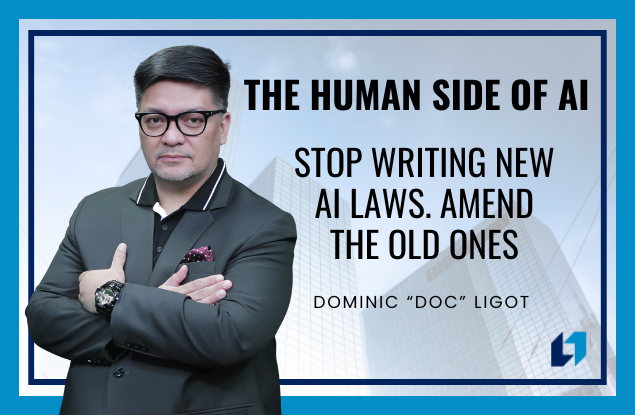
Dominic “Doc” Ligot is one of the leading voices in AI in the Philippines. Doc has been extensively cited in local and global media outlets including The Economist, South China Morning Post, Washington Post, and Agence France Presse. His award-winning work has been recognized and published by prestigious organizations such as NASA, Data.org, Digital Public Goods Alliance, the Group on Earth Observations (GEO), the United Nations Development Programme (UNDP), the World Health Organization (WHO), and UNICEF.
If you need guidance or training in maximizing AI for your career or business, reach out to Doc via https://docligot.com.

