

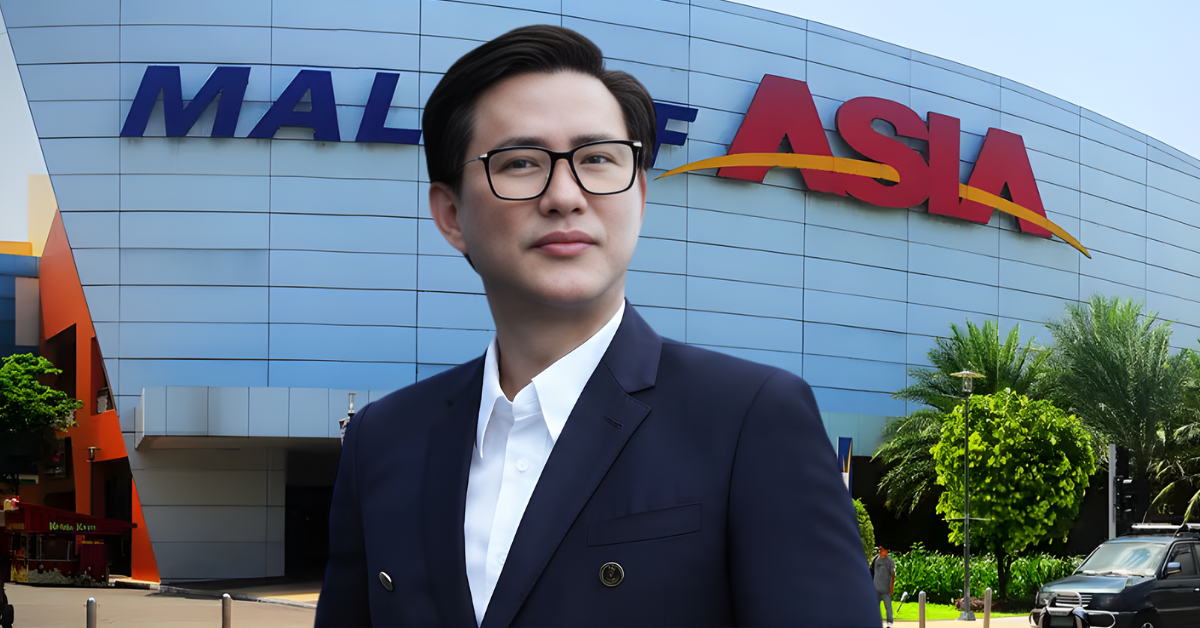
Before Mall of Asia became one of the most recognizable landmarks in the Philippines, it was widely dismissed as an impossible idea. Long before opening day, skepticism surrounded the project—from tenants, industry observers, and even people close to those tasked with bringing it to life.
Steven Tan, now President of SM Supermalls, remembers how deeply the doubt ran in the early days. “There were a lot of challenges, and people were doubtful.”
At the time, SM was already known for some of the country’s biggest malls. That reputation, however, did not shield Mall of Asia from criticism. “You know, how would SM do here in Mall of Asia?”
The doubts were rooted largely in location. When Tan and his team began work, the site was almost entirely undeveloped. “There was nothing around us, it was all cogon grass.” Aside from one familiar landmark, the area offered little reassurance. “There was only the church, and that was the only structure aside from a flat, one-story warehouse-looking office in front.”
Convincing tenants when there was no market—yet
Skepticism intensified when SM began engaging potential tenants. Leasing conversations quickly turned into interrogations. “So when we even showed spaces to tenants, they would ask me, ‘Who’s your market? Where would your market come from?’”
For many retailers, the absence of surrounding development made the project hard to take seriously. Some responses were openly dismissive. “Some tenants even laughed at me, saying, ‘Maybe it’s the fish who would come to your mall.’”
The ridicule underscored how unconventional the project appeared at the time. Mall of Asia was not simply another mall—it was being built ahead of demand, before the area had proven itself.
For Tan, the external skepticism was compounded by internal pressure. He was acutely aware of the scale of responsibility he had been given. “It was a daunting task and I was scared.” The fear was not abstract. The project carried enormous implications for the SM group. “Such a big responsibility was given to me.”
When doubt came from people you knew
Public skepticism was one thing. Hearing doubts from friends made the pressure more personal. “There were a lot of people, even my friends, who would call me and say, ‘Steven, I think you know, that would be the end of SM.’”
Some critics went further, framing the project as an existential threat. “You know, some people even said that it would be the end of the empire.”
For Tan, these comments landed heavily. He understood the stakes. “Of course, you get scared, right?” At that stage, nothing about Mall of Asia was guaranteed. The site was isolated, the scale unprecedented, and the skepticism relentless. “There was a lot of negativity around Mall of Asia back then.”
Staying focused amid noise
Tan’s response to the criticism was not to argue or over-explain. Instead, he narrowed his focus. “But for me, I just focused, stayed focused.”
Rather than reacting to every comment, he anchored himself to a broader conviction. “My guiding lights have always been the Sy family, especially Tatang.”
For Tan, trust in leadership mattered more than public opinion. The scale of commitment from the Sy family carried its own message. “They’ve invested billions of pesos.” That investment served as reassurance during moments of doubt. “Would a wise businessman, the most successful businessman, invest in something that would lose?”
For Tan, the logic was grounding. “That alone, for me, was already guidance.”
Opening day changed the conversation
When Mall of Asia finally opened on May 16, 2006, the narrative shifted overnight. “But we opened it, and on day one, it was swamped with people.”
The scene was overwhelming. “You cannot imagine that day—May 16, 2006.”
What critics had dismissed as impossible quickly proved otherwise. “The whole mall was full of people.”
Restaurants overflowed. “All the restaurants were packed. There were no spaces to eat.”
Customers improvised. “People were buying from the restaurants and eating in the common areas—that’s how successful it was.”
Nearly two decades later, the project’s outcome speaks for itself. “It’s been operating for the past, what, nearly 20 years?”
For Tan, the experience reinforced a hard-earned leadership lesson: transformative projects often attract the loudest doubts before they attract results.
Mall of Asia did not succeed because skepticism disappeared. It succeeded because the people behind it learned how to move forward despite it.

