

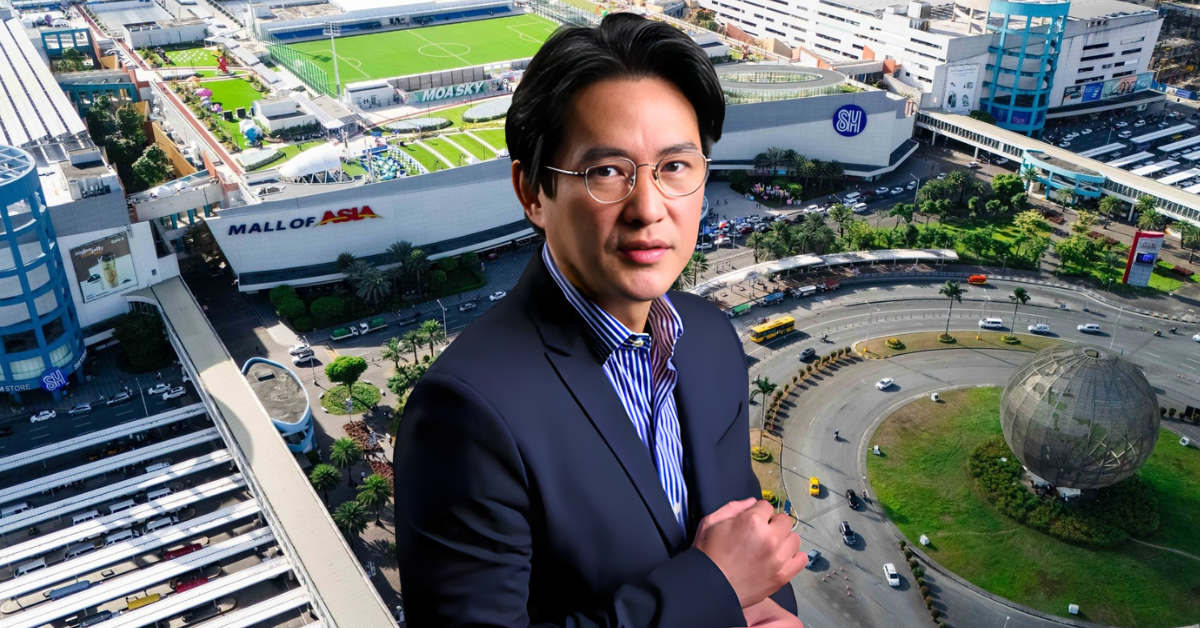
Before Mall of Asia reshaped the Manila Bay skyline, Steven Tan was managing a much smaller operation within SM Supermalls. At the time, he was running Podium, then the smallest mall in the group, far removed from the scale and ambition that would later define his career. “I was the mall manager of Podium, the smallest mall in the SM group at the time,” Tan recalls. “You had big malls like Megamall, North Edsa, and SM Manila during that time. Podium was very small then, and I was running it.” The work was familiar and contained, and he was deeply immersed in the day-to-day realities of managing a compact mall.
That sense of routine changed abruptly in late 2005. After just about a year, Tan was called into the office of Hans Sy. “After a year, in late 2005, Hans Sy called me into his office and said, ‘Okay, we need somebody to open Mall of Asia. Can you open it for us?’” The request was not framed as a discussion. “It wasn’t a question,” Tan says. “It was, ‘Open it for us.’ It wasn’t a choice. It was like, ‘Do it.’” In a single conversation, he went from managing one of SM’s smallest malls to being entrusted with the launch of what would become the largest mall in Asia. “So, I was doing my own thing in that small mall called Podium, and then they asked me to open the biggest mall in Asia.”
The weight of that responsibility was immediate. “It was a daunting task, to be honest,” he admits. Looking back, Tan believes that his willingness to accept the assignment had something to do with where he was in life at the time. “But when you’re young, you don’t think too much. You just go with whatever.” He clarifies that he was not inexperienced, but still early in his leadership journey. “I was in my mid-30s actually.” Instead of spending time questioning the assignment, he chose to move forward. “You just go for it. I don’t know, I just said yes to it and started working on it.”
That decision did not shield him from doubt. “Were there challenges? Of course, there were,” Tan says. “There were a lot of challenges, and people were doubtful.” Much of the skepticism centered on the location itself. “You know, how would SM do here in Mall of Asia?” At the time, the site offered little reassurance. “There was nothing around us,” he recalls. “It was all cogon grass.” Aside from a single church, the area was largely empty. “There was only the church, and that was the only structure aside from a flat, one-story warehouse-looking office in front.”
As Tan began showing the space to potential tenants, the doubts became more explicit. “So when we even showed spaces to tenants, they would ask me, ‘Who’s your market? Where would your market come from?’” Some reactions were blunt and dismissive. “Some tenants even laughed at me, saying, ‘Maybe it’s the fish who would come to your mall.’” The pressure was no longer theoretical. “It was a daunting task and I was scared,” he says. “Such a big responsibility was given to me.”
The skepticism followed him beyond work. “There were a lot of people, even my friends, who would call me and say, ‘Steven, I think that would be the end of SM.’” In some conversations, the doubts escalated even further. “Some people even said that it would be the end of the empire.” For someone still relatively young, carrying the responsibility of a project of that scale, fear was unavoidable. “Of course, you get scared, right?” Tan says.
What kept him grounded was not blind optimism, but trust in the people behind the decision. “There was a lot of negativity around Mall of Asia back then,” he says. “But for me, I just focused. Stayed focused.” His confidence came from years of observing how the Sy family made decisions. “My guiding lights have always been the Sy family, especially Tatang.” The scale of their commitment mattered to him. “They’ve invested billions of pesos,” Tan points out. “Would a wise businessman, the most successful businessman, invest in something that would lose?” For Tan, that question carried its own answer. “That alone, for me, was already guidance.”
Opening Mall of Asia became more than a professional assignment. It was a defining moment that tested leadership under uncertainty, where conviction had to outweigh fear and trust had to substitute for certainty. Tan’s experience reflects a reality faced by many leaders: sometimes growth does not come through gradual steps, but through being entrusted with something far larger than what one has handled before—and choosing to move forward anyway.
This article includes quotes from an interview originally published by Esquire Philippines, authored by Henry Ong.

