

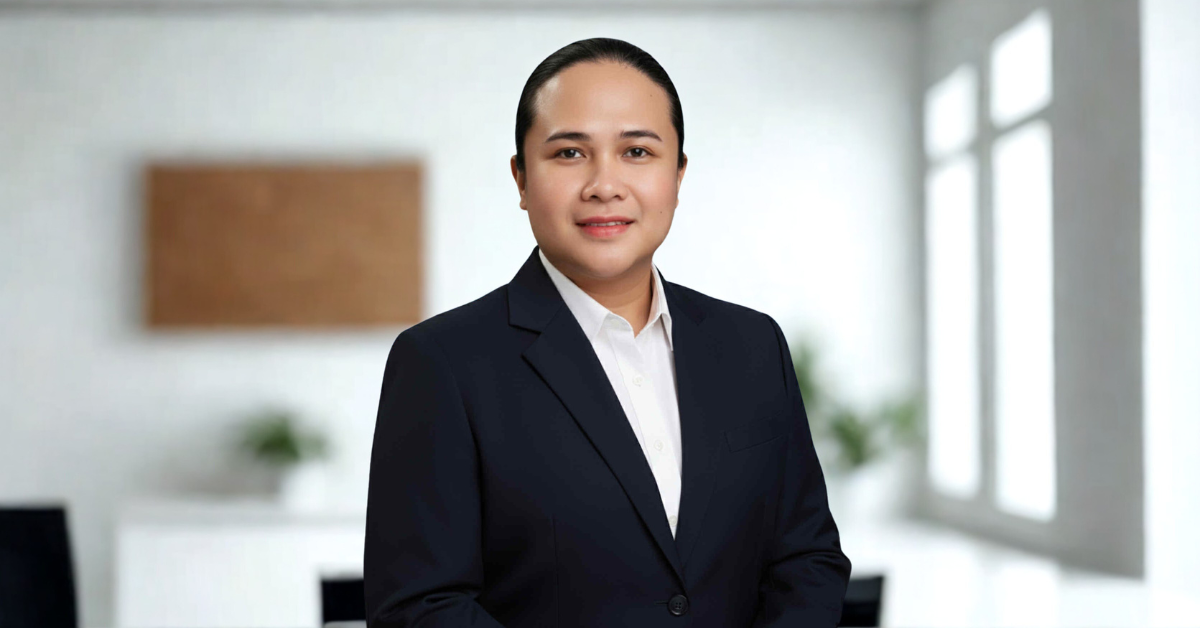
For this management consultant, credibility was never built on titles alone—it was earned through years of disciplined work across education, research, and institutional leadership.
Emerson Cabudol, Certified Management Consultant (CMC®) began his professional journey in academia, not in boardrooms or consulting firms. His early career unfolded inside universities, where he served as a business and management educator and later took on leadership roles that addressed institutional challenges far beyond the classroom.
“I began my career in academia as a business and management educator, then transitioned into roles that involved addressing institutional challenges in curriculum, research, quality assurance, and community engagement,” Cabudol shared.
Working closely with universities in the Philippines, the Middle East, and the United States, he found himself increasingly called upon not just to teach—but to advise. Institutions sought his guidance on program design, quality management, and research capability building, areas where academic rigor met operational reality.
“As I worked with universities in the Philippines, the Middle East, and the US, I was increasingly called upon to advise on program design, quality management, and research capability building,” he said. “That advisory work naturally evolved into formal management consulting, especially in higher education and organizational development.”
His consulting practice would eventually be shaped by the environments he knew best. Cabudol’s work has been rooted primarily in higher education, research and development, and ethics and quality assurance, spanning institutions in the Philippines, the UAE, Bahrain, and the US. These settings demanded more than theoretical solutions.
“These environments taught me to balance academic rigor with real-world practicality,” he explained. “To work within regulatory frameworks like CHED and accreditation bodies, and to design solutions that are sustainable, ethical, and data-driven.”
That balance—between structure and flexibility, compliance and creativity—became a defining feature of his consulting approach.
Cabudol credits much of his readiness for consulting to years spent in roles that required critical inquiry and evidence-based leadership. Leading research projects, heading community engagement offices, serving on ethics review boards, and chairing theses and dissertations trained him to approach problems methodically.
“These roles trained me to diagnose problems, ask the right questions, and guide teams to evidence-based decisions,” he said.
His work as an author also sharpened a key consulting skill: translation. “Authoring textbooks and training materials in financial management and capital markets sharpened my ability to simplify complex concepts for decision-makers,” Cabudol noted—an ability that remains essential when advising leaders with varying technical backgrounds.
Looking at the consulting industry today, Cabudol sees a clear shift in expectations. “Consulting is becoming more data-informed, ethics-conscious, and interdisciplinary,” he observed.
In the Philippine context, this evolution is especially pronounced. “There is a growing demand for consultants who can bridge global best practices with local realities, especially in education, government, and SMEs,” he said.
Globally, technological change is reshaping how value is delivered. “AI, digital transformation, and responsible innovation—areas reinforced by my CHED Husay–Wharton training in accountable AI—are reshaping how consultants deliver value.”
Despite these changes, Cabudol believes the fundamentals remain unchanged. “Successful consultants combine technical expertise with integrity, humility, and the ability to listen,” he emphasized. “They co-create solutions with clients rather than impose them.”
This philosophy carries into his leadership style, which he describes as facilitative and developmental. “I aim to create an environment where people feel safe to share ideas, challenge assumptions, and grow,” he said.
In consulting engagements, this means focusing on capability transfer—not dependency. “I don’t just deliver recommendations; I mentor clients and teams so they can own and sustain the changes long after the engagement ends.”
Managing consulting projects in academic and institutional settings comes with its own challenges. “A recurring challenge is aligning diverse stakeholders—administrators, faculty, staff, and regulators—who have different priorities,” Cabudol acknowledged.
His response is deliberate and structured. “I address this by clarifying shared goals early, using data to depersonalize issues, and setting clear roles, timelines, and communication channels,” he explained. “Patience and transparency are essential when navigating academic and institutional politics.”
One project illustrates this approach in action. In a higher education institution undergoing curriculum reform, Cabudol led the revision and review of business courses to meet international standards and accreditation requirements.
“Engaging faculty in the design process, integrating research and ethics components, and grounding decisions in evidence, we not only improved curriculum quality but also strengthened faculty ownership and readiness for external evaluation,” he shared.
For those aspiring to enter consulting, Cabudol offers grounded advice. “Listen more than you speak, clarify expectations early, and never overpromise,” he said. “Treat every engagement as a partnership, not a transaction.”
Balancing technical expertise with people management remains central to his practice. “I start with the technical work—data, frameworks, and analysis—but always translate it into language and processes that people can relate to,” he explained. “Tools and models are only effective if people understand and trust them.”
His decision to pursue the Certified Management Consultant (CMC®) designation reflected this same commitment to professionalism. “I wanted my practice to be anchored not only in experience, but also in a globally recognized standard of competence and ethics,” Cabudol said.
Preparing for certification required reflection as much as documentation. “The most challenging part was distilling years of diverse experience—academic leadership, research, curriculum design, and advisory work—into concise, evidence-based case examples.”
Since earning the credential, the impact has been tangible. “It has enhanced my credibility with institutional leaders, regulators, and international partners,” he said, complementing roles such as CHED Husay scholar in AI at Wharton and dissertation chair at Westcliff University.
For consultants considering the same path, his message is clear and principled: “If you are serious about consulting as a profession, not just an activity, pursue the CMC®.”
“It is both a credential and a commitment—to your clients, to society, and to your own continuous development.”

