

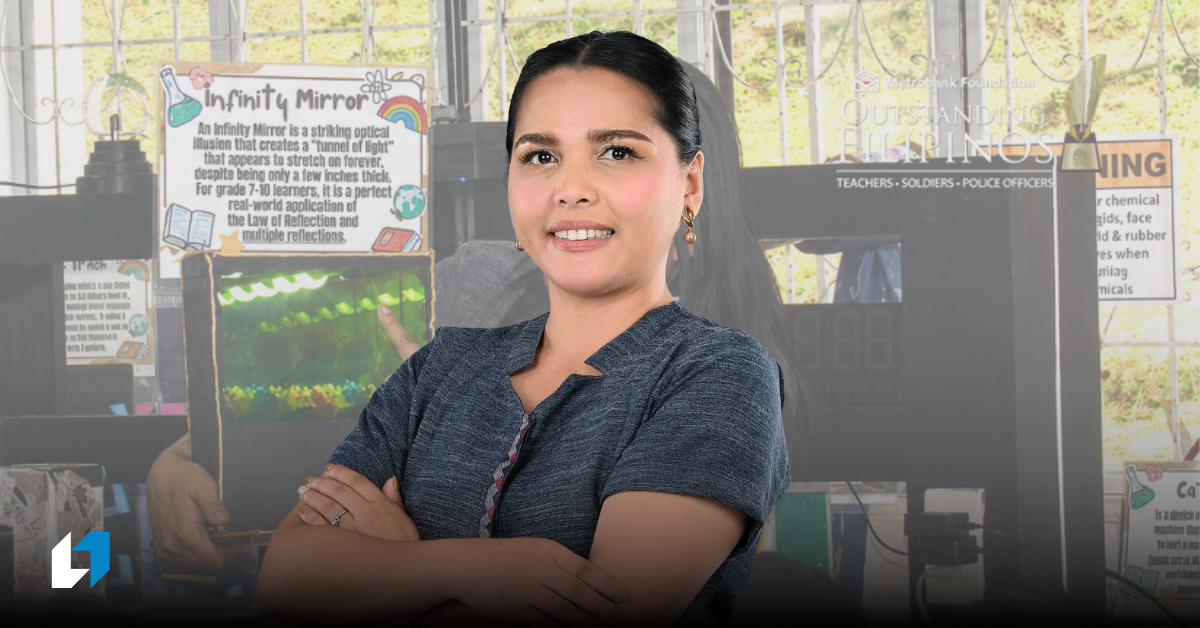
Sheila Amigo never planned to become a teacher. Trained in Electrical Engineering Technology and Electrical Engineering, she became a licensed engineer in 2012 and appeared headed for a career far removed from the classroom.
But when circumstances brought her to Siay, Zamboanga Sibugay, a part-time teaching opportunity changed the direction of her career.
“When we decided to stay for good here in Siay, I first worked at the local electric cooperative, on a project-based setup. Not long after, naging part-time instructor ako sa WMSU–ESU Siay, and that’s when I realized I actually felt more at home teaching than doing fieldwork,” she recalls.
Encouraged by her husband’s cousin, a school principal who told her that Physics teachers were badly needed, Amigo completed a Certificate in Professional Education. When a Physics teaching position opened at Siay National High School, she took the board examination in Physical Science, passed and eventually earned a place in the school.
Eleven years later, Amigo is one of the 2026 Metrobank Foundation Outstanding Filipinos, an honor that recognizes educators, soldiers and police officers whose work has made an exceptional contribution to their professions and communities.
For Amigo, the path to that recognition began with a problem familiar to many teachers: how do you make students want to learn something they have already decided is too difficult?
Turning Physics into play
Early in her teaching career, Amigo found herself handling classes of more than 50 students. Many already struggled with Mathematics and regarded Physics as another subject to endure rather than understand.
Instead of accepting their resistance, she began experimenting with different ways of teaching.
“I tried different strategies, asked mentors for guidance, and kept adjusting until I found what worked,” she says.
Those experiments eventually developed into DULA, or Dynamic Utilization of Learning by Amusement, an approach that uses games, toys, do-it-yourself materials and traditional Filipino games to explain Physics concepts.
“‘Dula’ means play, so the idea is to make Physics fun sa pamamagitan ng laro, toys, DIY realia, at traditional Larong Pinoy — mga relatable at playful scenarios na madali nilang maintindihan at ma-enjoy,” she explains.
The change was noticeable. Students who once dreaded Physics began participating.
But DULA also allowed Amigo to discover something that conventional examinations did not always reveal. Students who performed poorly in written tests sometimes excelled when asked to create something.
“Nakakagulat, kasi minsan yung mga estudyanteng mahina sa exams ang siya pa palang pinaka-creative sa outputs. Doon ko nakikita ang multiple intelligences nila,” she says.
She challenged students to create projects from recyclable materials, which taught resourcefulness while reducing costs. Some sought help from their parents, turning school assignments into opportunities for families to work together. Fast learners, meanwhile, were encouraged to think like young researchers and identify problems in the school or community that they could help solve.
What started as a classroom technique is now becoming something larger. Amigo hopes to establish the DULA Eco Haven, a community learning space where children and families can learn, play and spend time together. The project has already received budget approval from a barangay.
She is also developing a DULA workbook that can be used not only by regular students but also by learners under blended and modular arrangements, the Alternative Learning System and even out-of-school youth.
“My goal is to reach every child who wants to learn, kahit pa sila’y wala sa loob ng regular classroom,” she says.
More than a Physics teacher
Yet some of Amigo’s most important lessons as an educator have taken place outside Physics class.
Over the years, she encountered students struggling with anxiety, depression, smoking, drug abuse and the loss of loved ones. One student had to face the police without a parent present, so Amigo accompanied the learner herself.
Other students came to her with problems involving relationships, puberty and the difficult transition through adolescence. Some were students whom other teachers found difficult to handle.
“With each one of them, hindi ko naisip kung ano lang ang trabaho ko bilang guro. What I thought about was, they needed someone na makakasandalan,” she says.
Those experiences changed her understanding of what it means to teach.
“That’s when I really realized na ang pagtuturo ay hindi lang tungkol sa silid-aralan o sa Physics — sometimes, you also need to become a protector, a parent, and a friend to your students.”
That commitment has sometimes required sacrifices of her own. With limited school resources, Amigo has personally paid for materials used in DULA and helped finance the research projects of some of her student innovators. Weekends have also been spent at school working on research and environmental activities.
Still, she does not describe these simply as sacrifices.
“I’ve come to see them as simply part of what this profession asks of you — hindi lang ito trabaho, kundi bokasyon.”
The engineer never disappeared
Amigo acknowledges that her life might have been financially different had she remained in engineering.
“Totoo na maaaring mas mataas ang kikitain ko kung nanatili ako sa larangan ng engineering, pero I’ve never regretted choosing this path, kasi mas fulfilled ako sa pag-hubog ng aking mga learners kaysa sa anumang halaga na maaaring kitain,” she says.
Yet becoming a teacher did not mean abandoning what she learned as an engineer.
Instead, engineering became one of her advantages in the classroom.
“Yung analytical thinking, problem-solving, at disiplinang natutunan ko bilang engineer, silang mismo ang naging susi para lumikha ako ng mga innovation tulad ng DULA,” she says.
In that sense, Amigo’s two careers were never completely separate.
Engineering taught her to look at a problem, understand why something was not working and search for a better solution. Teaching gave her a place to apply that mindset to people.
When students were afraid of Physics, she redesigned the way they encountered it. When conventional tests failed to reveal what some students could do, she created other ways for them to demonstrate their abilities. When limited resources became a constraint, she turned to recyclable and readily available materials.
And when students faced problems that could not be solved by a Physics equation, she found another role for herself.
An award shared with others
For Amigo, being named among the Metrobank Foundation Outstanding Filipinos is therefore not simply recognition of an individual career.
She sees the award as something shared by the students, parents, stakeholders, educational leaders and family members who supported her work.
“This award isn’t just for me — ito ay para sa bawat learner na naniwala sa akin, sa aking pamilyang sumuporta sa bawat hakbang, sa mga magulang at stakeholders na hindi nagsawang tumulong, at higit sa lahat, sa Diyos na patuloy na gumagabay sa akin sa bawat desisyon,” she says.
Her ambitions have not ended with the recognition. She wants DULA to reach more learners, complete the DULA Eco Haven and publish the workbook she hopes can bring her approach beyond the students she personally teaches.
She also wants to remain the kind of teacher students can approach when what they need cannot be found in a textbook.
Looking back, the career she never expected has become the one in which she found her purpose.
“After all these years, alam kong tama ang napili kong landas,” Amigo says.
Perhaps the engineer in her never really left. She simply found a different kind of problem to solve — how to help young people learn, discover what they can do and believe that their circumstances do not have to define what they can become.

