

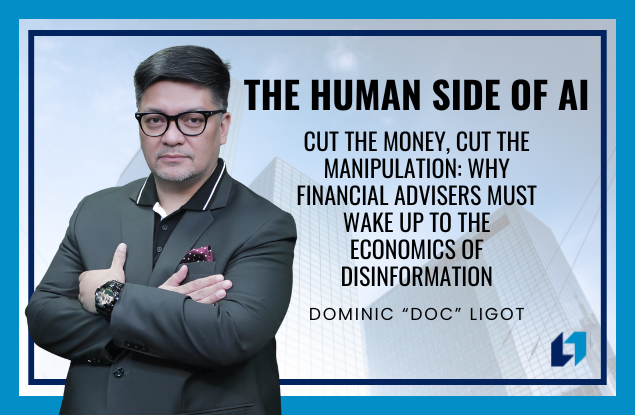
Every financial adviser understands one universal truth: follow the money if you want to understand the real risk. And in the fight against online deception, that principle is more relevant than ever.
The conversation around fake news often focuses on content, identifying falsehoods, debunking claims, or policing individual posts. But as I recently pointed out our testimony in the House Committee on Public Information, the core threat isn’t the random meme or the misinformed citizen. It’s organized, paid, and technology-enabled disinformation, a full-fledged industry that behaves like any other business sector, complete with budgets, payroll, and ROI.
And make no mistake: this industry is massive, well-funded, and extremely dangerous.
We like to believe AI detectors and fact-checking tools can keep us safe. But with only 60% accuracy, even the best AI detection tools are losing the arms race. Meanwhile, disinformation networks are evolving rapidly, deploying AI, microtargeting, and professional copywriting to shape public behavior at scale.
This isn’t theory. Organized disinformation fueled vaccine hesitancy, skewed elections in India and Indonesia, inflamed ethnic violence in Myanmar, and arguably distorted political outcomes in the Philippines. These aren’t isolated incidents, they’re coordinated influence operations powered by money.
And this is where the financial sector becomes central.
As we emphasized, organized disinformation leaves a financial footprint. Someone pays for the ads. Someone funds the troll farms. Someone bankrolls the websites and bot networks. These flows move through banks, e-wallets, ad platforms, and digital service providers. Where there is funding, there is traceability, and where there is traceability, there is potential accountability.
For financial advisers, this is not simply a political or regulatory concern. It is a stability concern.
Disinformation can distort markets just as easily as it distorts elections. It can trigger panic-selling, undermine trust in institutions, amplify economic fear narratives, and mislead clients about real risks. A population fed by engineered falsehoods becomes a volatile economic actor.
Which is why advisers must expand their role, not only as wealth managers, but as navigators of information risk.
Clients need more than portfolio guidance. They need help discerning credible signals from engineered noise. They need advisers who understand that truth has become an economic variable.
If “cutting the money flow” is the key to killing the disinformation beast, then financial professionals have a front-row seat, and a frontline responsibility.
Because safeguarding financial well-being today requires more than protecting assets. It requires protecting the information ecosystem that shapes how Filipinos think, act, and invest.
Dominic “Doc” Ligot is one of the leading voices in AI in the Philippines. Doc has been extensively cited in local and global media outlets including The Economist, South China Morning Post, Washington Post, and Agence France Presse. His award-winning work has been recognized and published by prestigious organizations such as NASA, Data.org, Digital Public Goods Alliance, the Group on Earth Observations (GEO), the United Nations Development Programme (UNDP), the World Health Organization (WHO), and UNICEF.
If you need guidance or training in maximizing AI for your career or business, reach out to Doc via https://docligot.com.

