

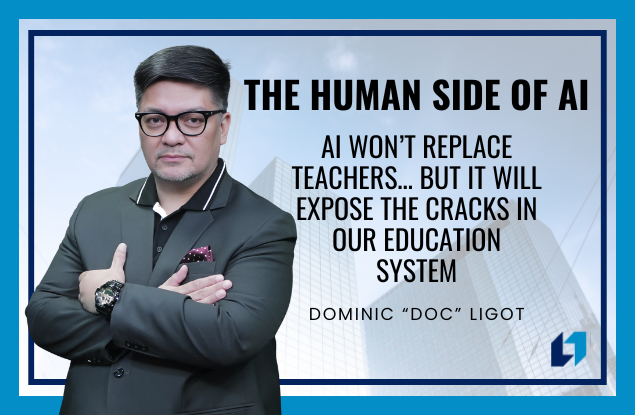
In the race to adopt AI, the loudest conversations tend to focus on builders, the coders, engineers, and developers who write the algorithms. But as the testimony above reminds us, this narrow view of AI is dangerously outdated. The real transformation is happening across every discipline, every profession, and every classroom. And the Philippines is not prepared.
For Filipino financial advisers, this matters more than it seems. The clients we serve tomorrow will come from an education system that is already struggling to keep pace with technological change. If that system falls further behind, our economy, and our talent pipeline, will suffer.
The bigger problem? We are not producing the teachers who can produce the workforce.
Everyone is talking about upskilling employees, but almost no one is talking about upskilling educators. Universities still offer curriculums built for the dial-up era: computer science, computer engineering, programs that barely scratch the surface of today’s AI landscape. Meanwhile, psychology, accountancy, business, healthcare, and even the humanities urgently need their own AI-integrated modules. This is no longer optional; it’s foundational.
And yet, who will teach these courses?
As the testimony bluntly states, “Some of us have to come back to school and teach.” The cutting edge of AI isn’t happening in academia, it’s happening in the workplace. The people with the knowledge are practitioners, not professors. But the path for these industry experts to enter classrooms is narrow, financially unattractive, and structurally inconvenient.
This gap is not merely academic, it is economic.
An undertrained teaching workforce produces an underprepared generation. That generation becomes a workforce that struggles to adapt. And as financial advisers, we will be the ones dealing with clients whose skills, and earning potential, did not keep pace with technological shifts.
So what do we do?
Government must invest in mass teacher training programs, not just student innovation labs. Schools must open their doors to industry experts, flexible contracts, competitive rates, hybrid teaching models, and micro-certifications for practitioners willing to teach part-time. And industry leaders, including those of us advising on wealth and strategy, must recognize that contributing to education is no longer charity, it’s economic self-preservation.
If we want a workforce ready for an AI-driven world, we must first build an education system ready to teach it. The next generation of Filipino talent will not emerge by accident. It will emerge because the people who understand the future, especially those already working in it, return to the classroom and help build it.
The question isn’t whether AI will change our industries. The question is whether we will produce the teachers capable of preparing Filipinos for that change.
Dominic “Doc” Ligot is one of the leading voices in AI in the Philippines. Doc has been extensively cited in local and global media outlets including The Economist, South China Morning Post, Washington Post, and Agence France Presse. His award-winning work has been recognized and published by prestigious organizations such as NASA, Data.org, Digital Public Goods Alliance, the Group on Earth Observations (GEO), the United Nations Development Programme (UNDP), the World Health Organization (WHO), and UNICEF.
If you need guidance or training in maximizing AI for your career or business, reach out to Doc via https://docligot.com.

