

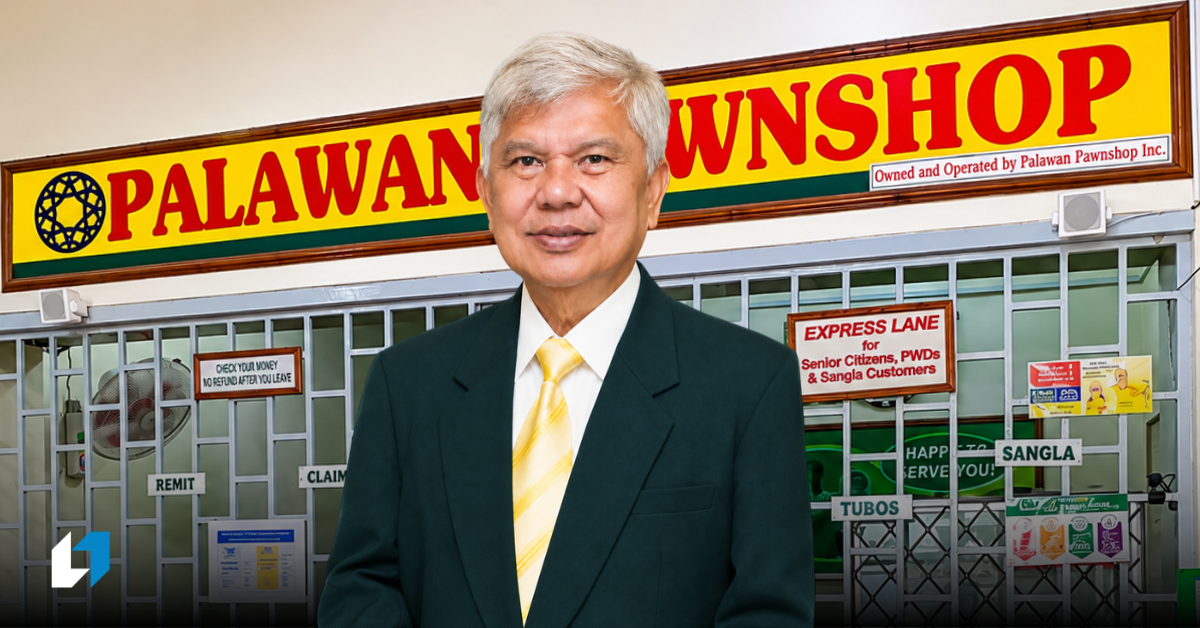
Bobby Castro built Palawan Pawnshop into one of the country’s most recognizable financial services businesses. But his understanding of the pawnshop industry began not as an entrepreneur, but as a young boy accompanying his mother whenever their family ran short of money.
Growing up in Marikina with seven siblings, Castro witnessed how his mother would pawn her jewelry just to buy groceries before the next payday. Those visits left him with an understanding of how important access to emergency cash could be for ordinary families.
Years later, when he encountered an opportunity to take over a struggling pawnshop in Palawan, Castro saw something that others might have overlooked. Although the business was losing money and the industry suffered from a poor reputation, he knew from personal experience that people needed its services.
His father questioned why he wanted to enter a business associated with taking advantage of financially distressed customers. But Castro believed that pawnshops could be operated differently, with transparency and fair treatment at the center of the business.
That conviction eventually became the foundation of Palawan Pawnshop, transforming a service his mother once depended on into a business that would serve customers facing similar financial needs.
Growing up with financial difficulties
Castro grew up in Marikina, where his parents raised eight children. With so many family members to support, managing household expenses was not always easy.
He remembers how his mother sometimes had to pawn her jewelry to buy groceries while waiting for the next payday.
“Dati taga Marikina kami. Yung mother ko, kung tingnan ko nga ngayon, ang alahas niya eh, napakababang uri, eh walo kaming magkakapatid. So before dumating ulit yung next payday, nagsasangla siya, kasama ako. Pag makakuha siya ng pera, makakabili na kami ng groceries.”
For Castro, these visits provided an early understanding of why people borrowed money against personal belongings.
His mother was not pawning jewelry to finance unnecessary spending. She needed cash to cover ordinary household expenses.
The family had an income, but there were times when money ran short before the next payday.
This is a common financial problem among households whose expenses do not always coincide with the timing of their income.
Even families with regular earnings can experience temporary cash shortages when unexpected expenses arise or when their available savings are insufficient.
Pawnshops help address this problem by providing short-term loans secured by personal property.
Unlike conventional bank loans, pawnshop transactions generally do not require borrowers to demonstrate a lengthy credit history or provide extensive financial documentation.
For customers who need relatively small amounts of money quickly, this can make pawnshops a practical source of financing.
Castro understood this need because he had witnessed it within his own family.
From student activism to helping his family
Before becoming an entrepreneur, Castro had been involved in student activism.
He met his future wife while they were classmates at Philippine Science High School.
They later studied at the University of the Philippines, where Castro pursued engineering and his wife studied chemistry.
Both became involved in the student movement during a period of widespread political activism.
“Kaming mag-asawa nagkita kami sa school,” he says. “Classmates kami sa Philippine Science High School, and then, sa UP ako, Engineering. Yung wife ko, Chemistry, pero we were both activists before sa UP. And sa UP noon, most of my classmates, pati mga students and teachers were activists.”
Castro recalls that his involvement in activism was motivated by a desire to bring about change in society.
“Sabi ko kasi there are many ways of helping the country. Kasi the reason naging aktibista ako is because I wanted change ‘no? And hindi ko nakikita yung change sa some peaceful means kaya sabi ko kailangan ng radical change para kailangan may mangyari.”
His life eventually took a different direction. After his release, Castro decided to return to Palawan to help his father support the family.
His mother had died, leaving his father with the responsibility of providing for their children.
“And then, nung na-release ako, sinabi ko sa mga kasama ko na uwi na akong Palawan and I will help my father. Noong 1979, umuwi na ako kasi my mother died din. So, kaming dalawa lang ng father ko ang nag tulong-tulong para mapa-aral mga yung mga kapatid ko.”
The decision marked an important transition in Castro’s life. Instead of continuing along the path he had pursued as a student activist, he focused on helping his father provide for his younger siblings.
The responsibilities of supporting a large family also reinforced his understanding of the financial pressures faced by ordinary households.
These experiences would later become relevant when he encountered an opportunity to enter the pawnshop business.
Recognizing a business opportunity in Palawan
When Castro returned to Palawan, he noticed that the local pawnshop market was very limited.
There was only one pawnshop operating in the area, and the business was losing money.
For many prospective entrepreneurs, an unsuccessful business might have suggested that the market was unattractive.
But Castro drew a different conclusion. He knew from his childhood experience that pawnshops provided a service people genuinely needed.
He also believed that the existing business had failed because of poor management rather than a lack of demand.
“My mother used to sangla pagkagipit. So nakita ko dito sa Quiapo na ‘oh kailangan talaga ito pero sa Palawan isa lang yung pawnshop tapos lugi.’ Because sa tingin ko na mis-manage nila, hindi nila napansin. Hindi nila binigyan ng atensyon itong negosyo nila kaya na nalugi.”
A company may lose money because customers do not want its products or services. In such cases, improving management may not be enough to make the business profitable.
But a company may also fail because it is poorly operated, lacks sufficient capital or does not serve customers effectively.
When the underlying demand remains strong, better management can potentially transform a struggling business.
Castro believed the pawnshop in Palawan belonged to the second category.
He had already seen how pawnshops helped his mother obtain money during difficult periods.
That experience gave him confidence that the service could be useful to other families facing similar financial pressures.
Why his father questioned the business
When Castro learned that the struggling pawnshop was available for acquisition, he approached his father. By then, he had accumulated approximately ₱40,000 in personal funds.
He asked whether his father wanted to acquire the business for the family or allow him to pursue it independently.
His father was skeptical. “Sabi ko sa tatay ko, ‘Dad, may in-offer satin na pawnshop, gusto mo ba sa family? O pwede bang akin na lang?’ Kasi meron na akong pera noon, mga P40,000. Hindi pa maganda yung reputation ng pawnshop noon eh? So sabi ng tatay ko, ‘Bakit ka papasok dyan?’ Sabi ko, ‘wala namang masama, nakakatulong ka naman sa mga nangangailangan’.”
His father’s reaction reflected the negative perception surrounding pawnshops at the time. Customers who pawned jewelry were often financially vulnerable because they needed money urgently.
This created opportunities for unscrupulous operators to take advantage of borrowers who had limited alternatives.
Castro understood why his father was concerned, but he believed the problem was not necessarily the nature of the business. It was how some operators treated their customers.
For Castro, providing loans against jewelry and other personal belongings was a legitimate service, particularly when customers needed money for essential expenses.
His own mother had depended on such transactions. He therefore saw an opportunity to operate a pawnshop without engaging in practices that had damaged the industry’s reputation.
Building trust in a business with a poor reputation
Castro recalls that pawnshops were sometimes associated with dishonest practices, including reducing the value of pledged jewelry or charging customers more than they should.
“Kasi nakita na rin niya na yung reputation ng pawnshop noon eh. Parang pag nagsangla ka, babawasan yung alahas mo tapos i-overcharge ka, ganon. Pero syempre, hindi natin ginawa yun. So, we were really transparent.”
His emphasis on transparency was particularly important because pawnshop customers must entrust their personal belongings to the lender.
Unlike an ordinary retail transaction, where customers receive a product in exchange for payment, a pawnshop transaction requires borrowers to surrender possession of an asset they hope to recover later.
Customers must therefore trust that the pawnshop will properly safeguard their belongings, accurately record the transaction and honor the agreed redemption terms.
When customers believe that an operator may undervalue their jewelry or impose unexpected charges, they may hesitate to use the service even when they urgently need cash.
Transparency can help reduce that uncertainty.
For a pawnshop, clearly explaining loan amounts, interest charges, redemption periods and other conditions can make customers more confident about entering into a transaction.
The value of this approach extends beyond customer satisfaction. Trust can influence whether customers return when they need another loan and whether they recommend the business to relatives and friends.
In communities where personal recommendations carry considerable weight, a reputation for fair dealing can become an important competitive advantage.
Castro recognized that an industry with a poor reputation could still offer a business opportunity if customers were given a reason to trust a new operator.
Understanding customers before building the business
One of the most interesting aspects of Castro’s entrepreneurial journey is that his business idea did not originate from a formal market study.
It came from his own experience as a child. He had accompanied his mother to pawnshops and understood the circumstances that led families to borrow small amounts of money.
That experience helped him recognize demand that might not have been obvious from the financial performance of the struggling pawnshop in Palawan.
The existing operator was losing money, but Castro believed the business still served an important need.
This shows the difference between understanding a market and understanding the customers within that market.
Financial statements can show whether a business is profitable, but they do not always explain why customers use a particular service or what problems they encounter.
Entrepreneurs who understand their customers’ circumstances can sometimes identify opportunities that are overlooked by competitors.
For Castro, the opportunity was not simply to operate another pawnshop.
It was to provide a financial service that people needed while addressing the mistrust associated with the industry.
His personal experience also influenced how he viewed borrowers. He understood that customers who pawned their belongings were not necessarily irresponsible with money.
Some were ordinary working families experiencing temporary shortages of cash. His mother had been one of them.
Turning personal experience into a business advantage
Castro’s decision to enter the pawnshop industry demonstrates how personal experiences can shape entrepreneurial judgment.
His childhood taught him that access to small amounts of emergency cash could make a meaningful difference to families struggling between paydays.
His experience in student activism reflected his desire to contribute to social change, while his decision to return to Palawan placed him in a position to help support his own family.
When he encountered a struggling pawnshop, he recognized a service that had been useful to his mother despite the industry’s negative reputation.
He believed the business could be operated differently, with greater transparency and respect for customers.
This understanding gave him a reason to pursue an opportunity that his father initially questioned.
For aspiring entrepreneurs, his experience offers an important lesson about identifying business opportunities.
Many entrepreneurs begin by searching for products they can sell or industries that appear profitable.
But another approach is to examine the difficulties people encounter in their everyday lives.
A recurring problem can indicate demand for a product or service, particularly when existing providers are failing to satisfy customers.
However, recognizing a problem is only the beginning.
Entrepreneurs must still determine whether they can provide a solution at a cost customers can afford while generating enough revenue to sustain the business.
In Castro’s case, his understanding of customers helped him recognize the opportunity, while his commitment to transparency provided a basis for distinguishing his business from operators with poor reputations.

