

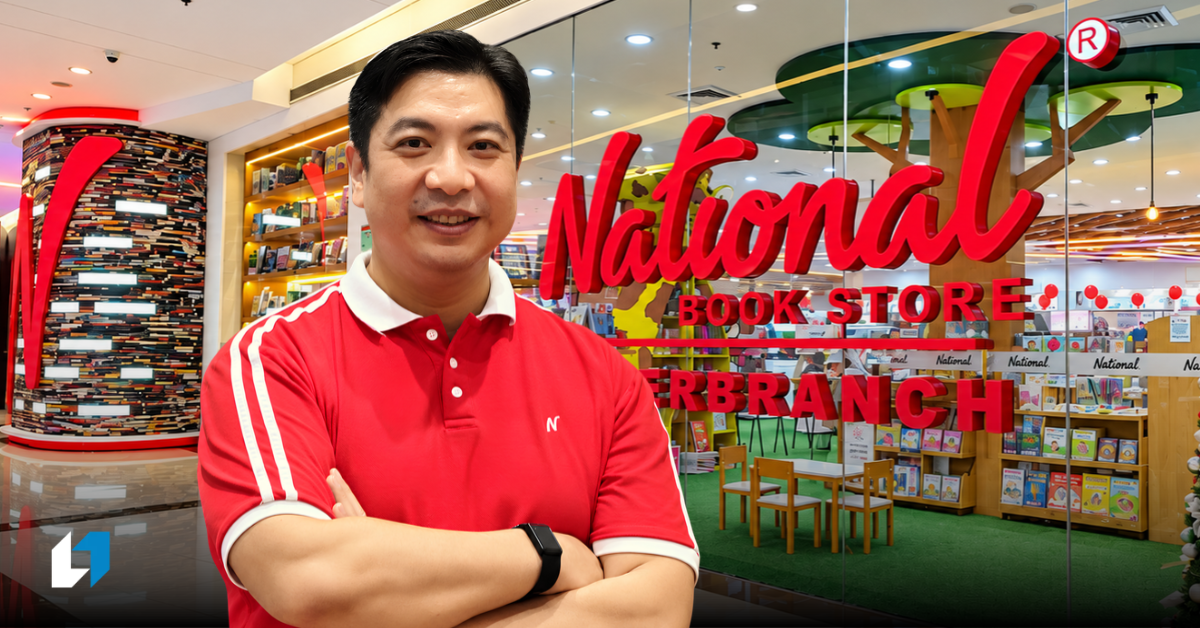
For generations of Filipinos, a trip to National Book Store meant buying textbooks, notebooks, pens, and other school supplies. Parents brought their children before the start of classes, students browsed the shelves after school, and office workers stopped by to purchase everyday essentials.
But as more consumers turn to online shopping and digital entertainment, Adrian Ramos, CEO of National Book Store, believes the country’s iconic bookstore chain needs to give customers more reasons to visit its physical branches.
Rather than simply modernizing the appearance of its stores, Ramos wants to transform National Book Store into a destination where people can spend time, discover new interests, and enjoy experiences beyond shopping.
“Our customers’ needs are changing faster than ever,” Ramos said in an interview with Financial Adviser.
“We’re making that shift from being purely transactional to experiential retail. It’s a transformation rolling out across the different touchpoints we have: our stores, our e-commerce platforms, our different events and campaigns.”
The transformation represents a significant undertaking for a retailer that has operated since 1942 and now has more than 260 branches nationwide.
For Ramos, the challenge is to modernize a familiar Filipino brand while preserving the accessibility and customer relationships that have sustained National Book Store for more than eight decades.
Why National Book Store needs to change
Ramos became CEO in late 2019, shortly before the COVID-19 pandemic disrupted the retail industry.
The pandemic accelerated changes in consumer behavior as schools shifted to remote learning, employees worked from home, and households became more dependent on digital technology.
These developments affected how consumers purchased books, school supplies, and office essentials.
However, Ramos has also observed an interesting shift among younger consumers.
“At the same time, we’re seeing younger generations expressing this renewed desire for screen-free moments, physical media, and hands-on creative spaces,” he said.
This has influenced how National Book Store approaches its physical branches.
Instead of competing with online retailers solely through product selection and convenience, the company wants to offer experiences that customers cannot easily replicate through a digital platform.
Ramos believes physical stores can remain relevant if they become places where customers enjoy spending time rather than simply completing purchases.
The strategy builds on a familiar aspect of National Book Store’s history.
“National Book Store has always been an after-school tambayan for students, a post-shift or lunch break pitstop for office workers, and a weekend destination for Filipino families,” he said.
“Today, that kind of venue is described as a ‘third space’ – that’s exactly what we want to be.”
A third space refers to a place outside the home and workplace or school where people can gather, relax, and interact.
For National Book Store, this means developing stores that encourage customers to browse, read, participate in activities, and spend time with family and friends.
Turning bookstores into destinations
One example of this strategy is National Book Store’s recently opened Festival Mall Superbranch.
Unlike traditional branches designed primarily around merchandise displays, the store incorporates areas where customers can spend time without necessarily making an immediate purchase.
Ramos said the branch introduced an Open Shelf concept that allows customers to read selected books for free.
“They’re welcome to browse a few pages as they drink coffee from Toby’s Estate, relax on the benches around our books section, or get fresh air and enjoy the view of the River Garden in the al fresco area,” he said.
The concept reflects the company’s ambition to make its stores more inviting and encourage customers to stay longer.
National Book Store is also introducing improvements across other branches, including brighter lighting, updated layouts, redesigned racks and shelves, and visually appealing book displays.
Even smaller branches are receiving upgrades appropriate to their locations and customer markets.
“But in our other new and existing branches, we’re constantly making improvements to the lighting, the layout, the racks and shelves, and the selfie-worthy book walls,” Ramos said.
“All these changes build up to refreshing what the National Book Store experience is like for our customers across the country.”
From a retail perspective, creating a more engaging store environment can provide several advantages.
Customers who spend more time inside a branch may discover products they did not originally intend to purchase. Attractive spaces can also encourage repeat visits and help distinguish physical retailers from online competitors.
However, the strategy also requires additional investment in store design, facilities, and customer experiences.
For National Book Store, the challenge is determining which improvements can generate sufficient customer interest to justify their cost.
Why one store format is no longer enough
As National Book Store transforms its retail operations, Ramos has also introduced different store formats to serve distinct customer needs.
The company’s flagship format, National Book Store Superbranch, provides its most extensive and experiential retail environment.
These larger stores are designed to offer customers a wider range of products and opportunities to explore books and other merchandise.
Ramos cited the company’s branches at Festival Mall and SM Mall of Asia as examples of this concept.
“The National Book Store Superbranch is our flagship tier and it offers the most experiential, immersive, and tactile environment,” he said.
However, not every location requires a large bookstore with extensive facilities.
The company’s core National Book Store format continues to focus on providing a broad selection of books, school supplies, and office essentials.
Meanwhile, smaller formats such as National Everyday and NBS Express offer a more streamlined selection of products in locations where customers primarily need convenience.
Ramos explained that National Everyday, introduced in early 2025, was designed with a smaller footprint that makes it suitable for community hubs and inline retail spaces.
“Its selection of core essentials and smaller footprint makes it suitable for inline retail formats and community hubs, allowing us to reach new markets and serve more customers,” he said.
The different formats allow National Book Store to adjust its retail presence according to the size, location, and characteristics of each market.
A large shopping mall may support a Superbranch that attracts customers who want to browse and spend time inside the store.
A smaller community location, on the other hand, may be better suited to a compact branch that provides convenient access to frequently purchased items.
This approach allows the company to pursue different customer segments without requiring every branch to operate under the same retail model.
The challenge of transforming more than 260 branches
Although Ramos wants to improve the customer experience throughout National Book Store’s network, transforming more than 260 branches requires substantial financial resources.
Renovations involve construction expenses, new fixtures, merchandising improvements, and possible disruptions to store operations.
As a result, the company cannot modernize every branch simultaneously.
“Our dream is to elevate the experience in all of our stores, but doing that to over 260 branches nationwide is no easy feat,” Ramos said.
“We have to weigh a number of factors in prioritizing the stores to refresh and renovate, including its location, its size, and its market.”
These considerations are important because the potential benefits of renovation may differ considerably from one branch to another.
A large store in a busy shopping mall may attract enough customers to justify extensive improvements.
However, a smaller branch serving a neighborhood market may require a more modest investment.
For a retailer with a nationwide network, allocating capital effectively is essential.
Investing too much in locations with limited customer demand could reduce the financial benefits of the transformation.
On the other hand, failing to improve stores in competitive locations could make it more difficult to attract customers.
Ramos acknowledges that the process will take time. “It takes time, effort and a lot of capital is needed,” he said.
The company is therefore prioritizing improvements based on the characteristics and requirements of individual branches rather than implementing the same changes everywhere.
Why physical stores still matter
Despite the expansion of e-commerce, Ramos remains confident that physical retail will continue to play an important role in National Book Store’s business.
The company already operates its own online store and maintains a presence on major e-commerce platforms, including Lazada, Shopee, and TikTok Shop.
However, Ramos does not view online and physical retail as competing businesses. Instead, he believes they serve different customer needs.
“E-commerce works together with our physical stores, allowing us to serve our customers online and offline,” he said.
Online shopping provides convenience, particularly for customers who already know what they want to purchase.
Physical stores, meanwhile, allow customers to discover products, examine merchandise, and enjoy the experience of shopping with other people.
Ramos believes this distinction remains particularly relevant in the Philippines, where shopping malls continue to serve as important destinations for families and friends.
“Filipino mall culture remains strong. Shopping together with your family or friends is a habit many households still practice, even with the abundance of digital entertainment,” he said.
For National Book Store, this creates an opportunity to position its branches as destinations that complement online shopping rather than merely compete with it.
The company’s challenge is to make the physical experience sufficiently attractive that customers will continue to visit even when they can purchase similar products online.
What National Book Store could look like five years from now
For Ramos, the transformation of National Book Store is not simply about opening larger branches or introducing modern interiors.
He wants to change how customers think about visiting the store.
In the past, customers often went to National Book Store because they needed a specific product, whether a textbook, notebook, pen, or list of school supplies.
Ramos wants future customers to visit because they look forward to the experience itself.
“Twenty years ago, you might have gone to National Book Store specifically because you or your kids needed something: a book, a pen, a list of school supplies,” he said.
“Five years from now, we want every customer to look forward to their next visit – parents, young professionals, artists, bookworms, kids, the whole family.”
He envisions branches where customers can explore books, discover collectibles, participate in creative activities, and enjoy time with family and friends.
The ambition is to establish National Book Store as a regular destination in people’s lives rather than a retailer they visit only when they need something.
“National Book Store will be a true third space, a go-to destination between your school and work and your home,” Ramos said.
For a company that has been part of Philippine retail since 1942, the strategy represents an effort to preserve its relevance by changing the experience it offers customers.
The challenge will be to translate that vision into a retail model that can work across hundreds of branches with different locations, sizes, and customer markets.
Ramos believes the company’s long-standing relationship with Filipino consumers provides a foundation for that transformation.
“For many years, National Book Store was known as the pambansang tambayan,” he said.
“We want to stay true to that promise, years and decades into the future.”

