

The slowdown in the Philippine economy is beginning to reveal how vulnerable some businesses are to weaker consumer spending, particularly companies that depend on purchases of household appliances and other durable goods.
One example is Concepcion Industrial Corporation (PSE: CIC), the listed company behind well-known appliance and air-conditioning brands such as Carrier, Condura, Toshiba and Kelvinator.
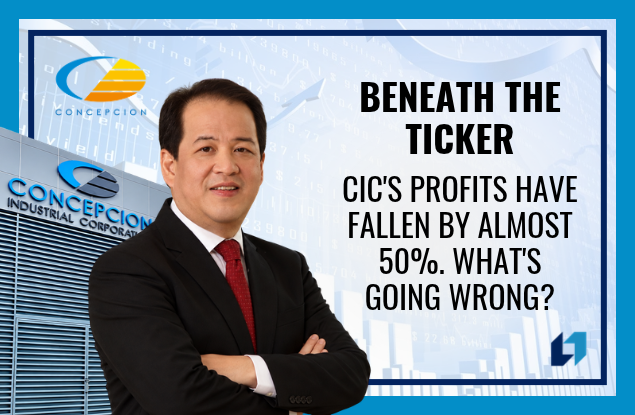
During the first nine months of 2026, CIC reported a 48.4 percent decline in consolidated net income to ₱478 million from ₱927 million a year earlier, despite a 2.4 percent increase in revenue to ₱14.29 billion.
The decline was even more pronounced for shareholders of the parent company. Net income attributable to CIC shareholders fell 60.6 percent to ₱253 million from ₱641 million, while earnings per share dropped from ₱1.63 to ₱0.65.
The sharp deterioration raises an important question. If CIC managed to increase its sales, why did its profits fall by almost half?
The answer lies partly in the company’s exposure to weaker household demand, but its financial statements also reveal higher operating costs, pressure on profit margins and substantial working capital requirements.
How the Economic Slowdown Affects CIC
The Philippine economy expanded by only 2.3 percent in the second quarter of 2026, according to the Philippine Statistics Authority (PSA).
Household consumption, which accounts for a substantial portion of economic activity, grew by just 2.8 percent during the quarter. Meanwhile, gross capital formation declined by 9.2 percent.
These figures suggest that both consumer demand and investment activity were under pressure.
For CIC, the slowdown is particularly relevant because its products include air conditioners, refrigerators, washing machines and other household appliances.
Unlike food and other essential purchases, many household appliances can be replaced later.
When consumers become more cautious about their finances, they may postpone buying a new air conditioner or refrigerator, particularly if their existing appliances remain functional.
The same principle applies to businesses and property developers. Commercial air-conditioning systems, elevators and other equipment represent investments that can sometimes be deferred when economic conditions become uncertain.
This makes CIC sensitive to both household consumption and business investment.
In its September 2026 financial report, CIC acknowledged that its consumer business experienced softer retail demand during the first half of the year, particularly for refrigeration and air-conditioning products.
The company also identified higher product costs, logistics expenses and peso depreciation as factors that affected profitability.
These disclosures suggest that CIC’s earnings difficulties reflect a combination of weaker demand and rising business costs.
Why Higher Sales Did Not Produce Higher Profits
At first glance, CIC’s revenue performance does not appear particularly weak.
Consolidated sales increased from ₱13.95 billion in the first nine months of 2025 to ₱14.29 billion in the corresponding period of 2026.
However, a closer examination reveals that much of the increase came from services rather than merchandise sales.
Revenue from the sale of goods declined slightly from ₱12.88 billion to ₱12.86 billion.
In contrast, revenue from services increased from ₱1.08 billion to ₱1.43 billion, an increase of approximately 32 percent. CIC’s traditional appliance business did not generate meaningful sales growth during the period.
The company reported that its consumer segment generated ₱9.6 billion in sales, a decline of approximately 1 percent from the previous year.
Meanwhile, its commercial segment grew approximately 11 percent to ₱4.7 billion, supported by commercial air-conditioning projects, aftermarket services and contractor-channel sales.
The commercial business helped offset weakness in the consumer segment. However, higher consolidated revenue was not enough to protect profitability.
CIC’s gross profit increased by less than 1 percent to ₱4.51 billion, while its gross profit margin declined from 32 percent to 31.5 percent.
This means that the company retained slightly less gross profit from every peso of sales.
Although the reduction in gross margin appears modest, it becomes significant when combined with rising operating expenses.
Operating Expenses Are Growing Faster Than Sales
One of the clearest explanations for CIC’s earnings decline is the increase in operating expenses.
During the first nine months of 2026, operating expenses rose 8.6 percent to ₱3.81 billion from ₱3.51 billion a year earlier.
This increase was more than three times the company’s revenue growth rate of 2.4 percent.
Personnel costs increased to ₱1.32 billion from ₱1.28 billion, while outside services rose to ₱772 million from ₱739 million.
One of the largest increases came from outbound freight expenses, which rose approximately 34 percent to ₱629 million from ₱468 million.
Warranty costs and certain other expenses also increased. These developments illustrate the difficulty of maintaining profitability when sales growth is weak but operating costs continue to rise.
For example, a company may need to maintain its warehouses, distribution network, employees and service operations even when demand for its products slows.
If sales fail to grow sufficiently, these expenses absorb a larger proportion of revenue.
CIC’s operating income consequently fell 41.4 percent to ₱595 million from ₱1.02 billion.
Its operating profit margin declined from approximately 7.3 percent to 4.2 percent.
This means that for every ₱100 in revenue, CIC generated only about ₱4.20 in operating profit during the first nine months of 2026, compared with ₱7.30 a year earlier.
The decline in operating profitability explains much of the deterioration in earnings.
Higher Costs and a Weaker Peso Add Pressure
CIC’s financial report also identifies rising product and logistics costs as important factors behind its weaker margins.
The company distributes several international brands and imports products and components for its operations.
This exposes the business to movements in foreign exchange rates and import-related costs.
When the peso depreciates against the US dollar, imported products and components can become more expensive in peso terms.
A company may attempt to pass these higher costs to consumers through price increases.
However, its ability to do so depends on market conditions.
When household spending is weak, raising prices can become difficult because consumers may postpone purchases or switch to cheaper alternatives.
This creates a potential squeeze between rising costs and limited pricing power.
CIC reported that higher product costs, import-related logistics expenses and peso depreciation affected its results during the first nine months.
The company also experienced lower production volumes during the first half, which reduced its ability to spread fixed factory costs across manufactured products.
This is known as factory under-absorption. For example, if a factory produces fewer units while maintaining much of its fixed operating costs, the cost allocated to each unit increases.
Lower production volumes can therefore reduce profitability even if selling prices remain unchanged.
CIC also recorded a ₱103 million net other operating loss during the first nine months of 2026, compared with ₱53 million in net other operating income a year earlier.
This represented an unfavorable movement of approximately ₱156 million.
The company’s share of earnings from associates also declined from ₱209 million to ₱104 million.
Together, these factors added to the decline in operating income and contributed to the sharp reduction in consolidated net profit.
Why Inventories Keep Increasing
Another interesting development concerns CIC’s inventories.
At the end of September 2026, the company reported ₱4.57 billion in inventories, compared with ₱3.19 billion at the end of December 2025.
This represented an increase of approximately ₱1.38 billion, or 43.2 percent, during the first nine months.
At first glance, such a substantial increase might suggest that products were accumulating because of weak demand.
However, a comparison with the previous year reveals a similar pattern.
During the first nine months of 2025, CIC’s inventories also increased by approximately 44 percent.
Inventory subsequently declined from about ₱4.23 billion in September 2025 to ₱3.19 billion by December.
This suggests that part of the inventory buildup may reflect the company’s purchasing and distribution cycle rather than an entirely new problem.
Nevertheless, the latest financial report provides an important qualification.
CIC explained that the increase in inventories reflected purchases in anticipation of demand, products in transit and weaker-than-expected retail sales in selected categories.
The company also said it was working to reduce aging inventories and align purchasing and production more closely with revised demand expectations.
This suggests that inventory accumulation cannot be attributed entirely to normal seasonal requirements.
A particularly notable development is the increase in finished goods inventory.
Finished goods rose from ₱1.77 billion at the end of 2025 to ₱2.68 billion in September 2026, an increase of approximately 51 percent.
The increase is significant because finished goods represent products that are already available for sale.
If demand remains weak, the company may need more time to convert these products into cash.
It could also face pressure to offer discounts or promotions to accelerate sales, although the financial statements do not establish that such measures will be necessary.
Why Profits Are Not Translating Into Cash
CIC’s inventory buildup also helps explain another important development in its financial statements.
Despite reporting ₱478 million in consolidated net income during the first nine months of 2026, the company recorded negative operating cash flow of approximately ₱38 million.
During the corresponding period of 2025, operating cash flow was positive at approximately ₱129 million.
The deterioration reflects the amount of cash absorbed by working capital.
According to the cash flow statement, inventory accumulation absorbed approximately ₱1.38 billion during the first nine months.
Increases in receivables and contract assets absorbed another ₱600 million.
These cash requirements were partly offset by a ₱908 million increase in trade payables and other liabilities.
This means that CIC relied partly on increased amounts owed to suppliers and other creditors to support its working capital requirements.
The company remained profitable on an accounting basis, but a significant portion of its resources was tied up in inventories and receivables.
As a result, cash and cash equivalents declined from ₱2.39 billion at the end of 2025 to ₱1.51 billion in September 2026.
The company also distributed approximately ₱677 million in cash to shareholders and non-controlling interests during the period.
Of this amount, approximately ₱394 million represented dividends attributable to CIC shareholders.
The parent-company dividend exceeded the ₱253 million in earnings attributable to those shareholders during the first nine months.
Although companies can pay dividends from accumulated retained earnings rather than current-period profits alone, the distribution becomes relevant when operating cash flow is weak.
CIC also spent approximately ₱63 million on share repurchases.
These capital allocation decisions deserve attention because the company must balance shareholder distributions against the cash needed to finance inventories, receivables and other operating requirements.
Consumer Confidence Remains Weak Despite Some Improvement
The broader economic environment helps explain why CIC’s consumer business may continue to face challenges.
According to the Bangko Sentral ng Pilipinas’ third-quarter 2026 Consumer Expectations Survey, the consumer confidence index for the current quarter improved to negative 29.8 percent from negative 42 percent in the previous quarter.
The improvement suggests that households became less pessimistic about economic conditions.
However, the index remained negative, which means pessimistic consumers continued to outnumber optimistic ones.
The survey also indicated that households remained cautious about their spending plans.
This is relevant to CIC because purchases of major household appliances often depend on consumer confidence as well as income.
Even households that can afford a new refrigerator or air conditioner may postpone the purchase if they are uncertain about their future finances.
However, the survey also offers a more encouraging signal.
Consumers became more optimistic about the next 12 months, and more households expressed an intention to purchase major items such as property and motor vehicles.
This suggests that consumer sentiment may improve if economic conditions stabilize.
For CIC, a recovery in confidence could eventually support demand for household appliances.
Nevertheless, improved confidence does not automatically translate into immediate sales growth.
The Third Quarter Shows Signs of Recovery
Despite the sharp decline in nine-month earnings, CIC’s third-quarter results provide some encouragement.
Revenue increased 12.6 percent to ₱4.37 billion during the July-to-September period from ₱3.88 billion a year earlier.
Gross profit rose approximately 20 percent, while operating income increased 44.7 percent to ₱215 million.
Consolidated net income also increased 29.4 percent to ₱183 million from ₱141 million.
More importantly, the company’s gross profit margin improved to 34.6 percent from 32.4 percent in the corresponding quarter of 2025.
This suggests that CIC was beginning to recover some of the profitability lost during the first half.
Management attributed the improvement partly to stronger demand in July and the greater effect of pricing adjustments implemented during the second quarter.
Commercial air-conditioning, aftermarket services and e-commerce also helped support revenue growth.
However, the company noted that consumer demand moderated during the remainder of the quarter.
This suggests that the recovery remains uneven. The improvement in third-quarter earnings also needs to be viewed against the company’s weak first-half performance.
During the first six months of 2026, CIC’s consolidated net income fell sharply from approximately ₱786 million to ₱295 million.
The third-quarter recovery helped reduce the nine-month earnings decline, but it was not enough to reverse it.
The question now is whether CIC can sustain its improved margins and revenue growth during the fourth quarter.
What CIC’s Results Tell Us About the Economy
CIC’s financial performance illustrates how an economic slowdown can affect businesses beyond the immediate decline in consumer spending.
When households postpone appliance purchases, companies may experience slower sales growth.
If operating costs continue to rise, even modest weakness in demand can lead to a much larger decline in profits.
The pressure becomes more pronounced when businesses must absorb higher import costs, logistics expenses and unfavorable exchange rate movements.
Meanwhile, inventories and receivables can continue to accumulate, which reduces the amount of cash available for operations and shareholder distributions.
CIC’s experience reflects several of these pressures. Its consumer business reported weaker demand, its operating expenses increased faster than sales, and its inventory buildup contributed to negative operating cash flow.
However, it would be inaccurate to attribute the entire earnings decline to the Philippine economic slowdown.
Company-specific factors, including its cost structure, manufacturing volumes, product mix, foreign exchange exposure and lower earnings from associates, also contributed to the deterioration.
Moreover, CIC’s commercial business continued to grow, while its third-quarter profitability improved.
These developments suggest that the company retains opportunities to recover as economic conditions and operating efficiency improve.
Can CIC Recover Its Profitability?
CIC’s immediate challenge is to sustain the improvement recorded during the third quarter.
The company needs stronger consumer demand, better cost control and continued growth in its commercial and service businesses.
It must also convert its substantial inventory holdings and receivables into cash.
If sales recover and operating expenses grow more slowly, CIC could benefit from operating leverage, where additional revenue generates a proportionately larger increase in profit.
However, if household spending remains weak and import-related costs continue to rise, the company’s margins may remain under pressure.
Investors should therefore monitor not only CIC’s revenue growth but also its gross profit margins, operating expenses, inventory levels and operating cash flow.
The company’s fourth-quarter results will be particularly important because inventories declined substantially during the corresponding period last year.
A similar reduction this year could ease working capital requirements and support cash generation.
Ultimately, CIC’s 48.4 percent decline in consolidated net income demonstrates that higher sales do not necessarily produce higher profits.
The company has managed to increase revenue despite a difficult economic environment, but rising costs and weaker margins have absorbed much of the benefit.
Its third-quarter recovery offers some encouragement. Whether that recovery can continue will depend partly on the strength of consumer spending and partly on CIC’s ability to improve efficiency, control costs and turn its sales into cash.

