

A country can create millions of jobs and still struggle to become rich. The reason is that development depends not only on how many people are working, but also on what kind of work they do and how productive those jobs are.
For the Philippines, economist Jesus Felipe argues that this distinction is critical. If a large share of Filipinos continues to depend on low-paying occupations several decades from now, the country may still have difficulty achieving the living standards associated with advanced economies.
Felipe, Distinguished Professor at the Carlos L. Tiu School of Economics of De La Salle University, raises the issue in his study, Could Pope Leo XIV and Karl Marx See Eye to Eye? Comments and Questions on MAGNIFICA HUMANITAS. The paper critically examines Pope Leo XIV’s encyclical Magnifica Humanitas, particularly its discussion of artificial intelligence, employment, wages, profits, inequality and economic development.
Felipe’s argument begins with a deceptively simple question raised by the Pope’s call for the creation of “valuable jobs.”
“May I inquire what is not a valuable job?” Felipe asks.
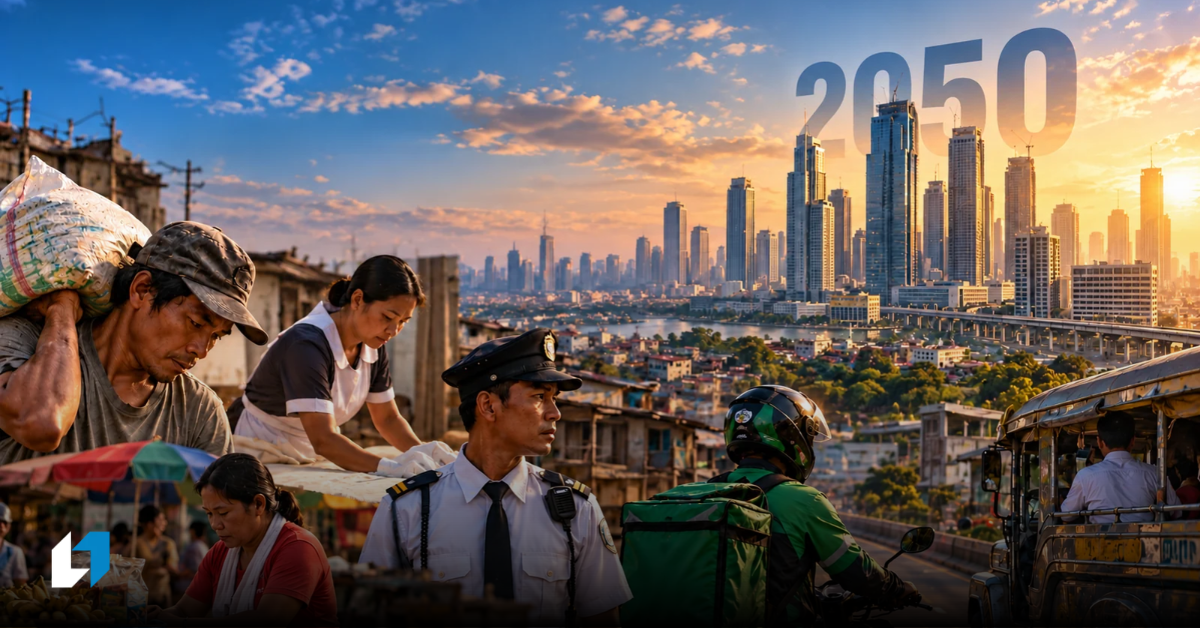
From the perspective of a company or household, almost every paid job has value. A security guard provides protection. A domestic helper performs services that a household is willing to pay for. A delivery rider moves goods from one place to another.
But Felipe argues that the development question is different. A job can perform a useful function and still generate low productivity, low wages and limited opportunities for workers to improve their living standards.
What the jobs Filipinos do say about the economy
Felipe points to the large number of Filipinos employed in elementary occupations and other forms of relatively low-productivity work.
About 25 percent of Filipino workers, he notes, are classified as “laborers” who perform simple and routine physical tasks. He also points to low-productivity services such as street selling and transport work involving tricycles, motorcycles and jeepneys.
These occupations are not unnecessary. The more important issue is why so many workers continue to depend on them.
Felipe connects their prevalence with what development economists call surplus labor: a large supply of workers willing to accept relatively low wages because there are not enough higher-productivity alternatives available.
He brings the argument closer to home by discussing domestic helpers, security guards and workers in the gig economy.
“These are workers willing to work in our cities for just a bit over subsistence wage in the province,” Felipe writes.
When large numbers of people compete for relatively simple jobs, wages tend to remain under pressure. Employers do not need to raise compensation substantially when many other workers are available to take the same position.
The result can be an economy that generates employment without producing equally strong improvements in household income.
Rich countries once had many of the same jobs
Felipe’s argument is not that domestic work, security services or other low-paying occupations are uniquely Filipino.
Advanced economies once had many more workers performing similar jobs. What changed as those countries developed was the structure of employment.
“Helpers and security guards existed in today’s advanced nations but disappeared during the course of development as the economy created jobs in industry and services at higher wages,” Felipe writes.
Some of these occupations still exist in wealthy countries, of course, but they are often much more expensive because workers have better-paying alternatives. A household that wants a full-time domestic helper in a high-income European country, for example, must generally pay much more for the service.
This difference illustrates an important feature of development. As economies become more productive, labor becomes more expensive because workers have access to a wider range of better-paying opportunities.
Low wages are therefore not simply a characteristic of particular occupations. They can also reflect the absence of more productive alternatives elsewhere in the economy.
The 2050 warning
Felipe then makes one of the strongest statements in his study about the Philippines.
“I venture to argue that if these jobs still exist in the Philippines in the year 2050 (at today’s wage rates), we will still be a poor nation,” he writes.
His point is not that domestic helpers, security guards or gig workers must literally disappear.
The more important test is whether these occupations remain a major source of employment at wages close to today’s levels, or whether the economy creates enough higher-productivity jobs to give workers better alternatives.
An economy may continue to expand while malls, office buildings, delivery platforms and service businesses create thousands of new jobs. But if many of those positions offer only modest productivity and wages, employment growth alone may not be enough to close the income gap with richer countries.
Felipe also argues that the continued prevalence of such jobs contributes to inequality because a large part of the workforce remains concentrated in occupations with limited earning power.
Development should change the kind of work people do
For households, this helps explain why strong headline economic growth does not always feel transformative.
The difference between a poor and a rich economy is not simply that more people have jobs in the richer one. Workers in advanced economies tend to operate with more capital, better technology and higher levels of skill, which allow each employee to produce more economic value.
Higher productivity creates room for higher wages.
The Philippine challenge, therefore, is not merely to keep unemployment low. It is to create enough opportunities that workers no longer have to compete intensely for jobs that offer little more than subsistence income.
Felipe’s 2050 warning provides a useful benchmark for measuring progress. If the country continues to grow but the structure of employment looks largely the same several decades from now, the numbers may have improved without the economy fundamentally changing.
A richer Philippines should eventually be visible not only in GDP statistics, new buildings or corporate profits, but also in the kinds of jobs ordinary Filipinos can choose from and the wages those jobs are able to support.

