

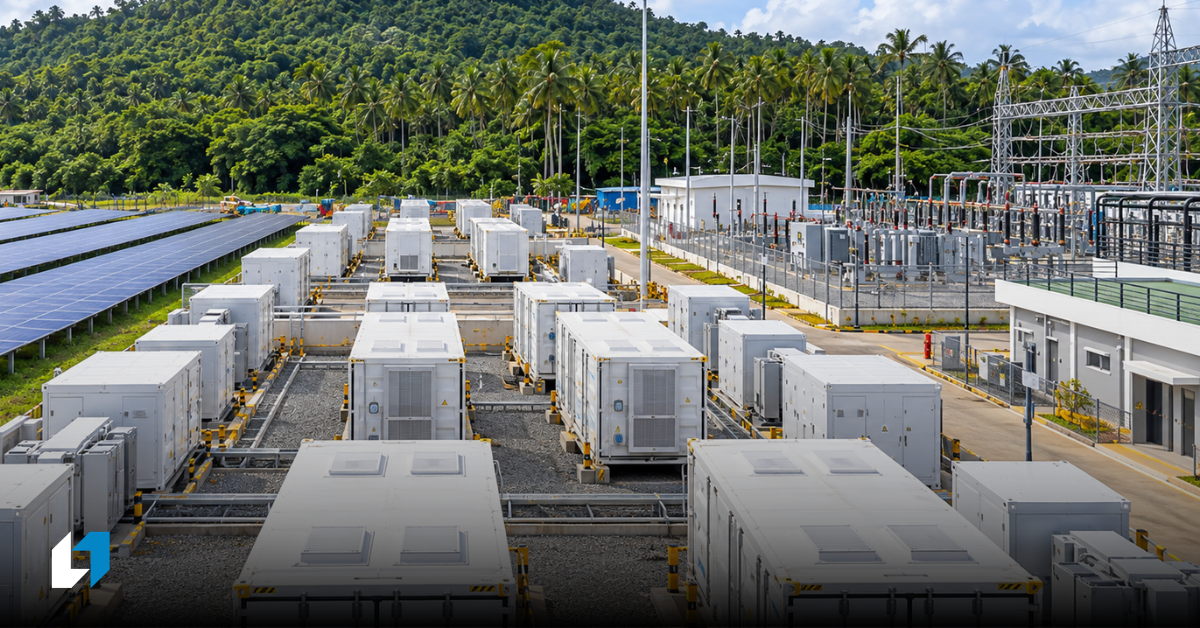
Battery storage is often presented as one of the technologies that will support the transition to renewable energy.
But its role in the Philippine power system may become much more important than simply storing excess solar electricity during the day and releasing it at night.
Mike Thomas, co-founder of The Lantau Group, argued that batteries could become increasingly valuable because the Philippine electricity market is moving into a stage where flexibility matters as much as generating capacity.
Thomas discussed this during the AmCham Annual 9th Energy Forum: Powering Through the 2026 Energy Disruption: Strategies for Resilience, Recovery, and Transition, held on August 13, 2026.
His argument is that a power system with more solar and other variable renewable energy does not simply need more megawatts.
It also needs resources that can respond quickly when electricity supply and demand change. This is where batteries can play a larger role.
Batteries Are Really a Flexibility Business
A battery does not generate electricity in the traditional sense. Instead, it shifts electricity from one period to another.
When electricity is abundant and prices are low, a battery can charge. When supply becomes tighter and prices rise, it can discharge electricity back into the grid.
This ability makes battery storage fundamentally different from most conventional power plants.
Thomas said flexibility resources such as battery storage need a business model that allows them to capture several different sources of value.
“Battery storage, flexibility resources require certain things in order to make sense,” he said.
For Thomas, the ideal model involves what he described as a “stacked” revenue source.
“They should be able to access energy arbitrage, ancillary services, and if your market needs a capacity, maybe a capacity value according to their capability,” he said.
A battery that relies on only one source of revenue may struggle to earn an adequate return. A battery that can earn money from several services may have a stronger investment case.
The First Revenue Stream: Energy Arbitrage
Energy arbitrage is perhaps the easiest battery business model to understand.
Electricity prices can vary significantly throughout the day. When prices are low, a battery buys electricity and stores it. When prices rise, the battery sells electricity back into the market.
The difference between those prices creates the potential profit.
As more solar generation enters the Philippine grid, these price differences could become more pronounced.
Large amounts of solar electricity can push prices down during daylight hours. Later in the day, solar production falls while demand may remain relatively high. A battery can take advantage of that difference.
But Thomas said battery investors need enough transparency about what else is happening in the electricity market before they can confidently make those decisions.
“The storage investor needs to know what else is going on in the market,” he said.
“If you don’t understand how everything else is going to work, how can you get into the arbitrage business?”
This means the investment case for batteries depends not only on technology costs.
It also depends on whether investors can understand and predict how the electricity market is likely to behave.
Batteries Can Also Sell Speed
The second source of revenue comes from ancillary services.
Electricity supply and demand must remain balanced almost continuously. If there is a sudden loss of generation or an unexpected change in demand, other resources need to respond quickly.
Batteries are particularly useful because they can change their output much faster than many conventional power plants.
Thomas explained that electricity itself has value, but so does the ability of the power system to adjust quickly.
“The speed with which electrons in the system adjusts to situation, that’s your ancillary services, that has value,” he said.
This means a battery may earn money even when it is not simply buying and selling electricity. It can also be paid for helping stabilize the system.
As renewable-energy penetration rises, this service can become more valuable because solar and wind output can change depending on weather conditions.
A Third Revenue Stream Could Be Capacity
Thomas also raised a third potential source of value: capacity.
Some electricity markets compensate power plants or storage systems simply for being available when the system needs them.
This is separate from the electricity they actually sell.
Thomas referred to markets such as Western Australia and PJM in the United States, where capacity-related payments can provide revenue that the energy market alone may not generate.
Such payments address what electricity economists sometimes call “missing money.”
If market prices are capped or market rules prevent generators from earning enough revenue during periods of scarcity, investors may not earn sufficient returns to build the capacity the system eventually needs. Capacity payments can provide an additional source of income.
Thomas did not argue that the Philippines necessarily needs to copy these systems.
His broader point was that flexibility resources need an economic framework that recognizes the different services they provide.
Renewable Energy Makes Flexibility More Valuable
The case for batteries becomes stronger as more variable renewable energy enters the system.
Solar generation is concentrated during daylight hours. When solar output becomes abundant, electricity prices can become very low.
When the sun sets, that supply disappears. A battery can absorb some of the surplus electricity when production is high and release it when solar generation declines.
Thomas described this transition as part of what he calls Wave Two, the stage when an electricity system begins to run out of the flexibility that previously allowed it to absorb renewable energy relatively easily.
At that stage, he said, the system begins to experience curtailment, very low prices, the so-called duck curve and greater opportunities for batteries.
This suggests that batteries are not simply an optional addition to renewable-energy development. They could become part of the infrastructure required to support it.
Existing Power Plants Can Help Batteries Too
One of the more counterintuitive points in Thomas’ presentation was that batteries do not necessarily compete with flexible conventional power plants.
Greater flexibility from existing gas and coal plants could actually make the environment more attractive for battery investment.
Thomas and The Lantau Group modeled what could happen if existing generating plants operated more flexibly.
He said the resulting changes could firm up electricity prices and improve the overall investment environment.
“The prize is actually really big,” Thomas said.
“It firms up prices for everybody else. So all of the rest of the environment becomes more attractive for batteries and/or solar or other things.”
This is important because battery investment depends partly on price signals.
If electricity prices are consistently compressed or do not properly reflect scarcity and flexibility, it becomes more difficult for storage developers to determine when they will earn money.
A more responsive electricity market could therefore improve the economics not just of conventional generation but also of newer technologies.
The Philippines Can Learn From Other Markets
Thomas pointed to Western Australia as a useful example.
The market is relatively small and isolated, but it has extremely high rooftop solar penetration.
As rooftop solar expanded, the system needed more flexibility to respond to sudden changes in supply.
Thomas said Western Australia had moved toward flexible capacity and battery storage as these challenges became more significant.
The Philippines is not yet at the same stage, but if renewable-energy capacity continues to expand, similar challenges could gradually emerge.
This creates both a technical requirement and an investment opportunity.
The Investment Case Is More Than Falling Battery Prices
Much of the discussion around battery storage focuses on technology costs.
As batteries become cheaper, more projects become financially viable, but Thomas’ analysis suggests that cost is only part of the equation.
The investment case also depends on whether battery developers can access enough sources of revenue.
A battery that can earn from electricity arbitrage, ancillary services and possibly capacity has a very different financial profile from one that depends on only a single market.
The other requirement is confidence. Thomas said storage investors need to understand what is happening across the electricity market before committing capital.
Without clear price signals and transparent market behavior, investors may simply wait for someone else to offer them a long-term contract. This limits the development of a more dynamic storage market.
From Power Generation to Power Flexibility
For decades, the Philippine electricity investment story was largely about building power plants.
The key questions were how many megawatts a project could generate, how much fuel it needed and what electricity price it could secure.
Battery storage changes that calculation. Its value does not come primarily from producing more electricity, but from making the electricity system more responsive.
This means batteries could increasingly earn money from something that historically received less attention in the Philippine power market: flexibility itself.
As renewable energy expands, that ability to move electricity across time and respond within seconds could become increasingly valuable.
The next big opportunity in Philippine power may therefore not simply be another plant that produces electricity. It may be a battery that helps the entire system use electricity more efficiently.

