

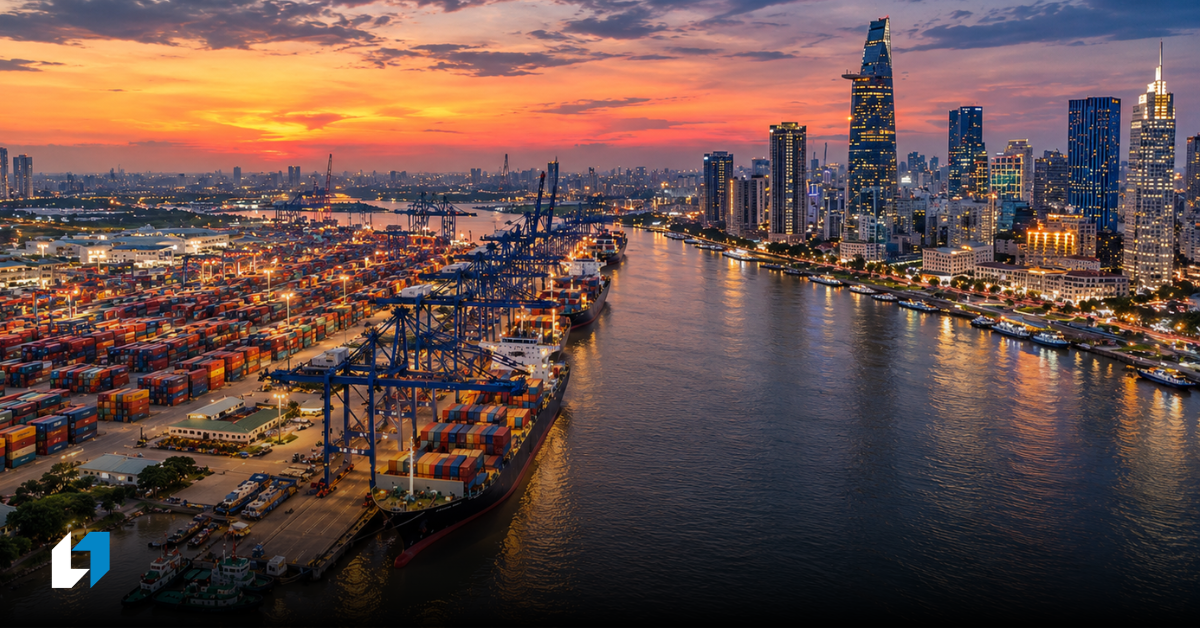
For years, the Philippines and Vietnam were often seen as emerging economies competing for the same foreign investment, manufacturing jobs and export opportunities.
Yet over the past two decades, Vietnam has moved ahead much faster in industrial development, exports and manufacturing employment.
Economist Dr. Jesus Felipe believes the reason is not difficult to understand.
Speaking during the launch of The Philippine Economy Toward 2050 at De La Salle University on August 26, 2026, Felipe argued that Vietnam succeeded in building the kind of industrial base that the Philippines never developed at sufficient scale.
He summarized the contrast bluntly:
“Only 7% of all our workers are in manufacturing, unfortunately.”
He then pointed to Vietnam’s much larger industrial workforce.
“Total industry plus 20%, and in Vietnam, 35%.”
For Felipe, that difference helps explain why the two economies have followed very different development paths.
Vietnam built a larger industrial base
Felipe’s argument starts with economic structure.
A country can grow through consumption, services and construction, but sustained increases in income usually require workers to move into sectors where productivity is much higher.
Manufacturing has historically played that role. It allows firms to use technology, machinery, capital and scale to produce more output per worker. It also creates demand for logistics, engineering, finance, research and other higher-value services.
Vietnam expanded this part of its economy much more aggressively.
Felipe pointed to the difference in industrial employment as evidence of that transformation.
“No wonder why Vietnam has overtaken us.”
The statement may sound severe, but it reflects a broader point in his speech: countries do not become richer simply because their economies grow. What matters is what kind of activities workers move into as the economy develops.
The Philippines remained concentrated in low-productivity sectors
Felipe contrasted Vietnam’s industrialization with the structure of Philippine employment.
He noted that roughly half of Filipino workers remain concentrated in three sectors: agriculture, wholesale and retail trade, and construction.
He argued that these sectors, particularly agriculture and low-end retail, generally generate less output per worker than advanced manufacturing.
“That is why our wages are so low, that is why our income per capita is so low.”
The problem, in Felipe’s view, is therefore not simply unemployment. It is where people are employed.
An economy can technically create millions of jobs while still failing to raise living standards quickly if most of those jobs remain in low-productivity activities.
Vietnam’s advantage, he argued, is that it moved more workers into industrial jobs connected to global supply chains.
Foreign investment alone is not enough
The Philippines has attracted foreign investment for decades, particularly in electronics, services, real estate and business process outsourcing.
But Felipe’s presentation suggests that the quality and direction of investment matter as much as the amount.
Vietnam attracted large-scale manufacturing investment that became integrated into global production networks. Foreign manufacturers did not simply sell into the local market. They used Vietnam as an export base.
This is important because export-oriented manufacturing forces firms to compete internationally on cost, quality, technology and delivery.
Felipe believes Philippine companies have had less pressure to make that transition.
Later in his speech, he criticized the tendency of local firms to focus primarily on the domestic market rather than compete internationally.
“Our conglomerates have to leave their comfort and profitable zoning and embrace the world economy and compete.”
In his view, stronger domestic competition is not enough. Philippine firms need to become capable of selling products that can compete abroad.
The electronics warning
The Philippines does have a large electronics export industry, but Felipe questioned whether it has moved far enough up the value chain.
During his speech, he referred to comments from the head of the semiconductor and electronics industry, who described the sector as a “zombie industry.”
Felipe explained that the phrase referred to an industry that remains alive and continues generating export revenue but is no longer attracting enough investment to significantly expand, upgrade or move into more sophisticated activities.
A country can remain part of global manufacturing without necessarily climbing the technological ladder.
Vietnam, by contrast, has continued to attract new factories and production capacity across electronics, machinery, garments and other industrial sectors.
Felipe’s concern is that the Philippines risks remaining stuck in older parts of the value chain while competitors continue to move forward.
Industrial policy helped make the difference
Felipe also argued that Vietnam’s progress cannot be explained purely by cheap labor or geography.
He repeatedly emphasized that successful economies historically used industrial policy to encourage manufacturing, infrastructure investment, technological upgrading and export development.
“Governments were behind all this understanding that manufacturing matters in the form of what? Industrial policy.”
He acknowledged that governments sometimes make mistakes.
“Not all the interventions succeeded by the government.”
But the broader historical lesson, he argued, is that industrialization rarely happens without sustained policy support.
Vietnam built export-processing zones, invested in infrastructure, attracted multinational manufacturers and integrated itself into global trade agreements.
The Philippines has also pursued industrial policies, but Felipe believes they have not produced the same depth of manufacturing capability.
Why services were not enough
The Philippines took a different development path. Instead of becoming a major manufacturing hub, it developed strengths in services, particularly BPO, finance, tourism and domestic consumption.
These sectors have contributed substantially to growth and employment. Felipe does not dismiss them.
His concern is that service-led growth has not generated productivity gains on the same scale as industrialization did in successful East Asian economies.
Manufacturing also creates demand for sophisticated services. Factories need engineering, technology, finance, logistics, research, marketing and professional management.
For that reason, Felipe does not see manufacturing and services as competing development strategies. A strong industrial base can help create a stronger service economy.
The Philippines still has time
Felipe did not argue that the Philippines should try to recreate South Korea’s industrial model from the 1970s or copy Vietnam exactly.
Economic conditions have changed. Automation is reducing the number of workers needed in some factories, while technology and global supply chains are becoming more complex.
But he believes the underlying lesson remains relevant.
“Either we make a serious industrialization effort… or all we’re going to do in the next 25 years is most of the same.”
This warning goes to the heart of his comparison with Vietnam.
The Philippines can continue growing at moderate rates through consumption, services and construction. But without a stronger industrial base, Felipe believes it will struggle to generate the productivity gains needed to raise wages rapidly and approach high-income status.
Vietnam’s rise therefore represents more than a story about one neighboring country moving ahead.
For Felipe, it demonstrates what can happen when an economy succeeds in shifting workers into manufacturing, building export capabilities and integrating more deeply into global production.
The Philippines, he argues, still has the opportunity to make a similar transition. But the longer the country waits, the more difficult the catch-up becomes.

