

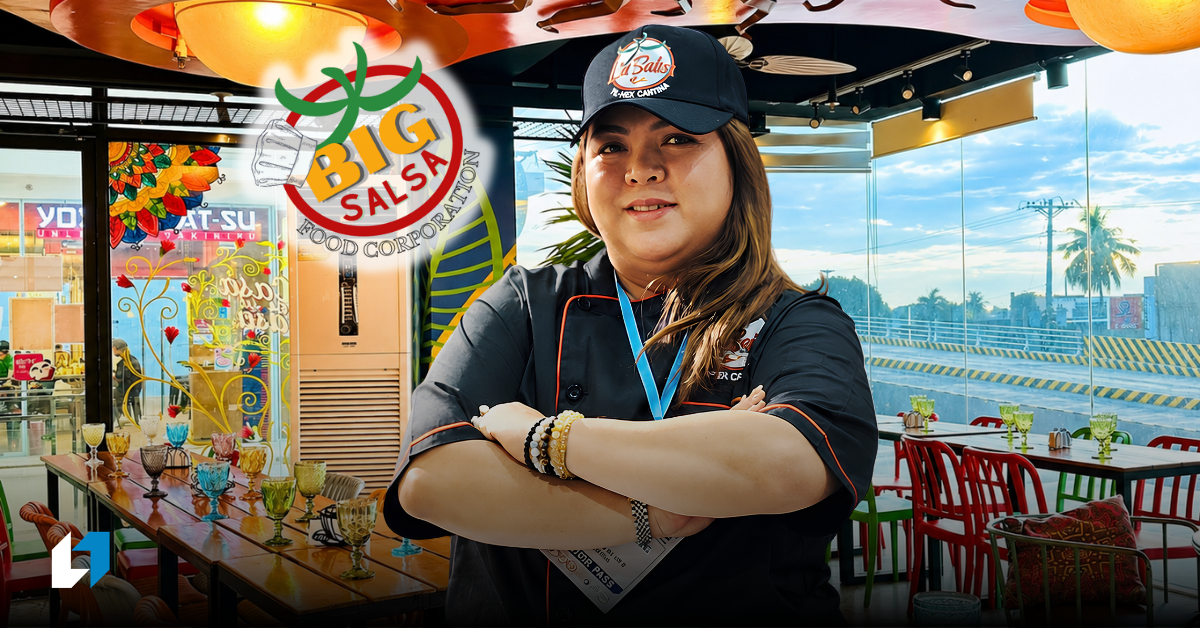
In the early days of La Salsa FilMex Cantina, Atlee Chan found herself trapped in a situation many restaurant founders know too well.
The restaurant was doing well, customers were lining up, and demand kept growing. But behind the scenes, the business depended almost entirely on her.
She was in the kitchen every day—from opening to closing.
If she stepped away, the operation struggled.
“At the beginning, I couldn’t leave my staff on their own,” Chan recalls. “I was doing all the cooking while they assisted me.”
That experience eventually led her to one of the most important lessons of her entrepreneurial journey: a restaurant cannot grow without strong systems.
When success becomes a problem
When La Salsa first opened, Chan expected a gradual start.
Instead, the restaurant quickly attracted large crowds—even during the pandemic.
Customers lined up, orders flooded the kitchen, and demand exceeded what her small team could handle.
But the rapid growth exposed a major weakness.
The restaurant had no standardized processes.
“There were no standardized recipes, no proper orientation, and no structured preparation system,” Chan says.
The sudden surge of customers also exposed operational problems.
The kitchen’s exhaust system was too small for the volume of cooking, causing smoke to fill the dining area. Staff struggled to keep up with orders, and the entire operation depended heavily on Chan’s presence.
Looking back, she describes those months as some of the toughest in the restaurant’s history.
But they also became the turning point.
Building the systems the business needed
Chan realized that if La Salsa was going to survive—and eventually expand—the restaurant needed a system that could operate without her constant supervision.
The first step was standardizing the recipes.
Previously, many dishes existed only in her memory. That made it difficult for kitchen staff to replicate them exactly.
To solve this, she began documenting every ingredient and measurement.
While cooking, she asked her assistant chef to write down the details of each recipe.
“We jotted down everything until we achieved the right taste for every dish,” she explains.
Once the recipes were finalized, all kitchen staff were trained to measure ingredients precisely instead of estimating them.
The result was immediate: food quality became more consistent.
Creating a commissary system
Another major improvement was the creation of a central commissary.
Instead of preparing everything individually in each restaurant, the commissary began processing and marinating meats and preparing sauces for all branches.
This approach brought several advantages.
First, it ensured that every location used the same ingredients and preparation methods. Second, it simplified kitchen operations in each branch, making it easier to train new staff.
Most importantly, the commissary system allowed Chan to maintain consistent quality across multiple restaurants.
Fixing operations beyond the kitchen
Standardizing recipes solved only part of the problem.
Chan also needed to improve daily operations.
The restaurant introduced clearer workflows, documented procedures, and defined responsibilities for each staff member.
From kitchen preparation to service operations and back-office management, every part of the business gradually became more structured.
With clear processes in place, staff could perform their tasks more efficiently and confidently.
Training also became easier.
Instead of relying solely on Chan’s direct supervision, new cooks could learn the system and replicate the dishes accurately.
Technology as a control tool
Another important improvement came from adopting better technology.
Chan implemented a point-of-sale system that linked menu items directly to ingredient inventories.
This system allowed the restaurant to track sales, expenses, and ingredient usage in real time.
“Choose the right POS system with inventory tracking and expense records,” she advises. “It helps monitor your cash flow anytime and anywhere.”
The system also helped reduce common problems in restaurant operations such as pilferage, waste, and inaccurate inventory counts.
With accurate data available, Chan could make better decisions about purchasing, pricing, and menu management.
Managing costs and protecting margins
Like many restaurant operators, Chan learned that profitability depends heavily on controlling food costs.
In most restaurants, the cost of goods sold—including ingredients—represents one of the largest pressures on margins.
“In a food business, cost of goods sold is often around 35 to 40 percent,” she explains.
Maintaining profitability requires careful monitoring of these costs.
Inventory systems, standardized recipes, and precise portion control all play important roles in protecting margins.
Without those controls, even restaurants with strong sales can struggle financially.
Knowing when the business was ready to grow
For years, Chan remained deeply involved in daily operations.
But eventually something changed.
She realized that she could travel for several days—or even weeks—without worrying about the restaurant’s performance.
“That’s when I knew the system was working,” she says.
The business no longer depended entirely on her presence.
Instead, the systems she had built allowed the restaurant to operate smoothly with trained teams and clear processes.
That realization gave her the confidence to expand.
Today, La Salsa’s growth includes a mix of company-owned stores, franchising, and partnerships across different parts of the Philippines.
A lesson for restaurant entrepreneurs
For many restaurant founders, the biggest challenge is not creating a great dish.
It is building a business that can function without the founder standing in the kitchen every day.
Chan’s experience with La Salsa reflects a lesson that many entrepreneurs eventually learn.
Talent and passion may launch a restaurant, but systems are what allow it to grow.
Standardized recipes, disciplined operations, and strong financial controls turn a single restaurant into a scalable brand.
And once those systems are in place, the founder finally gains something many entrepreneurs rarely experience in the early years of their business:
The ability to step away—knowing the business can still run successfully without them.

