

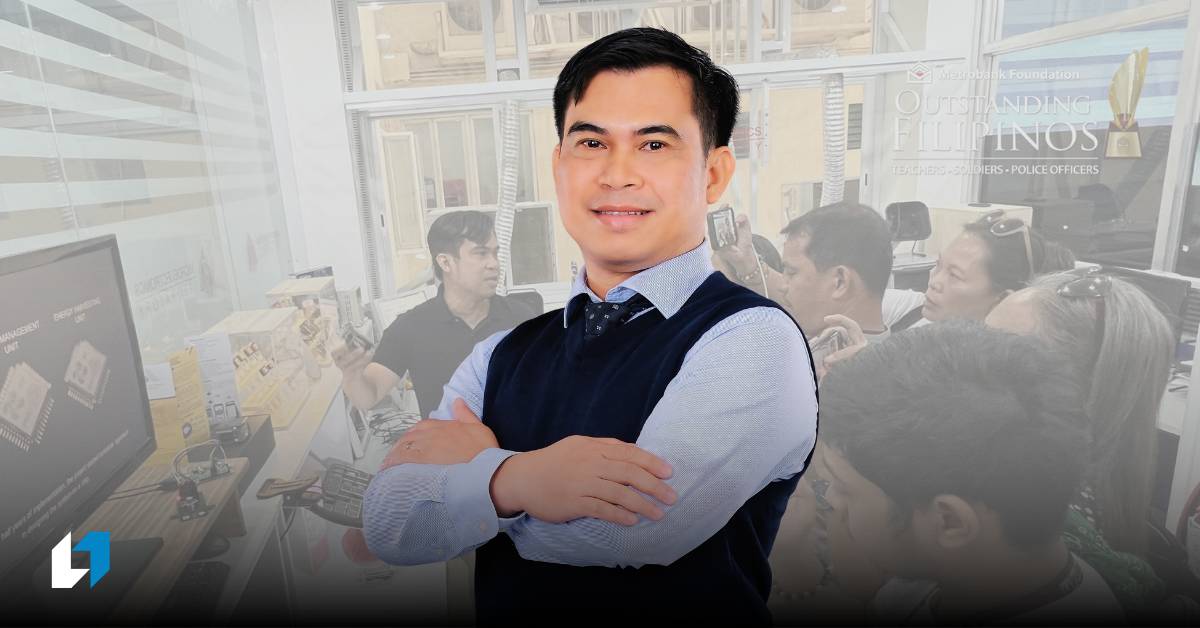
Dr. Jefferson A. Hora could have built his semiconductor career overseas.
An Electronics Engineer by profession, Hora pursued advanced training in some of the world’s established technology markets. He earned his master’s degree in Taiwan, spent two years working for an integrated circuit design company, and later completed his PhD in Australia.
But instead of building a more comfortable career abroad, he eventually chose to return home.
Friends questioned the decision. With his education and semiconductor experience, Hora had opportunities that could have provided a different future for his family.
His reason for returning was rooted in a different calculation.
“I chose the multiplier effect of education over the opportunity to become just one successful engineer,” Hora says.
Today, Hora’s decision has grown into something larger than a teaching career. At Mindanao State University-Iligan Institute of Technology, or MSU-IIT, he has helped develop an ecosystem for microelectronics and integrated circuit design education that connects universities, students and the semiconductor industry.
His work has earned him recognition as one of the 2026 Metrobank Foundation Outstanding Filipinos.
But Hora hopes the recognition will draw attention to an ambition that extends beyond himself: to help transform Mindanao from a source of engineering talent into a place where high-value semiconductor jobs can also be created.
From engineer to educator
Teaching was actually Hora’s first job after passing the Electronics Engineering licensure examination.
He taught engineering courses at a local college in his hometown before eventually gaining experience in the semiconductor industry. Even while working in industry and pursuing further education, however, he continued to teach part-time.
Over time, he realized that teaching offered something different from the individual success he could achieve as an engineer.
“Eventually, I realized that teaching was more than a profession for me—it was a vocation and a way of serving others,” he says.
The roots of that idea went back to his college years, when he served as a youth leader in Couples for Christ. Mentoring young people introduced him to the satisfaction that came from sharing knowledge and helping others develop.
“That experience planted the seed that teaching could be my way of serving and touching lives,” he says.
His engineering and industry experience would later become important because Hora was not interested only in teaching what was already available, then he saw something missing.
The IC design gap
The Philippines has long participated in the global semiconductor industry, but Hora saw a geographical gap in the education required for some of its more specialized fields.
Advanced IC design education was concentrated largely in Metro Manila. Mindanao had fewer specialized faculty members, limited facilities and little access to the expensive industry-standard tools used to design integrated circuits.
For a student in Mindanao interested in the field, geography itself could become a disadvantage.
Hora decided that the answer was not simply to send more talented students elsewhere.
“Instead of seeing this as a limitation, I saw it as an opportunity to build something,” he says.
That meant creating more than a class. Hora and his colleagues developed partnerships, secured external funding and brought industry into the classroom. At MSU-IIT, Hora helped build the microelectronics learning ecosystem through the Center for Integrated Circuit Design, IC design and energy harvesting research, industry partnerships and laboratories.
He was also instrumental in initiating the pioneering BS Microelectronics Engineering program.
Industry engineers were integrated into classes. A Graduate Research Internship Program was established. Access to industry-standard tools was sustained, while training was extended beyond MSU-IIT to other universities.
According to Hora, more than 500 students and faculty members have benefited from these initiatives.
For him, the objective is to give students a pathway into one of the highest-value segments of the semiconductor industry.
When students become industry leaders
The impact became more visible as Hora’s students entered the workforce.
He remembers personally advocating for his first batch of IC design graduates with industry partners. At the time, they were young engineers trying to enter a highly specialized industry.
Years later, some of those students became successful IC design engineers and eventually managers.
Some even invited their former professor to international semiconductor engagements.
For Hora, their progress illustrated one of the fundamental differences between succeeding individually and developing other people.
“Teaching has a multiplier effect—the students we develop can go on to influence many others,” he says.
Perhaps an even more significant moment came when graduates from their programs became part of the workforce of the first IC design company established in Mindanao.
“I realized that what we were doing in the classroom was creating opportunities that did not previously exist in the region,” he says.
That experience points to a larger question about regional development.
Universities typically educate talented young people so they can enter the workforce. But if the specialized jobs they seek exist only elsewhere, education can also accelerate the migration of talent away from the region that developed it. Hora wants to help change that equation.
Building talent so investment can follow
Hora’s ambition is not merely to produce more engineers from Mindanao who can find semiconductor jobs in Metro Manila or overseas.
He wants Mindanao itself to become a destination for the industry.
“I hope to see Mindanao become a genuine destination for microelectronics and IC design talent—not merely a source of talent migrating elsewhere,” he says.
“I want to see more companies establish operations where the talent is.”
That reverses the usual way regions sometimes think about attracting investment.
Companies require infrastructure and incentives, but high-value industries also need specialized people. Building a sufficiently deep talent pool can therefore become part of the investment proposition itself.
Hora’s work at MSU-IIT reflects that approach. Instead of treating the university and semiconductor companies as separate worlds, his initiatives have brought industry engineers into classrooms, provided students with exposure to industry-standard tools and created research internships that connect academic training with actual industry requirements.
Extending training to faculty and students from other universities also broadens the potential talent base beyond a single institution.
The objective is an ecosystem rather than an isolated academic program.
Why he came home
Building that ecosystem required Hora to make a personal choice.
After his training abroad, remaining overseas could have offered greater financial security and a more comfortable career.
“Friends asked why I would return when my family could have had a better future abroad,” he says.
But Hora believed the knowledge and experience he accumulated overseas could have greater impact if he brought them back to Mindanao.
“I chose to invest my time and energy in building people and opportunities here.”
The decision did not mean that financial responsibility stopped mattering.
Hora says teaching has taught him to distinguish between generosity and sustainability. He prioritizes his family’s needs, lives within their means and tries to use resources responsibly.
When students or research teams encounter financial constraints, his first response is not necessarily to pay for everything himself.
Instead, he looks for institutional, government, industry or partnership-based solutions.
“For me, responsible service means helping others while also ensuring that I remain responsible to my own family,” he says.
It is an approach that also mirrors how he helped build the IC design program itself. The answer to limited resources was not simply individual sacrifice. It was collaboration.
Creating opportunities where talent already exists
Hora sees his recognition as one shared with the people and institutions that made the work possible.
“It belongs to my students, family, colleagues, industry partners, and MSU-IIT,” he says.
More importantly, he hopes the recognition creates greater visibility for what is being developed in Mindanao and encourages more investment in regional talent and innovation.
That may ultimately be the larger significance of his work.
The Philippines does not only need more engineers. It also needs pathways that allow engineers to develop specialized capabilities for industries where knowledge and skills command greater economic value.
And regions outside Metro Manila do not necessarily have to accept that their best technical talent must leave in order to find those opportunities.
Hora’s career provides one possible model: develop specialized programs, connect universities with industry, give students access to the tools companies actually use, build a critical mass of talent, and give businesses a reason to locate where that talent is being created.
For Hora, however, the measure of whether that effort succeeds remains personal.
He could have pursued his own career in the semiconductor industry. Instead, he chose to develop generations of engineers who could go farther than he could alone.
“Money is important, but it is not the only measure of success,” he says. “A meaningful life is about using what we have—our knowledge, skills, opportunities, and influence—to create value for others.”
After years of teaching, research and institution building, his definition of success has become straightforward.
“Success, for me, is not how far I can go alone, but how many people I can help move forward with me.”
If Hora’s larger ambition succeeds, some of those people may no longer have to leave Mindanao to build careers at the frontier of the semiconductor industry. The opportunities may increasingly come to them.

