

Artificial intelligence is becoming available to almost every business. A small company can subscribe to ChatGPT or another generative AI platform for a relatively modest amount, while a large corporation can spend millions of pesos on enterprise systems, data infrastructure and AI development.
But access alone does not appear to determine who benefits most.
A recent analysis by Brownstone Research describes an emerging “AI profit gap,” where a relatively small group of companies is beginning to capture a disproportionate share of the economic benefits from artificial intelligence. The idea is that companies that embed AI deeply into their operations may pull away from those that merely experiment with it.
The evidence behind that argument is becoming harder to ignore.
PwC surveyed 1,217 senior executives across 25 industries and found that the top 20 percent of companies captured about 74 percent of the AI-driven economic returns reported in the study. These companies were not simply using more AI tools. They were twice as likely to redesign workflows around AI and almost three times as likely to increase the number of decisions made without human intervention, while also putting stronger governance structures in place.
Boston Consulting Group has reached a similar conclusion. Its research suggests that companies that redesign entire processes around AI can achieve significantly larger productivity gains than those that simply insert AI into existing workflows. BCG estimates that end-to-end redesign can produce cost reductions of as much as 60 percent in some agentic deployments, compared with less than 20 percent when companies make more limited changes.
If those patterns continue, the question for Philippine businesses is no longer simply whether they should adopt AI. It is which companies are best positioned to convert AI into higher revenue, lower costs and stronger profitability.
Banks may have an early advantage
Philippine banks appear to have many of the characteristics that could make AI particularly valuable.
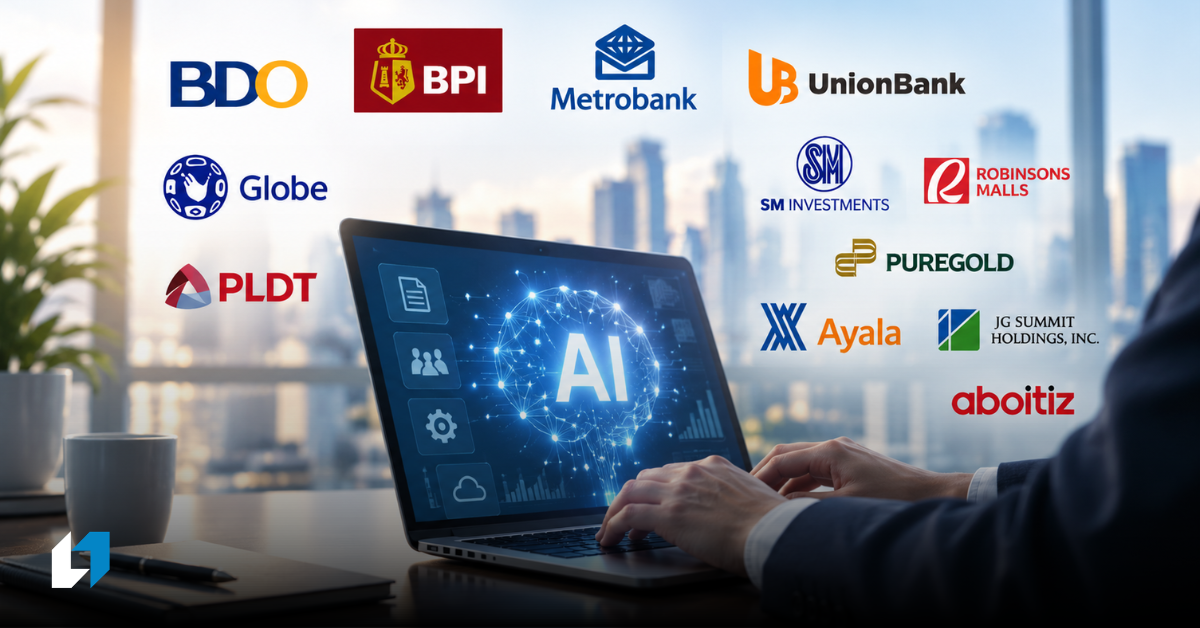
Large banks such as BDO, BPI, Metrobank and UnionBank process huge volumes of transactions every day. They already maintain digital banking platforms, customer records, credit histories, payment data and risk-management systems.
That matters because AI becomes more useful when it has access to large amounts of reliable data.
Banks can potentially use AI to detect suspicious transactions, improve credit assessment, personalize financial products, automate routine customer inquiries and help employees process documents more quickly.
The advantage does not come simply from having an AI chatbot. It comes from connecting AI with the underlying processes that determine how loans are approved, how fraud is detected and how customers are served.
This is consistent with BCG’s broader argument that the most durable AI advantages will increasingly come from assets and relationships that improve with scale and use rather than from AI tools that competitors can easily acquire.
Telecommunications companies have both data and infrastructure
Globe and PLDT may also be relatively well positioned.
Telecommunications companies already operate sophisticated networks and handle millions of customer interactions. Their systems continuously generate information about network performance, service usage, customer behavior and equipment.
AI can potentially help predict network failures, optimize capacity, improve customer service and identify customers at risk of leaving.
More importantly, telecommunications companies already possess something many smaller businesses lack: large technology organizations capable of integrating new systems into existing operations.
That implementation capability could become increasingly valuable because global research suggests the biggest challenge is no longer gaining access to AI. It is changing the organization around it.
BCG argues that the structural advantage of AI-native competitors is organizational rather than purely technological. The biggest obstacles for established companies are often talent, workflows and culture rather than access to the technology itself.
Retailers could turn transaction data into an advantage
Large Philippine retailers may have another important advantage: enormous amounts of purchasing and inventory data.
Groups such as SM, Robinsons and Puregold operate large store networks where millions of transactions generate information about what customers buy, when they buy it and how purchasing patterns change across locations.
AI could help retailers improve demand forecasting, inventory allocation, promotional planning and pricing.
Consider something as simple as inventory.
A traditional system may use historical sales to estimate how much stock a store should carry. An AI-enabled system can potentially combine sales history with weather, holidays, local events, promotions and changing customer behavior to refine those forecasts.
Even small improvements can matter when they are applied across hundreds of stores and thousands of products.
The same logic applies to supply chains. Better forecasting can reduce stock-outs without requiring retailers to carry excessive inventory. That can improve both customer satisfaction and working-capital efficiency.
Conglomerates may gain from scale across businesses
Large diversified groups such as Ayala, SM Investments, JG Summit and Aboitiz may also have an advantage because AI capabilities developed in one business can potentially be shared across others.
A conglomerate may have banking, property, healthcare, retail, logistics or energy businesses under the same corporate umbrella.
The use cases may differ, but the infrastructure needed to support them often overlaps.
The same group can build capabilities in data governance, cybersecurity, AI training and cloud infrastructure, then spread those capabilities across multiple subsidiaries.
Scale therefore matters in a different way.
The advantage may not come from spending more on a single AI application. It may come from spreading the cost of building AI capabilities across many businesses.
The BPO industry faces both the biggest opportunity and the biggest risk
For the Philippines, perhaps no industry faces a more consequential AI transition than business process outsourcing.
Many BPO activities involve knowledge work that AI can increasingly assist or automate, including customer support, document processing, research and routine administrative tasks.
That creates obvious risks.
But it also creates an opportunity for Philippine outsourcing companies to move up the value chain.
Instead of selling labor hours, BPO companies could increasingly sell AI-enabled services that combine human judgment with automation.
Customer service agents could handle more complex cases while AI resolves routine inquiries. Accounting teams could use AI to review transactions before humans examine exceptions. Research teams could use AI to gather information while analysts focus on interpretation.
The companies that learn to redesign these workflows may become more productive and more competitive internationally.
Those that continue selling essentially the same labor-intensive service could face pressure as clients adopt AI themselves.
SMEs face a different challenge
The situation is more complicated for small and medium enterprises.
Access to AI itself is no longer the biggest barrier. A small Philippine business can use many of the same generative AI tools available to large corporations.
An entrepreneur can use AI to draft marketing materials, answer emails, prepare presentations, summarize documents or generate ideas.
These applications can save time.
But saving an employee an hour does not necessarily transform the economics of a company.
PwC’s study suggests that the largest financial gains occur when companies go beyond isolated productivity improvements and redesign how the business operates. The highest-performing companies were more likely to use AI to pursue growth opportunities and reinvent business models, rather than simply reduce costs.
That creates a different challenge for Philippine SMEs.
Many still rely heavily on spreadsheets, manual processes and fragmented records. Customer information may sit in one system, inventory in another and accounting records somewhere else.
AI cannot easily optimize a business when the underlying information is incomplete or disconnected.
The first step for many SMEs may therefore have little to do with buying more AI.
It may be digitizing workflows, organizing data and defining processes clearly enough that AI can eventually work with them.
The real advantage may be management
This leads to perhaps the most important lesson from the global research.
The companies most likely to benefit from AI may not necessarily be the ones spending the most money on technology.
They may be the ones whose leaders are willing to redesign the organization.
PwC found that AI leaders are more likely to rethink workflows rather than simply place AI tools on top of existing processes. BCG similarly argues that organizations need to redesign work around what AI can now do instead of using the technology merely to support traditional ways of operating.
That changes the question management should ask.
Instead of asking, “Which AI platform should we buy?” executives may need to ask, “Which part of our business should work differently because AI now exists?”
For a bank, that could be credit evaluation.
For a retailer, it could be inventory planning.
For a telecommunications company, it could be network maintenance.
For a BPO company, it could be the division of work between AI and human agents.
For an SME, it could be something as basic as automating the process from customer inquiry to order fulfillment.
The technology may be increasingly accessible. The ability to reorganize a business around it is not.
That could ultimately determine which Philippine companies benefit most.
Artificial intelligence may therefore create a competitive divide, but not simply between large companies and SMEs. Some smaller businesses may move faster precisely because they have fewer legacy systems and less bureaucracy.
The more important divide may be between companies that treat AI as another software tool and those that use it as an opportunity to rethink how they create value.
If the global evidence is correct, that distinction may eventually show up not only in productivity, but in revenue growth, margins and market share.
And by then, the companies that started redesigning themselves early may already be difficult to catch.

