

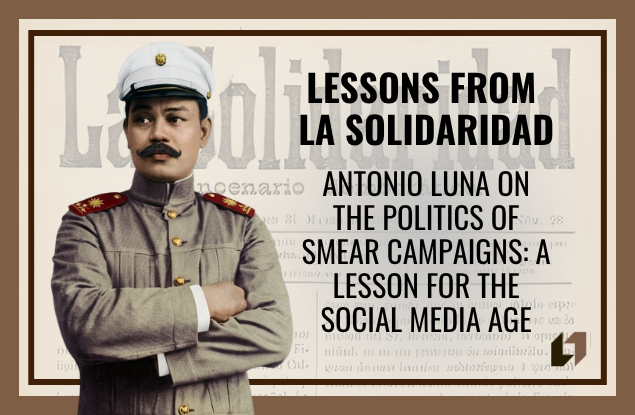
In April 30, 1890, Antonio Luna published an essay in La Solidaridad titled “The Lady Teacher of My Town (Philippine Sketch).”
At first glance, the piece reads like a simple story about a teacher named Jacinta. But beneath the narrative lies a sharp critique of a tactic that remains familiar even today: character assassination.
Luna describes Jacinta as a respected teacher who ran a girls’ school in a small town. She was admired by parents and students and was known for the care she showed her pupils.
He writes that she managed her school with the attention of a devoted guardian:
“Miss Jacinta received boarding students in her house who were looked after with all the care of a loving mother.”
Jacinta was not merely teaching etiquette. She wanted her students to become educated women capable of participating in society.
Luna explains that she tried to combine modern education with Filipino values:
“She tried to give her students an education which was almost European mixed with our Filipino simplicity and modesty.”
Her school even organized cultural activities for the community.
Luna writes:
“She organized concerts, dances, literary programs in her school which served for pleasant recreations for her students.”
These events were attended by parents and relatives.
“These programs were attended by tatays and nanays, their friends and relatives, and therefore were almost informal family reunions.”
Everything seemed normal—until rumors suddenly began to circulate.
When Reputation Becomes the Target
Despite Jacinta’s good work, accusations began to spread in the town.
Luna writes that the news of her removal spread quickly:
“The news of the dismissal of the teacher was heard and it was said that several outstanding citizens called for her expulsion for giving dances and parties scandalous to the town.”
What had once been harmless cultural activities were suddenly described as immoral.
Soon after, Jacinta lost her job.
Luna states plainly:
“She was dismissed from the municipal school.”
The implication in Luna’s story is clear: Jacinta’s downfall was not caused by poor teaching or misconduct, but by a deliberate effort to destroy her reputation.
Rumors had become a weapon.
The Mechanism of Character Assassination
Luna’s story illustrates a familiar pattern.
First, an individual gains influence or respect in the community.
Then someone with power or influence begins to feel threatened.
Finally, accusations—often moral or personal—are circulated to damage that person’s reputation.
The accusations do not need to be proven. They only need to be repeated.
Once the rumors spread, public perception begins to change.
The person’s achievements are forgotten, and attention shifts entirely to the accusations.
In Jacinta’s case, the accusation was that her school events were “scandalous.” That was enough to remove her.
The Same Pattern in the Age of Social Media
More than a century later, the same mechanism continues to operate—only faster.
In Luna’s time, rumors spread through gossip and word of mouth. Today they spread through social media.
A single post can reach thousands or even millions of people within hours.
Reputation can be damaged almost instantly.
Just as Jacinta was accused of immorality without clear evidence, modern individuals—whether teachers, professionals, journalists, or public figures—can suddenly find themselves targeted by online attacks.
A rumor, a misleading video clip, or an out-of-context statement can trigger a wave of criticism and condemnation.
The phenomenon is now commonly called “cancel culture,” online harassment, or digital character assassination.
The Power of Repetition
One of the most powerful insights in Luna’s story is how repetition transforms rumor into perceived truth.
Once people begin repeating an accusation, others assume it must be credible.
By the time the accused person responds, the narrative may already be fixed.
In Jacinta’s case, the accusation that her gatherings were “scandalous” overshadowed the fact that parents and families had attended those events.
Her reputation was destroyed not by evidence, but by perception.
Luna’s Warning
Toward the end of the essay, Luna offers a reflection that goes beyond the story itself.
He writes:
“What do you expect? The fault lies in those who are worthy of despotism which oppresses them.”
The statement is harsh, but it carries a warning.
When society allows rumor and authority to destroy individuals without questioning the accusations, injustice becomes easier to sustain.
A Lesson That Still Applies
Antonio Luna wrote his essay in 1890 to expose how power and rumor could be used to silence capable individuals.
More than a century later, the technology has changed, but the pattern remains the same.
Where gossip once spread in town plazas, it now spreads on digital platforms.
Where accusations once traveled slowly, they now move at the speed of a click.
But the underlying lesson Luna offered remains relevant: reputation can be destroyed not only by wrongdoing, but by rumor—and societies that accept rumor without scrutiny risk silencing the very people who contribute to their progress.

