

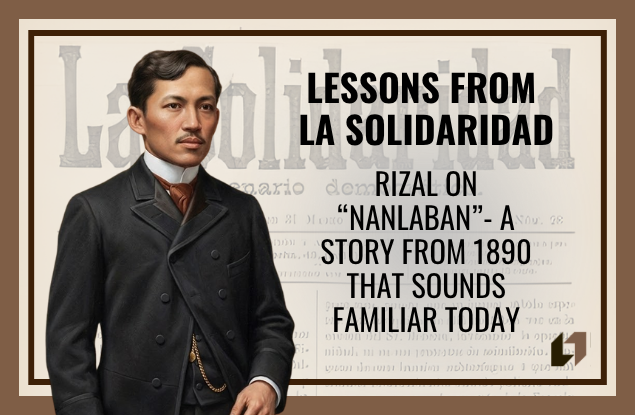
In the April 30, 1890 issue of La Solidaridad, José Rizal wrote a striking commentary about an incident in Negros. The story he described is unsettling not because it is unfamiliar—but because it sounds eerily similar to explanations often heard today when suspects are killed during police operations.
Rizal recounts the case of a tenant who had killed his landlord. Instead of fleeing, the man surrendered to authorities.
“A tenant killed his landlord and immediately presented himself to the authorities, giving an account of what he had done.”
The man was then placed under the custody of the Civil Guard and transported to Bacolod to face trial. But something happened along the way.
Rizal writes:
“On the way they shot the criminal twice saying that ‘in a fit of madness, he had tried to escape.’”
Rizal immediately points out the contradiction. If the man had already surrendered voluntarily, why would he suddenly attempt escape?
He writes with unmistakable irony:
“How incongruous this looks! Trying to escape after he had given himself up voluntarily.”
This single line captures Rizal’s skepticism. The explanation offered by the authorities did not make sense.
More troubling for Rizal was how the incident was treated by certain newspapers. Instead of questioning the killing, some writers described it as a “providential act.”
Rizal reacts sharply to this justification.
“To call the act ‘providential’ is not only an insult to the porter—I mean, the civil guard—but to the laws and the authorities.”
He compares the reasoning to someone breaking a mirror and then claiming it was an act of Providence.
“There are providential acts which happen so that some gifts be broken.”
Rizal’s sarcasm is clear. Calling the killing “Providence” was simply a convenient way to avoid accountability.
He then turns to the broader implication. If suspects who surrender can still be killed, what incentive remains for criminals to cooperate with the law?
Rizal warns:
“If criminals are to be treated in this manner, then there will no longer be criminals who will surrender or submit to arrest.”
In other words, once people believe the justice system will not protect them, they may choose resistance over surrender.
Rizal also criticizes the colonial press for celebrating the act rather than questioning it.
“Something like a nauseating smell of garbage can be inferred: the desire not that the criminal be given justice, but that the criminal be killed.”
For Rizal, the disturbing element was not just the killing itself but the public reaction. Justice had been replaced by vengeance.
He explains that such thinking ultimately weakens the rule of law.
“Since the law has no longer any hold or prestige… the courts no longer enjoy the confidence of anybody.”
Once trust in the justice system disappears, Rizal argues, society itself becomes more dangerous.
“He who commits a crime should be considered a desperate man—a wild beast—and to live, he must perpetuate his evil exploits.”
Rizal saw clearly that abuse of power creates the conditions for more violence.
A disturbing parallel in the modern Philippines
More than a century later, Rizal’s account feels unsettlingly familiar.
In recent years, many killings during police operations in the Philippines have been justified with the explanation that the suspect “nanlaban”—that the suspect fought back.
Just as in Rizal’s story, the official narrative often describes a suspect attempting escape or attacking authorities.
The similarity lies not only in the explanation but in the logic behind it.
Rizal already questioned that logic in 1890.
“How incongruous this looks!”
His argument was simple. If a suspect had already surrendered, claiming that he suddenly tried to escape raises obvious questions.
More importantly, Rizal warned about the long-term consequences of such practices.
If the public believes suspects can be killed even after surrendering, trust in law enforcement and the justice system begins to erode.
That warning remains relevant today.
When extrajudicial killings occur—or when deaths during police operations are explained only through official narratives—the public inevitably asks the same questions Rizal asked.
Was there due process?
Was the suspect given a chance to stand trial?
Was justice served?
Rizal’s deeper lesson
Rizal’s article was not merely about one incident in Negros. It was about the dangers of allowing violence to replace justice.
His warning was clear:
“If criminals are to be treated in this manner, then there will no longer be criminals who will surrender.”
When people lose faith in the law, the law loses its power to govern.
More than a century later, Rizal’s words still echo in debates about policing, accountability, and human rights.
The story he described in 1890 reminds us that the struggle between justice and expediency is not new.
And that explanations such as “he tried to escape”—or in modern language, “nanlaban”—have a long and troubling history.

