

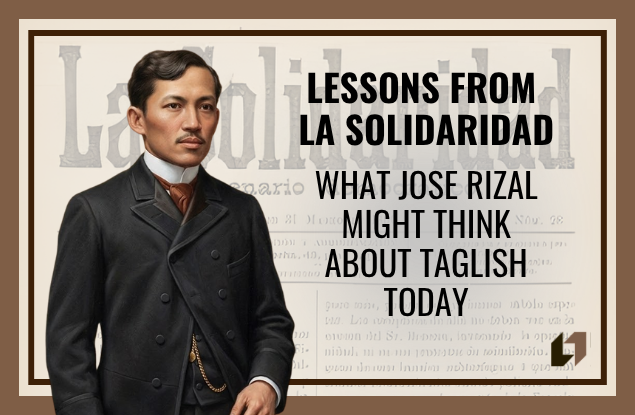
On April 15, 1890, José Rizal published an essay in La Solidaridad titled “On the New Orthography of the Tagalog Language (A Letter to My Fellow-Countrymen).” The newspaper at the time was edited by Marcelo H. del Pilar.
The essay is usually remembered as a technical discussion about spelling reform. But beneath the linguistic debate lies something more interesting: Rizal’s sharp observations about the nature of Tagalog itself—how Filipinos spoke it, how it was taught, and how foreign systems distorted it.
Ironically, many of the issues Rizal observed in 1890 still echo today in the Philippines, particularly in the widespread use of Taglish, the mixture of Tagalog and English that dominates everyday speech.
Rizal’s First Observation: Tagalog Was Being Forced Into a Foreign System
Rizal began by describing the confusion Filipino children experienced in school.
They were forced to memorize Spanish spelling rules that did not match the sounds of Tagalog.
He wrote:
“The great difficulty the children encountered when they got to the syllables ca, ce, ci, co, ga, ge, gua, gue, gui, since they could not see the reason for the irregularities.”
Because Tagalog did not actually use these sound combinations, students struggled to understand them.
Rizal vividly described what happened in classrooms:
“The whips came down, the punishments came increasingly, the little hands were slapped, the ferule snapped… the children cried.”
For Rizal, this was not simply a problem of spelling.
It showed that Tagalog was being taught through a foreign linguistic framework that ignored how Filipinos actually spoke.
Rizal Observed That Tagalog Had Its Own Natural Logic
Rizal pointed out that Tagalog followed its own sound patterns.
He explained that many of the Spanish spelling rules were unnecessary because those sounds simply did not exist in Tagalog.
He wrote:
“In our language… we do not have either the ce nor the ci, neither the ge nor the gi.”
This meant that Tagalog was naturally simpler and more phonetic than Spanish.
Words tended to be written the way they were pronounced.
Rizal believed that if the language were allowed to follow its natural structure, learning it would be far easier.
Rizal Also Noticed That Tagalog Was Flexible
Another observation Rizal made was that language constantly evolves.
Even in his time, Tagalog writers were already experimenting with different forms.
He noted that scholars and writers were adopting new ways of writing.
“This orthography has been adopted not only by Tagalog writers like Pedro Serrano, Marcelo H. del Pilar, and others.”
Rizal recognized that languages are never static.
They change as people use them.
From Spanish Influence to English Influence
In Rizal’s time, Tagalog was being shaped by Spanish colonial influence.
Today, the dominant foreign influence is English.
Instead of Spanish syllables like ce and ci, Filipinos now mix English words directly into everyday speech.
This has produced what many call Taglish.
In ordinary conversations today, sentences often sound like:
“Mag-meeting tayo tomorrow.”
“Na-download mo na ba yung file?”
“I’ll message you later.”
This blending of languages reflects the Philippines’ complex linguistic environment.
In a way, the situation is similar to what Rizal observed more than a century ago.
Foreign linguistic systems continue to interact with Tagalog.
Rizal Believed Language Reflects Identity
Despite foreign influences, Rizal described Tagalog with admiration.
Toward the end of the essay he referred to it as:
“our melodious language.”
For Rizal, Tagalog was not a crude dialect but a language with its own elegance and logic.
He believed it deserved to be studied seriously.
He also noted that scholars outside the Philippines had begun paying attention to it.
He mentioned the Austrian scholar: Ferdinand Blumentritt.
Rizal wrote:
“Foreign scholars like Blumentritt… are always interested in everything concerning the Philippines.”
This recognition reinforced his belief that Filipino language and culture were worthy of intellectual respect.
What Rizal Might Think About Taglish Today
If Rizal could hear everyday conversations in Manila today, he might be surprised by how much Tagalog has absorbed English words.
But he would probably also recognize something familiar.
Languages evolve as societies change.
Tagalog absorbed Spanish influences during Rizal’s time. Today it absorbs English.
The deeper issue Rizal raised still applies: a language should be understood according to how its speakers actually use it.
The widespread use of Taglish today shows that Filipino language continues to adapt to new cultural realities.
Rizal’s Observation Remains True
More than a century ago, Rizal noticed that Tagalog had its own rhythm, structure, and logic.
He warned against forcing it into rigid foreign frameworks.
His insight still resonates today.
Languages grow not through rules imposed from above, but through the living speech of the people who use them.
In that sense, the evolution of Tagalog—from Spanish influence in Rizal’s time to English influence today—simply reflects the same truth Rizal already understood in 1890: language is alive, and it changes with the nation that speaks it.

