

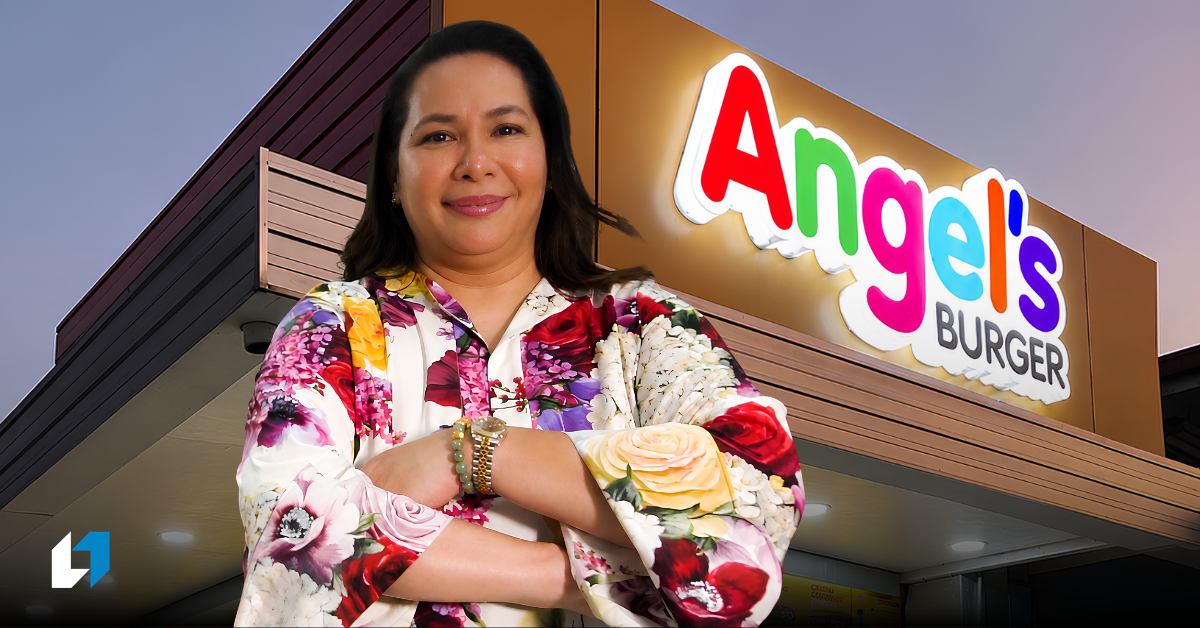
Entrepreneurship rarely follows a straight line. Many successful businesses are built only after founders experiment with different ideas, learn from setbacks, and gradually discover what works.
For Vicky Mojica, co-founder of the popular burger chain Angel’s Burger, the road to building a recognizable brand involved several food ventures that came before it.
By the mid-1990s, Mojica and her husband were already operating multiple hamburger stores. Their early business had expanded significantly, growing from a single stall in Quezon City to several locations.
“Over the years bago mag 1997, naging 13 na tindahan namin,” Mojica recalls.
Yet despite strong sales, Mojica began noticing something puzzling about the business.
“Pero parang kulang lagi yung kita namin kasi magbabayad ka ng stock pero wala ka pang pera,” she says.
In other words, revenue was coming in, but cash flow remained tight.
Experimenting with new food concepts
Rather than relying solely on the burger stores, Mojica began exploring other food ideas.
“Sabi ko bakit kaya, malakas naman yung tindahan,” she says.
To supplement their income, the couple decided to launch additional food businesses alongside their hamburger stores.
One of the first ventures was a small eatery serving a popular Filipino comfort dish.
“So nagtayo kami ng ibang negosyo alongside yung hamburger business namin,” Mojica says. “Yung pinangalan ko sa una kong anak na si Cholo, Cholo’s Goto.”
The business was personal in more ways than one.
“Ako nagluluto nun,” she says.
Cholo’s Goto operated as a simple food stall offering goto, a Filipino rice porridge commonly eaten for breakfast or late-night meals. The concept reflected the kind of small food businesses that many Filipino entrepreneurs experiment with when trying to find additional income streams.
But running multiple food ventures at the same time proved difficult.
The stall was located near her mother-in-law’s store in Kamias, Quezon City, but Mojica eventually had to step away from the business.
“Kaso nagbubuntis ako dito sa pangalawang anak ko,” she says. “So pinatigil din ako ng husband ko.”
Launching another restaurant
After giving birth, Mojica once again tried a different food concept.
“Nung finally napanganak ko siya, nagtayo naman ako ng Joma’s Bulalo,” she says.
The restaurant was named after their second child.
“It was named after him.”
Unlike Cholo’s Goto, which was a small food stall, Joma’s Bulalo operated more like a restaurant.
The location was promising.
“Malakas yon, nasa tabi siya ng tollgate sa Valenzuela,” Mojica recalls.
The high traffic area meant strong customer demand. But the restaurant business also introduced a new set of operational challenges.
“Kaso syempre, restaurant yun, maraming nawawala dun sa negosyo,” she explains.
Running a full restaurant involves more complex operations than running a food stall. Inventory management, staffing, and operational oversight become much more demanding.
Losses and inefficiencies can easily erode profits if the business is not tightly managed.
Focusing on what works
After experimenting with several food ventures, Mojica’s husband eventually made a decision that would shape the future of their business.
“Sabi ng husband ko, ‘mag-concentrate na lang tayo talaga sa hamburger,’” she recalls.
The realization reflected a common turning point for entrepreneurs.
Trying multiple businesses can be a valuable learning process, but long-term success often requires focus. Businesses that spread their resources across too many ventures may struggle to build strong systems and brand identity.
For Mojica and her husband, the experiments with Cholo’s Goto and Joma’s Bulalo helped clarify an important insight: their real strength was in the burger business.
Learning through experimentation
The experience highlights an important truth about entrepreneurship.
Many founders discover the right business not by getting it right the first time, but by testing different ideas and learning from each attempt.
Side ventures, even when they do not become long-term successes, can reveal important lessons about operations, customer demand, and the limits of a business model.
For Mojica, the experiments with different food concepts helped refine their understanding of what kind of business they wanted to build.
Eventually, the couple made a pivotal decision: instead of continuing to operate other brands, they would focus on creating a hamburger concept of their own.
That decision would later lead to the launch of Angel’s Burger—the brand that would grow into one of the most recognizable burger chains in the Philippines.

