

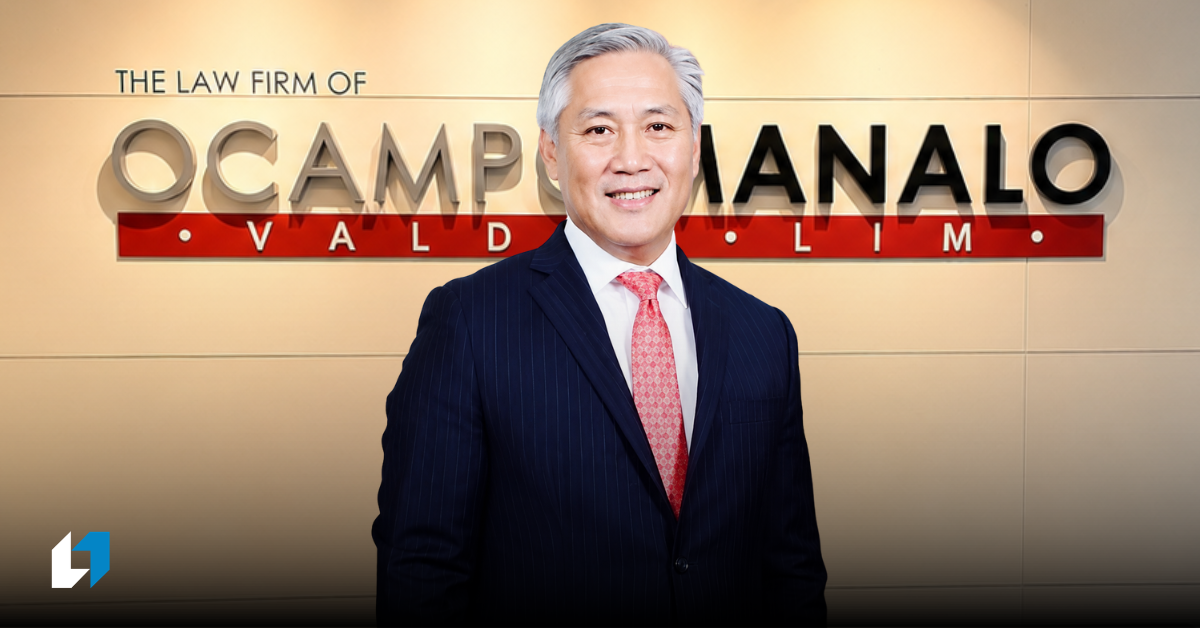
When most lawyers graduate, the allure of litigation is hard to resist. The courtroom offers drama, victories, and the thrill of verbal sparring before a judge. But for Atty. Carlos Ocampo, founding partner of what is now Ocampo, Manalo, Valdez, and Lim Law, the pull of corporate and commercial law proved far stronger.
In an interview with Financial Adviser PH, Ocampo explained why he turned away from the courtroom battles many of his peers pursued.
“In litigation, even when you win, sometimes you don’t really win,” he said. “The client still has to execute the judgment—collect payments, enforce orders. It’s not over.”
That realization came early in his career. Ocampo wanted his work to translate into tangible results for clients, outcomes they could celebrate as soon as a deal was signed.
“But in commercial law, when you close a deal, when your client acquires something, expands, or secures financing, you see them succeed. You see them grow. That’s a different kind of fulfillment,” he added.
Building Beyond Compliance
For Ocampo, commercial law wasn’t just about compliance—it was about enabling growth. The transition demanded a shift in mindset, from guarding against risks to exploring opportunities.
“Instead of only thinking about risk and compliance, I started thinking about possibilities and strategies,” he explained. “That thinking made my transition to the boardroom more natural.”
This perspective shaped his role not just as a lawyer, but also as a strategic partner. He became the person clients could count on not only to review contracts but to help navigate expansion, partnerships, and new ventures.
Why the Courtroom Wasn’t Enough
In practice, Ocampo found that litigation was reactive—it dealt with conflicts after they had already happened. Corporate law, by contrast, was proactive. It gave him the chance to shape outcomes before problems arose.
“In the courtroom, you’re usually dealing with disputes that already damaged relationships. In commercial law, you can help prevent those disputes by structuring agreements properly,” he shared.
For a lawyer drawn to big-picture thinking, this was the right arena. “Helping clients execute their strategy became more meaningful to me than arguing over past mistakes,” he said.
A Deal-Maker’s Orientation
This shift also honed what Ocampo calls a “deal-making orientation.” It’s a way of thinking that goes beyond legal drafting—it’s about seeing the client’s ultimate objective and finding the clearest path to achieve it.
“When your client succeeds—when they get funding, close a merger, or expand into new markets—you’re part of that win. That fulfillment is very different from hearing a judge declare victory,” he noted.
This deal-making lens proved to be a powerful foundation when Ocampo later entered the corporate world himself, joining boards and guiding companies through governance and strategy.
Lessons for Young Lawyers
For younger lawyers considering their own paths, Ocampo’s journey is a reminder that success in law does not have to mean success in litigation.
“The courtroom isn’t the only measure of legal success. You can build just as much, if not more, fulfillment by helping companies grow,” he said.
By choosing the boardroom over the courtroom, Ocampo positioned himself not just as a lawyer, but as a builder of institutions. His story shows that the practice of law can be about more than cases—it can be about creating value, driving growth, and shaping industries.
Key Takeaway
Carlos Ocampo’s choice to pursue corporate and commercial law over litigation was not about avoiding the fight—it was about choosing a different kind of victory. For him, success lies not in courtroom verdicts but in watching clients expand, thrive, and achieve their ambitions.
“Success is built step by step,” Ocampo told Financial Adviser PH. “In commercial law, those steps are visible in the growth of your clients. And that’s a legacy worth building.”

