

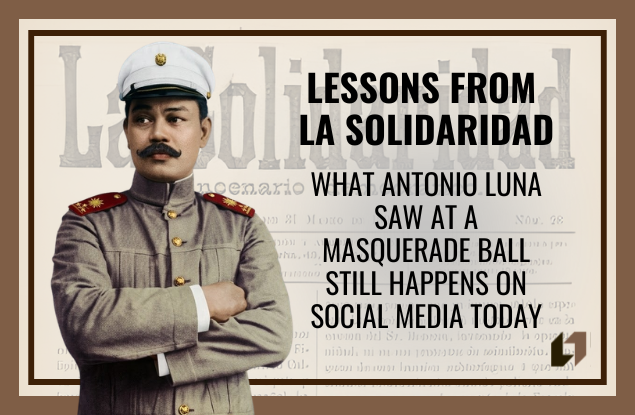
On February 28, 1890, an article titled “The Masquerade Ball” appeared in La Solidaridad. It was written by Antonio Luna under the pen name “Taga-Ilog.”
At first reading, the piece seems to describe a lively social event—a ballroom filled with costumes, music, laughter, and dancing. But Luna was not really writing about a party. The article is a sharp social satire. Through the imagery of a masked ball, he criticizes hypocrisy, vanity, and the obsession with appearances in colonial society.
Society Behind Masks
Luna begins by observing the crowd of masked participants moving through the ballroom. Faces are hidden, identities blurred, and imagination replaces reality.
He writes:
“All that pile of human beings whose faces, covered with masks, do not take us to reality, but giving free rein to the imagination.”
The mask becomes a powerful metaphor. People at the ball hide their true identities behind elegant disguises. But Luna suggests that this behavior is not limited to the ballroom. Society itself functions in the same way.
Individuals present themselves as refined, respectable, or noble, while their real motives remain concealed.
Beauty, Desire, and the Seduction of Appearances
Luna describes the women and costumes with vivid imagery.
At one point he writes:
“Those lips begging and inviting kisses… indications of a living Venus of flesh and blood.”
The atmosphere is intoxicating. Beauty, music, and fantasy blur the boundaries between admiration and temptation.
But Luna’s description also hints at something deeper: the way appearances can captivate people and distort judgment. The masquerade creates a world where fantasy becomes more appealing than truth.
When the Illusion Breaks
In the midst of the spectacle, Luna witnesses a disturbing moment behind a theater door.
He writes:
“That a girl was trying to free herself, while the man was blocking her way… one was laughing and the other cursing.”
Suddenly the elegant atmosphere collapses. Behind the glamour of the ballroom lies a darker reality.
The masquerade hides uncomfortable truths about human behavior.
Luna shows that beneath the elegance of society there may be manipulation, coercion, or exploitation.
The Energy of the Crowd
Luna vividly captures the chaotic excitement of the ballroom.
He writes:
“Amidst the murmur of a hundred voices… loud screams of drunkenness and joy… whispers of masqueraders who flit about, kiss, embrace, cling.”
The mask liberates people from social restraint. When identities are hidden, behavior changes. People act more boldly, more impulsively, and sometimes more recklessly.
In this environment, moral boundaries become blurred.
A Filipino Identity in a European Setting
Luna also observes the mixture of cultural identities present at the ball. Guests appear dressed as Andalusian women, French peasants, aristocrats, and various European characters.
Amid this spectacle he encounters someone representing the Philippines.
The greeting is brief but telling:
“Hello, Filipino! You here?”
The moment reveals the cultural tension of colonial society. Filipinos were present within Europeanized social circles but often treated as outsiders within them.
The masquerade therefore reflects not only personal disguise but also the complicated identity of a colonized people navigating a foreign cultural environment.
The Illusion of Society
As the evening progresses, Luna reflects on the meaning of the spectacle he has witnessed.
He writes:
“How many lies in our eyes and how much metaphor in our thoughts!”
The masquerade ball becomes a metaphor for society itself.
People wear masks not only during the dance but also in everyday life. Reputation, status, and social etiquette often conceal ambition, desire, or hypocrisy.
The elegant ball becomes a stage where individuals perform roles rather than reveal their true selves.
A Satire of Colonial Elite Society
Through this vivid narrative, Antonio Luna exposes the superficiality of elite colonial culture.
The masquerade symbolizes:
-vanity and social pretension
-hypocrisy behind polite manners
-fascination with status and appearances
-hidden motives beneath refined behavior
What appears to be a celebration of elegance becomes, in Luna’s hands, a critique of a society obsessed with appearances.
A Lesson That Still Resonates
More than a century later, Luna’s insight remains strikingly relevant.
Modern society continues to operate through appearances—carefully curated identities, social reputations, and public images. People often present themselves in ways that conceal their true motives.
Luna’s metaphor reminds us that the masks may change, but the tendency to hide behind them does not.
As he observed in 1890:
“How many lies in our eyes and how much metaphor in our thoughts!”
The masquerade continues—only the ballroom has changed.

