

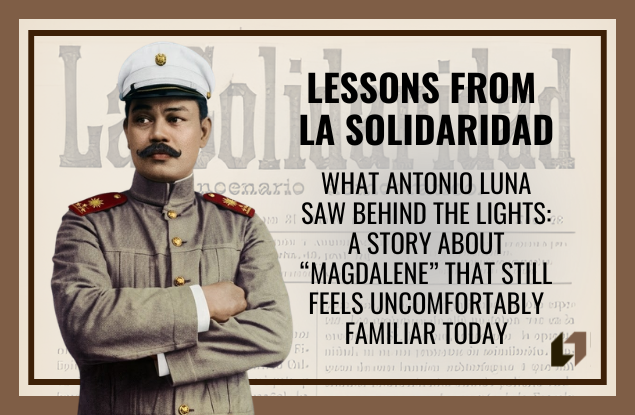
In February 1890, readers of La Solidaridad encountered a deeply moving article titled “Magdalene.” It was written by Antonio Luna—better known in Philippine history for his military brilliance, but equally powerful as a social critic.
The piece is not simply a story about a woman. It is a meditation on poverty, exploitation, and the hypocrisy of society. Through the fictional story of a woman named Magdalene, Luna exposed a reality that many preferred not to see: the suffering hidden behind glamour and moral judgment.
More than a century later, the questions Luna raised remain strikingly relevant.
A Woman Judged by Society
Luna begins by observing how society condemns women like Magdalene without ever trying to understand their circumstances.
“The world condemns her without understanding her; she is not allowed to defend herself, because to hear her is to be soiled.”
With this line, Luna highlights a familiar pattern: people are quick to judge but reluctant to listen.
The woman at the center of the story was not born into degradation. Luna describes her almost poetically as someone who began life with innocence and promise:
“Magdalene is a flower born with the smile of dawn in the Andalusian gardens.”
But like many tragedies, her story changes when love becomes betrayal. Luna writes that the man she trusted mistook desire for love:
“That man for whom her heart had nothing except loving thoughts… took desire to mean love.”
From that moment, Magdalene’s life spirals downward.
Poverty, Betrayal, and the Road to Exploitation
Luna refuses to portray Magdalene as morally corrupt. Instead, he shows how circumstances push vulnerable people into desperate situations.
He writes that many women begin with modest dreams but end up selling their bodies because of poverty and abandonment.
“These young women who start by giving up modesty end by selling their bodies for a handful of silver.”
For Luna, the tragedy is not merely individual—it is social. Magdalene represents countless women caught in a system that profits from their vulnerability.
Prostitution as a Form of Slavery
One of the most powerful passages in the article comes when Magdalene describes her life in prostitution.
She explains that even her earnings are not truly hers:
“Half goes to the Madame… she profits from my body, but she also usurps my freedom.”
She cannot go outside freely. She cannot control her time. Even her health offers no escape.
“When I get sick, the only consolation and refuge I have is San Juan de Dios… I prefer to die a hundred times than to enter that horrible house of suffering.”
Through Magdalene’s voice, Luna presents prostitution as a form of bondage.
The comparison he makes is startling for its time:
“Between the treatment of Negroes and that of white slavery, there was no difference.”
For a writer in 1890, this was a bold accusation. Luna was suggesting that prostitution was not merely a moral issue but a system of exploitation comparable to slavery.
The Illusion of Glamour
Another theme Luna explores is the illusion surrounding prostitution.
From the outside, the world sees elegance: beautiful clothes, graceful smiles, and luxurious surroundings. But Luna reveals the truth hidden beneath the surface.
“Amidst the brightness of artificial lights… elegant clothes hide between their folds loathsomeness and horrible filth.”
What appears glamorous is actually misery disguised as beauty.
The smiles that men see are not expressions of happiness but tools of survival.
“Smiles and glances for sale; kisses and embraces that are bought.”
Luna’s message is clear: the glittering façade hides a system built on exploitation.
Society’s Hypocrisy
Perhaps the sharpest criticism in Luna’s article is directed at society itself.
He notes that the same society that condemns women like Magdalene also creates the demand for prostitution.
Men who seek pleasure in secret are often the first to judge publicly.
Luna writes that when someone tries to help a woman escape that life, society responds with ridicule.
“If a friendly hand stops her… the world will say: ‘He is a simpleton, a fool, a moron.’”
In other words, compassion is mocked while exploitation is tolerated.
A “Pearl Lost in the Mire”
Despite the darkness of Magdalene’s story, Luna never loses sight of her humanity.
He refuses to reduce her to a stereotype.
Instead, he describes her with sympathy and dignity:
“In the arms of delirium… one might perhaps find a good woman, a pearl lost amidst the eddying mire.”
This metaphor captures the essence of Luna’s argument. Magdalene is not simply a fallen woman; she is a human being lost in circumstances beyond her control.
Why Luna’s Message Still Matters Today
More than a century has passed since Antonio Luna wrote “Magdalene,” yet many of the issues he described remain painfully relevant.
Across the world today, millions of women still enter prostitution because of poverty, coercion, or lack of opportunity. Human trafficking and exploitation continue to thrive in many societies.
Luna’s observation about appearances is also strikingly modern. In today’s world of social media and curated images, the gap between outward glamour and hidden suffering may be wider than ever.
And perhaps most relevant of all is Luna’s critique of hypocrisy. Society still often condemns individuals while ignoring the deeper social forces that shape their lives.
A Voice Ahead of Its Time
Antonio Luna is remembered in Philippine history as a brilliant military leader. Yet this article reveals another side of him: a writer deeply concerned with justice and human dignity.
Through the story of Magdalene, Luna forced readers to confront a difficult truth—that behind many social problems lie systems of exploitation that society itself helps sustain.
More than 130 years later, his words still challenge us to look beyond judgment and ask a harder question:
If Magdalene’s tragedy continues in many forms today, have we truly changed—or have we simply learned to hide it better?

