

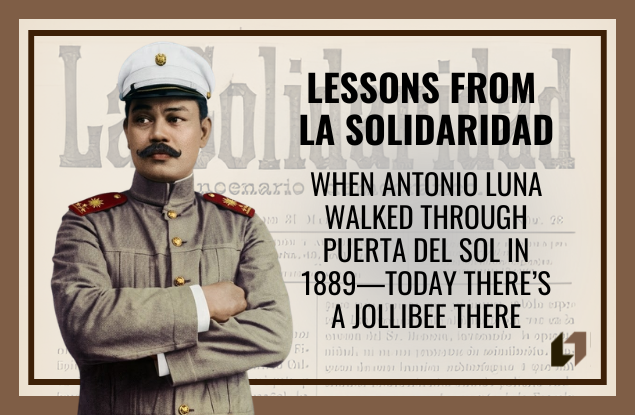
In 1889, long before he became a revolutionary general, Antonio Luna wrote a striking travel essay for La Solidaridad titled “Madrid Impressions of a Filipino.” Writing under the pen name “Taga-Ilog,” Luna described his first encounter with Spain’s capital and what he discovered once the romantic image of Europe faded.
For many Filipinos in the 19th century, Spain represented the pinnacle of civilization. It was the distant center of empire, the land of grand cities and advanced culture. Luna himself admitted that before arriving, he had imagined Madrid almost like a dream.
“Madrid grew before my eyes like a fantastic, dreamy illusion; the beautiful city sung by the poets to me, occupied first place among the grandiose capitals.”
As his ship approached Europe, the city seemed to promise everything that colonial subjects had been taught to admire—magnificent architecture, bustling plazas, and the vitality of European life.
Yet the more Luna observed Spain, the more his expectations began to unravel.
The Reality He Saw in Spain
Traveling by train across the Spanish countryside, Luna noticed something that surprised him: the landscape did not resemble the prosperous Europe he had imagined.
“The mountainous country, arid and dry; nature rachitic and impoverished; uncultivated fields and everywhere, rocks and quarries.”
He recalled a remark made earlier by an Igorot who had been brought to Spain during the Madrid Exposition of 1887:
“Here there is much hunger because there is nothing but stones.”
Compared with the lush tropical forests of the Philippines, the land he saw appeared harsh and barren. Luna began to realize that the image of Europe many Filipinos held was partly a colonial illusion.
Europeans Who Knew Almost Nothing About the Philippines
Luna was even more surprised by the ignorance he encountered among ordinary Spaniards. Despite ruling the Philippines for more than three centuries, many people in Spain seemed to know almost nothing about the archipelago.
He described conversations that revealed the confusion.
“Are you Chinese?”
“No, sir, from the Philippines.”
“And where is that, in China or in America?”
Others assumed that Filipinos, Chinese, and Igorots were all the same.
“To these people Chinese, Igorots and Filipinos are one and the same.”
The experience was jarring. Spain often claimed that the Philippines was an integral part of the empire, yet many Spaniards could not even locate it on a map.
A Filipino Treated Like a Curiosity
Luna also wrote about how his appearance attracted attention in Madrid. His “Malay figure,” as he described it, made him a curiosity to many people.
“My very pronounced Malay figure… excited curiosity… little girls and young women would turn their heads twice or thrice to look at me.”
Sometimes the attention turned into ridicule.
“Small boys and big boys… started to shout like savages: Chinese! Chi-ne-se! Igorot!”
For Luna, the incident revealed a deeper contradiction in the Spanish empire. Filipinos were supposedly Spanish subjects, yet they were treated as exotic foreigners.
The Famous Puerta del Sol
One place Luna was especially eager to see was Madrid’s most famous square, the Puerta del Sol. For Filipinos who had never visited Spain, the Puerta del Sol symbolized the energy and sophistication of the European capital.
At first glance, the square indeed appeared lively.
“What would the Puerta del Sol be? Center of flurry and of life… where the omnibuses, the coaches, the crowded throng meet.”
But the more Luna watched the scene, the more puzzled he became. Instead of a place of activity, he saw crowds of people standing around idly for hours.
“What struck my curiosity was the large number of idle people… I do not know and never found out what they were there for.”
Even the people of Madrid joked about the square’s reputation.
“The people of Madrid say of the Puerta del Sol: a coach-house with a central fountain for the mules.”
For Luna, this was another moment when expectation collided with reality.
Puerta del Sol Today
More than a century later, the Puerta del Sol remains the symbolic heart of Madrid. It is still crowded, but for very different reasons. Tourists gather there to see the famous clock tower that marks Spain’s New Year countdown, street performers entertain visitors, and shops and cafés fill the surrounding streets.
Ironically, one of the most recognizable establishments near the square today is a branch of Jollibee—a reminder that Filipinos now travel freely across the world and even bring their own culture into the very heart of Spain’s capital.
The presence of Jollibee just steps from the Puerta del Sol would likely have amused Luna. In 1889, Filipinos were treated as curiosities in Madrid. Today, Filipino food is part of the city’s everyday landscape.
Luna’s Warning to Filipinos
At the end of his essay, Luna offered a caution to his readers back home. Filipinos, he said, should not be too easily dazzled by romantic images of Europe.
“Filipinos who are in the Philippines, do not be carried away by the song of the siren… the disenchantment is terrible.”
The more people elevate something into myth, the harsher the disappointment when reality appears.
A Lesson That Still Feels Modern
Although written in 1889, Luna’s reflections still resonate today. His essay was not merely about Madrid. It was about the psychology of colonial societies—the tendency to idealize distant powers and assume that everything foreign must be superior.
By describing Spain honestly, Luna quietly dismantled that illusion.
The young Filipino scientist who wandered through Madrid’s streets realized something important: the empire that ruled the Philippines was not as grand, nor as enlightened, as many had imagined.
And once that illusion disappeared, it became easier to imagine a different future for the Filipino nation.

