

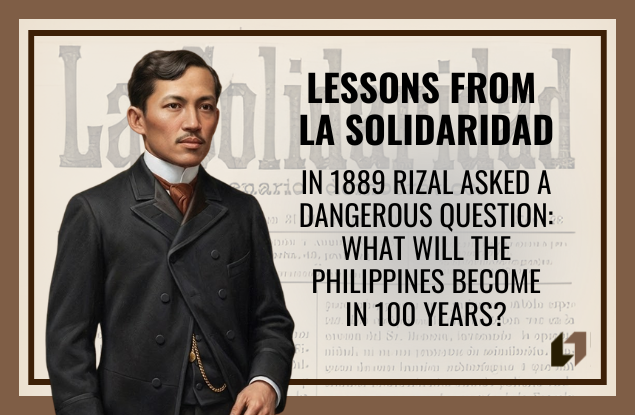
In October 1889, José Rizal published one of the most remarkable essays of the Propaganda Movement in the reformist newspaper La Solidaridad.
The essay carried a bold title: “The Philippines a Century Hence.”
At a time when Spain had ruled the Philippines for more than three centuries, Rizal asked a question that few dared to raise publicly:
What will become of the Philippines within a century?
Will it remain a Spanish colony?
For colonial authorities, even asking such a question was dangerous. But Rizal believed that the future of the Philippines could be understood by examining the forces already shaping the country.
His essay was not merely political criticism. It was a careful historical analysis of why colonial rule had lasted so long—and why it might not last forever.
Why Spain Had Maintained Control
Rizal began by explaining why Spain had been able to govern the archipelago for centuries despite the vast distance from Europe.
The Philippines, he wrote, was a fragmented land of islands where communication between provinces was slow and difficult. Communities remained isolated, and travel was rare.
These conditions prevented the formation of a unified national consciousness.
Spanish authority was also maintained by surprisingly small forces. At times only a few hundred Spanish soldiers were enough to maintain order across the colony.
Spain’s rule did not depend solely on military strength.
It depended on the lack of unity among the inhabitants.
A Changing Philippines
But Rizal observed that the conditions that sustained colonial rule were beginning to change.
Education was spreading. Steamships and telegraphs were improving communication. Filipinos were traveling abroad to study.
A new class of educated Filipinos was emerging—lawyers, writers, professionals, and students exposed to ideas circulating in Europe.
Rizal described them as the “brain of the nation.”
Through education and the exchange of ideas, Filipinos were beginning to understand their common experiences.
Local grievances were slowly transforming into national consciousness.
Rizal’s Warning to Spain
Rizal did not initially call for independence.
In fact, he still believed the Philippines could remain part of Spain if reforms were implemented.
He proposed:
- equal rights for Filipinos
- representation in Spanish institutions
- an end to abuses by colonial authorities
- expansion of education
But he also issued a warning.
If Spain refused to introduce reforms, resentment would grow.
And eventually, a political rupture could occur.
Rizal asked a simple but dangerous question:
What will become of the Philippines within a century if the present system continues?
What Actually Happened After 100 Years
History answered Rizal’s question far sooner than he expected.
Just seven years after his essay was published, the Philippine Revolution erupted in 1896.
Two years later, Spain lost the Philippines after the Spanish–American War of 1898.
But independence did not immediately follow.
Instead, the Philippines became a colony of the United States.
The country would experience another war—the Philippine-American War (1899–1902)—before eventually moving toward self-government.
In 1946, after World War II, the Philippines finally achieved full independence.
Over the next decades, the nation went through dramatic transformations:
- democratic experiments
- authoritarian rule under Ferdinand Marcos
- the People Power Revolution of 1986
- economic growth and political instability
- globalization and migration
By 1989, exactly one hundred years after Rizal wrote his essay, the Philippines was no longer a colony.
But it was still wrestling with many of the problems Rizal had identified: inequality, political division, and the struggle to build a strong national identity.
Was Rizal Right?
In many ways, Rizal proved remarkably accurate.
He predicted that education would awaken national consciousness.
He warned that colonial oppression could not permanently suppress intellectual progress.
He foresaw that if reforms were denied, revolution might follow.
History confirmed all three.
But Rizal’s vision of the future also carried an implicit hope: that once Filipinos understood themselves as a nation, they would build a society grounded in freedom, dignity, and civic responsibility.
That part of the prophecy remains unfinished.
Rizal’s Question Still Matters Today
More than a century later, Rizal’s question still echoes.
The Philippines is no longer a colony.
Yet the deeper question remains the same:
What kind of nation will Filipinos build?
Rizal believed that the destiny of the country would ultimately depend not on foreign powers but on the character, unity, and vision of its people.
In 1889 he dared to imagine the Philippines a hundred years into the future.
Today, more than 135 years later, the question he raised still challenges every generation of Filipinos.
What will the Philippines become next?

