

For years, Southeast Asia’s technology story revolved around population growth, rising internet penetration, and the rapid expansion of digital consumers.
Investors poured billions into e-commerce, fintech, ride-hailing, and online platforms across Indonesia, Vietnam, Singapore, and the rest of the region because many believed the next generation of technology giants would emerge from Southeast Asia’s massive user base.
But the artificial intelligence boom now unfolding may be changing that narrative entirely.
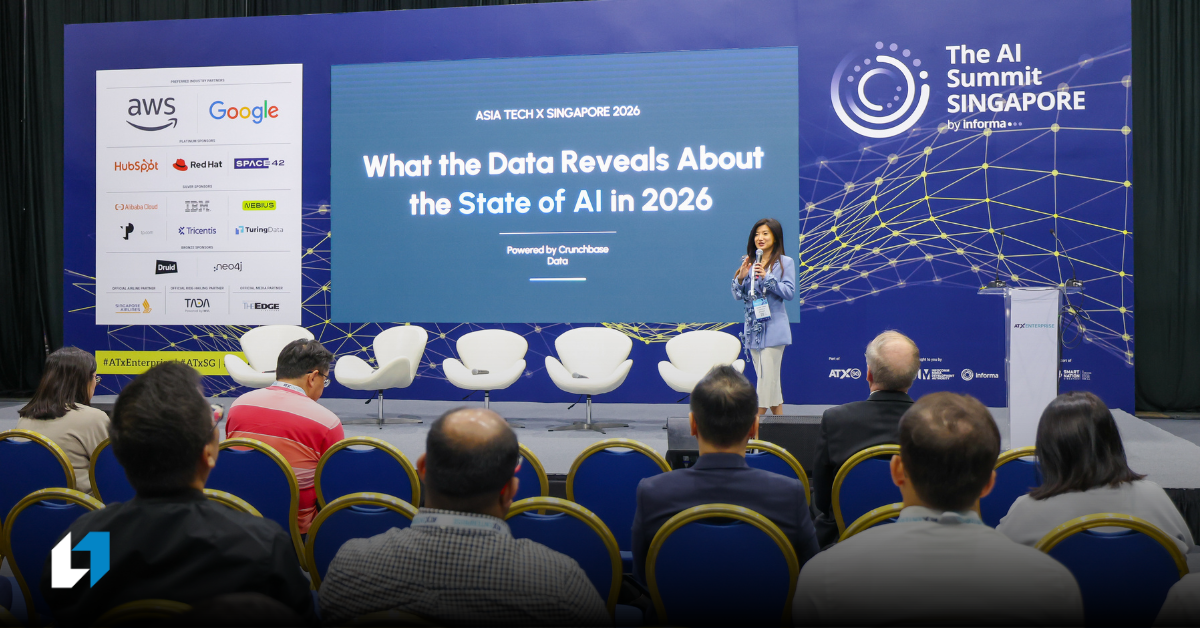
Instead of spreading broadly across the region, AI funding increasingly appears to be concentrating within a single country. And according to data presented by Jeanie Fang, Director of AI and Data Management at Crunchbase, during ATxEnterprise 2026 in Singapore, that country is overwhelmingly Singapore
Fang explained during the presentation that nearly all Southeast Asia AI funding in the first quarter of 2026 went to Singapore. Even broader startup funding across Southeast Asia increasingly shifted toward the city-state after earlier years when capital spread more evenly across Indonesia, Vietnam, and the rest of ASEAN.
This represents a major structural shift from the earlier Southeast Asian startup cycle.
From Consumer Internet to AI Infrastructure
During the previous decade, venture capital firms focused heavily on consumer internet expansion. Indonesia attracted enormous investor enthusiasm because of its massive domestic market and fast-growing digital economy. Vietnam drew strong investor attention because of manufacturing expansion, software development growth, and rising startup activity.
Capital flowed aggressively across the region into digital consumer ecosystems that benefited from rapid user growth, rising smartphone penetration, and expanding online commerce.
The earlier internet cycle rewarded user growth and market size.
But the AI cycle now unfolding appears to reward something very different.
The data presented by Crunchbase suggests that AI funding globally increasingly concentrates into infrastructure, enterprise systems, governance, workflow integration, and foundational platforms rather than broad consumer applications.
This shift naturally favors Singapore.
Why Singapore Keeps Attracting the Capital
Unlike many neighboring economies, Singapore already possesses several structural advantages that matter enormously in an AI-driven economy. The country operates as Southeast Asia’s financial center, regional enterprise headquarters hub, data infrastructure center, and venture capital gateway.
Singapore also offers stronger regulatory predictability, deeper institutional capital pools, higher enterprise technology adoption, and closer integration with multinational corporations.
More importantly, Singapore spent years building institutional trust around technology, governance, cybersecurity, and digital infrastructure long before the current AI boom emerged.
This matters because enterprise AI increasingly depends not only on intelligence itself, but also on secure infrastructure, governance systems, enterprise-grade deployment capability, data controls, compliance systems, and operational reliability.
Fang emphasized during the presentation that the AI market is becoming more concentrated, more selective, and far more infrastructure-driven.
In effect, the AI economy increasingly rewards ecosystem depth rather than consumer scale alone.
AI May Reward Institutional Depth More Than Population Size
The earlier startup era allowed relatively smaller companies across Southeast Asia to scale rapidly through apps, digital payments, ride-hailing, and e-commerce platforms.
But AI increasingly rewards countries capable of supporting hyperscale infrastructure, enterprise integration, advanced data ecosystems, and deep pools of institutional capital.
Singapore operates at a very different level from much of the region in those areas.
The city-state may therefore benefit from a self-reinforcing cycle. The more AI capital enters Singapore, the stronger its enterprise ecosystem becomes. And the stronger the ecosystem becomes, the more attractive it appears to global investors and multinational companies.
This dynamic may explain why AI funding concentration has accelerated so dramatically.
The Philippines May Still Be Far Behind
For the Philippines, the implications may prove uncomfortable.
The country made meaningful progress in digital adoption during the past decade. E-commerce, fintech, outsourcing, and digital payments expanded rapidly. The Philippines also possesses one of the region’s largest English-speaking workforces and remains deeply integrated into the global business process outsourcing industry.
But the AI economy described during the Crunchbase presentation increasingly depends on deeper institutional foundations that remain relatively underdeveloped locally.
The Philippines still lags significantly in venture capital depth, enterprise AI deployment, hyperscale data infrastructure, research ecosystems, and large-scale AI financing capability.
Many local companies also remain relatively early in their digital transformation journey itself. A large portion of Philippine businesses still operate through fragmented systems, manual processes, and uneven digitization.
This creates another layer of difficulty because production-grade AI systems require structured enterprise data, workflow integration, governance controls, and operational standardization before AI deployment can scale effectively across organizations.
In many ways, the Philippines may still sit closer to the digital services layer of the AI economy rather than the infrastructure and ownership layer where most capital increasingly concentrates.
The Philippines Could Still Benefit — But Differently
This may become one of the defining economic questions of the next decade.
The Philippines could still benefit substantially from AI-enabled outsourcing, enterprise support services, implementation work, workflow operations, and labor productivity improvements. But those opportunities differ significantly from becoming a true AI capital hub or foundational infrastructure center.
The country may ultimately participate more heavily through labor, implementation, and support rather than through ownership of the highest-value AI infrastructure layers.
That distinction may matter enormously over the long term because the highest economic value in AI may increasingly concentrate around infrastructure, enterprise integration, governance, data ecosystems, and foundational platforms.
The Bigger Shift Happening in Southeast Asia
The deeper message from Fang’s presentation may therefore extend far beyond AI itself.
The next phase of the digital economy increasingly rewards countries capable of building dense ecosystems around infrastructure, enterprise integration, governance, institutional trust, and long-term capital formation.
And at least for now, Southeast Asia’s funding data suggests Singapore continues pulling away from the rest of the region much faster than many realize.

