

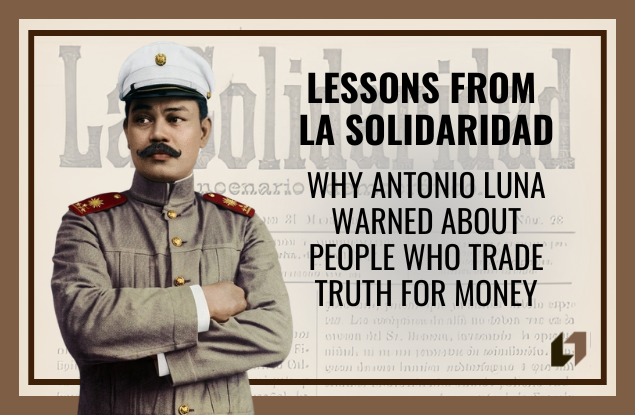
In March 1891, Filipino intellectual Antonio Luna, writing under the pen name Taga-Ilog, published a satirical one-act play in the reformist newspaper La Solidaridad. The piece was titled “Everything for the Stomach” (Todo por el Estómago), and although it reads like a short comic dialogue, its message is unmistakably serious.
Through a group of characters engaged in writing political attacks and propaganda, Luna exposes a disturbing truth about public life: many people are willing to sacrifice their principles simply to secure their livelihood.
The title itself captures the essence of the problem. “Everything for the stomach” suggests that survival—and the pursuit of money—can easily become more important than truth, integrity, or intellectual honesty.
When Words Become a Means to Survive
In Luna’s satirical play, several characters represent different personalities within the world of writers and political commentators. One of them openly admits the nature of their work. Speaking with blunt honesty, he declares:
“You know I follow what you do: writing, insulting and lying in order to eat.”
The line captures Luna’s criticism perfectly. Writing, which should ideally serve truth and reason, becomes a tool for survival. Instead of defending ideas or principles, these writers produce whatever arguments are required to earn their daily bread.
Another character reinforces this mentality with cynical pragmatism. Referring to the economic theories of Thomas Malthus, he remarks:
“Let the money come. According to Malthus, the stomach… comes first.”
In this worldview, moral considerations come second. Financial necessity—or the desire for financial security—takes priority over intellectual honesty.
The Mechanics of Propaganda
Luna’s satire also reveals how easily propaganda can be manufactured. The characters in the play show little concern for accuracy or fairness. Their goal is simply to produce persuasive rhetoric that pleases their patrons and attacks their enemies.
At one point, a character casually describes the formula for creating political attacks:
“A few high-sounding words, an alleged attack on the Mother Country… and done.”
The remark highlights the emptiness behind much political writing. Instead of careful reasoning, the process relies on exaggeration, emotional language, and strategic insults. Complex arguments are replaced by dramatic accusations designed to capture attention.
Luna suggests that when public discourse becomes dominated by such tactics, truth itself becomes secondary.
Intellectuals in Service of Power
The characters in the play are not independent thinkers. Their writings serve powerful individuals whose approval determines their livelihood.
One character admits this openly, observing that endless speeches and grand rhetoric ultimately serve a simple purpose:
“So many speeches and empty words can be synthesized in making Silviero happy so that we can have our bread every day.”
The comment reveals how intellectual work can become subordinated to political authority. Writers may present themselves as defenders of ideas, yet in reality they produce arguments designed to satisfy those who hold power.
For Luna, this represents a dangerous moral compromise. When intellectuals abandon their independence, public debate becomes distorted by opportunism.
When Truth Becomes Dangerous
The play ends with an ironic twist. Guards suddenly arrive and arrest the characters for what is described as a “scientific crime.”
The accusation itself is absurd, but the scene carries a deeper meaning. It suggests that societies sometimes punish individuals who challenge authority or speak inconvenient truths.
One character responds bitterly by recalling a historical example:
“Columbus also came back in chains.”
The reference to Christopher Columbus—who was arrested and returned to Spain in chains despite his discoveries—serves as a reminder that even great achievements do not always protect individuals from political retaliation.
Why Luna’s Warning Still Matters
More than a century after Luna wrote “Everything for the Stomach,” the dynamics he described remain visible in modern public life.
Political commentators, media personalities, influencers, and corporate advocates sometimes face the same temptation Luna satirized. Financial incentives, audience approval, or institutional pressure can shape the narratives they present.
In such environments, opinions may shift depending on who pays, who sponsors, or who holds influence. The result can be a form of intellectual opportunism in which persuasion matters more than accuracy.
The tools have changed—from nineteenth-century pamphlets to digital media—but the underlying incentives often remain similar.
The Lesson Behind Luna’s Satire
Luna’s satire ultimately raises a simple but uncomfortable question: what happens when truth becomes less valuable than survival or profit?
When individuals prioritize money, approval, or career advancement above integrity, public discourse begins to lose its foundation. Arguments become performances. Ideas become commodities.
By framing his critique as a humorous play, Antonio Luna exposed a pattern of behavior that extends far beyond his own era.
His warning still resonates today: when everything is done “for the stomach,” principles are often the first thing sacrificed.

