

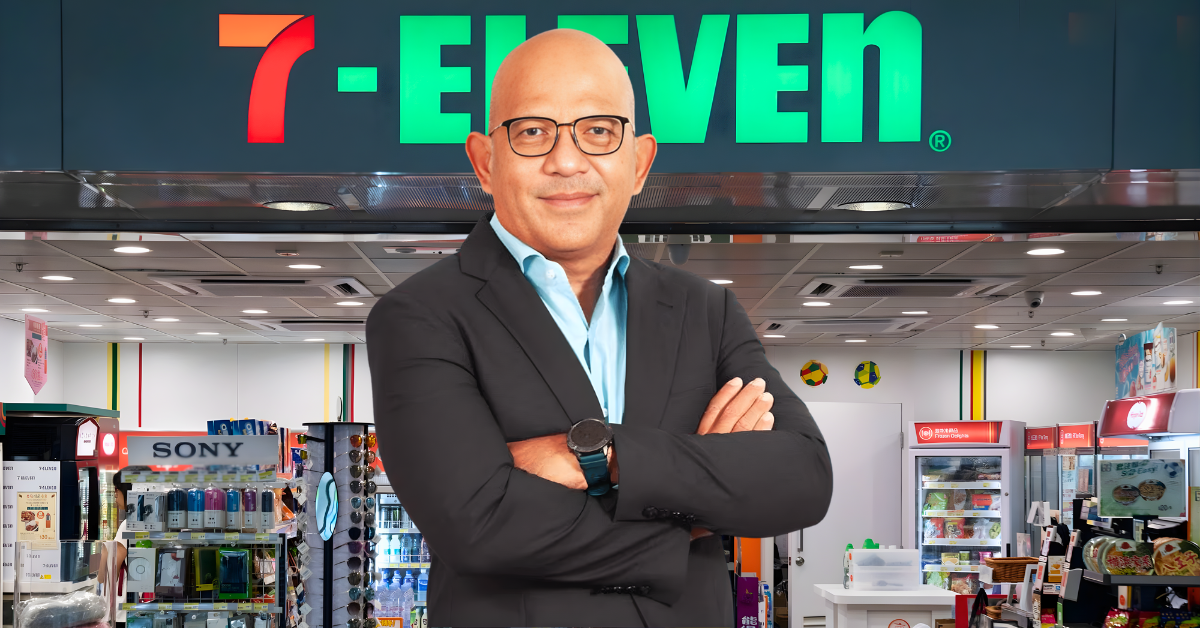
When Victor Paterno joined 7-Eleven Philippines in the early 1990s, he wasn’t stepping into the business as a future CEO. At the time, he saw himself as an aspiring entrepreneur looking for direction—and the family business offered a practical place to learn.
“When I joined the business in November 1993, we had around 40 stores.”
The mandate was clear and specific. The company needed to grow quickly, not just for expansion’s sake, but to prepare for a financial milestone.
“The mandate was to expand to 100 stores to prepare for an IPO and allow the private equity investors to exit.”
Paterno joined after spending several years abroad. His decision to return to the Philippines was shaped by both personal and economic considerations.
“I joined as the construction and maintenance manager after spending three years working abroad.”
At the time, global conditions were shifting, and his own priorities were changing.
“At that time, I decided to return to the Philippines because I missed home. The Philippines was starting to grow, the US was heading into a recession, and I wasn’t enjoying the corporate big life.”
More than anything, he was searching for a path that felt entrepreneurial.
“I wanted to be an entrepreneur.”
Learning the business from the ground up
Rather than immediately taking on a leadership role, Paterno entered through operations—building stores faster and more efficiently.
“Initially, they agreed and said, ‘While you’re figuring out what space you want to be in as an entrepreneur, why don’t you join me? I need some help building out stores faster.’”
His early role in construction and maintenance put him close to execution, timelines, and costs—critical elements during a period of rapid expansion.
As the business grew, so did his responsibilities.
“Eventually, I started taking on more roles.”
Those roles expanded beyond physical infrastructure.
“The next position was in strategy, and later on, I became the general manager for support services, which included everything except operations.”
Through these roles, Paterno gained a broad view of how the business functioned—from store rollout to corporate support—while the company worked toward its IPO goal.
Leaving after the IPO
The IPO marked a turning point—not just for the company, but for Paterno personally.
“But I left after the IPO in 1999.”
Rather than staying on, he chose to pursue his own entrepreneurial path.
“I ended up starting a technology company called EC Pay.”
The move represented a shift away from retail and into a completely different industry.
“Which was later sold to Globe in 2019.”
For Paterno, leaving after the IPO wasn’t a rejection of the family business. It was part of a longer learning arc—one that allowed him to build, operate, and eventually exit a company of his own.
An apprenticeship in entrepreneurship
Looking back, Paterno’s early years at 7-Eleven Philippines functioned less like succession planning and more like an apprenticeship. He entered with a specific task, learned through execution, and gradually took on broader responsibilities.
The experience gave him exposure to growth under pressure, investor expectations, and the operational demands of scaling a retail network ahead of a public listing.
At the same time, his decision to leave after the IPO underscores a recurring theme in entrepreneurial careers: learning often requires stepping away to build something independently.
Paterno’s path from construction manager to strategy executive, and then to founder of a technology company, reflects a deliberate effort to test himself outside the shadow of an established brand.
Those experiences would later become relevant again—but at the time, his focus was simple: to learn, to build, and to prove that he could create value on his own.
This article includes quotes from an interview originally published by Esquire Philippines, authored by Henry Ong.

