

I’ve spent years watching the call center industry lift Filipino families up. For many people I know, a headset and a night shift were not just a job. They were a way out. Rent got paid. Kids stayed in school. Parents stopped choosing which bill could wait. Hope stopped being a dream and became something real.
That’s why I feel uneasy when people wave away artificial intelligence and say, “It won’t hit us yet.”
Because the truth is, it already has.
If you look at the numbers, around 8 percent of BPO companies are now reporting job losses. At the same time, about 13 percent say they’ve gained jobs. At first glance, that looks balanced. Like nothing to worry about.
But I don’t see balance. I see the early signs of a shift.
This is how big changes usually start. Some companies grow. Others quietly shrink. Nothing collapses overnight. The damage comes slowly, then all at once. And what worries me most is what happens in the next two or three years.
In the United States, major investors are pouring money into AI companies built to do BPO work. These tools are made to answer calls, reply to chats, and handle basic customer problems without human help. They start simple. Then they get better. Then they spread. By the time the impact feels “real” to most people, it’s often too late to stop.
There’s also a political risk we don’t talk about enough.
In the U.S., there are proposed laws that would force companies to disclose how much work they send overseas. Some ideas even push to bring call center jobs back to American soil. This matters because about 70 percent of our BPO industry depends on North America. A small policy change there can send shockwaves through our economy here.
People often say, “We’ll just shift to Europe.” That sounds smart, but it’s harder than it sounds. In many European countries, outsourcing work to someone halfway around the world, working a night shift, is not popular. They prefer to bring workers in, not send jobs out. That limits how fast we can grow outside our main market.
Then there’s the technology itself, which may be the biggest threat of all.
AI can now neutralize accents. It can translate languages almost instantly. For years, English was our edge. We trained for it. We became world-class at it. It helped make the Philippines a global BPO leader.
That edge is shrinking fast.
With AI, someone who doesn’t speak English well can still sound clear and confident. The language barrier that once protected us is fading. And when that happens, competition increases.
In places like Vietnam or parts of Africa, there are skilled technical workers who often cost less. Before, language slowed them down. Now, AI removes that limit. The global playing field is changing.
I’ve seen this story before, and it still hurts.
Years ago, the Philippines was strong in electronics manufacturing. We worked on chips. But we stayed focused on basic assembly. We didn’t move up fast enough. Other countries did. Slowly, the jobs left.
I’m afraid we’re making the same mistake with BPOs.
For years, we optimized for low-cost, high-volume voice work. And to be fair, it worked. Millions of Filipinos benefited. But voice work is also the easiest thing for AI to replace. If we stay there, we make ourselves vulnerable. The decline won’t be loud. It will be quiet. Then sudden.
The only real defense is to move up the value chain.
That means more analytical roles. More complex back-office work. More jobs that need judgment, context, and problem-solving. I’ve seen this kind of work firsthand. I once worked briefly in a banking back-office team. The work was demanding. It required thinking. And it was much harder to automate.
But here’s the hard truth: higher-value work needs higher-level skills.
We can’t talk about moving up without talking about training and education. Upskilling isn’t a buzzword. It’s survival. Workers need clear paths to grow beyond basic voice roles. They need to learn how to work with AI, not be replaced by it.
Is two or three years enough time? I honestly don’t know.
But I do know this: waiting is the worst choice we can make.
AI doesn’t have to be the villain. Used well, it can help people learn faster and do more meaningful work. But that future won’t happen by accident. It needs urgency. It needs investment. It needs action.
The future is already knocking. We can pretend we don’t hear it. Or we can open the door and start climbing.
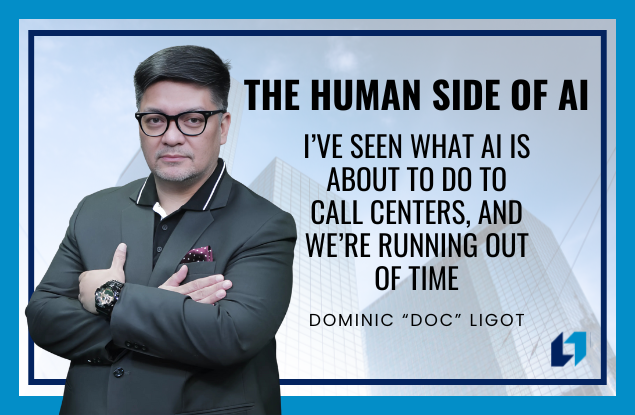
Dominic “Doc” Ligot is one of the leading voices in AI in the Philippines. Doc has been extensively cited in local and global media outlets including The Economist, South China Morning Post, Washington Post, and Agence France Presse. His award-winning work has been recognized and published by prestigious organizations such as NASA, Data.org, Digital Public Goods Alliance, the Group on Earth Observations (GEO), the United Nations Development Programme (UNDP), the World Health Organization (WHO), and UNICEF.
If you need guidance or training in maximizing AI for your career or business, reach out to Doc via https://docligot.com.

